CM Fadnavis: Solar Power for 66,153 Homes in Amravati
Synopsis
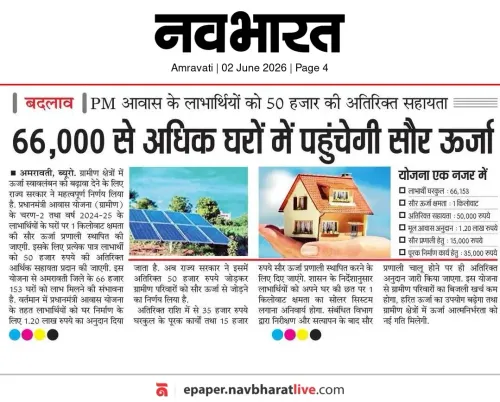
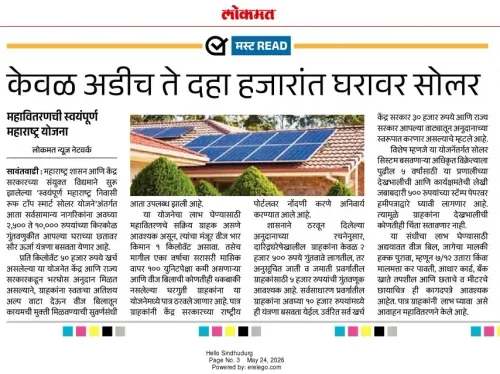
The Chief Minister's Office of Maharashtra has announced that 66,153 houses in Amravati district will receive rooftop solar installations, part of the state's strategy to converge housing schemes with renewable energy and meet India's 500 GW non-fossil target by 2030.
Key Takeaways
66,153 houses in Amravati district are targeted for rooftop solar energy installations under a state housing-solar convergence drive.
The announcement was made by the Chief Minister's Office of Maharashtra on 30 May 2026 , tagging CM Devendra Fadnavis .
Amravati is in the Vidarbha region, which has seen multiple district-level housing-solar drives since 2023.
Maharashtra's rooftop solar policy targets 7,500 MW of installed rooftop capacity, aligned with India's 500 GW non-fossil goal by 2030.
The initiative aims to reduce electricity costs for rural households and ease load on the stressed Vidarbha distribution grid.
Progress on sanctioned versus installed capacity in Amravati will be a key metric for assessing the programme's delivery.
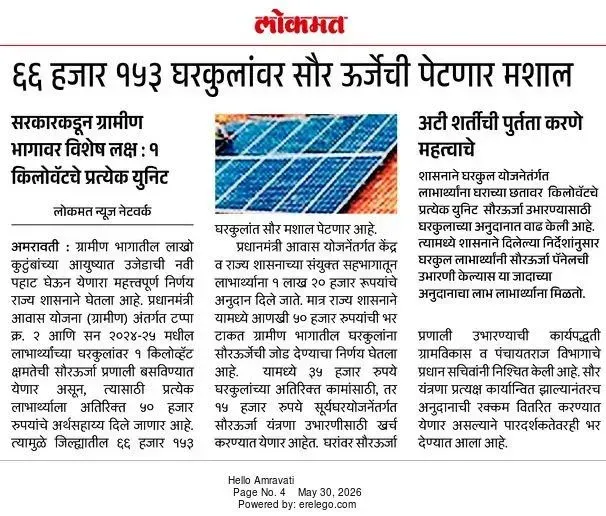
The Chief Minister's Office of Maharashtra announced on Saturday, 30 May 2026 that 66,153 houses in Amravati district are set to receive rooftop solar energy installations, tagging Chief Minister Devendra Fadnavis in the post and signalling a major push for renewable electrification in the Vidarbha region.
Context
The CMO's post, written in Marathi, announced: 'अमरावती जिल्ह्यातील 66,153 घरकुलांवर सौर ऊर्जेची पेटणार मशाल' — loosely translated as 'The torch of solar energy will be lit on 66,153 houses in Amravati district.' The announcement targets residential units under state housing schemes, converging shelter and clean energy in a single district-level drive. Amravati, located in eastern Maharashtra's Vidarbha belt, has a large base of rural households covered under state and central housing programmes.
Policy Backdrop
Maharashtra's rooftop solar push draws from the state's Solar Policy and successive revisions that set an ambitious target of 7,500 MW of rooftop solar capacity. The state has been combining central government rooftop solar subsidies with state-level incentives to electrify rural homes while simultaneously reducing distribution losses on the grid. Since 2023, similar district-level housing-solar convergence drives have been rolled out across Vidarbha and Marathwada, making Amravati part of a broader geographic pattern rather than an isolated initiative.
The broader national context is India's commitment to 500 GW of non-fossil fuel capacity by 2030, with states like Maharashtra carrying a significant share of the renewable purchase obligation. Rooftop solar on government-scheme housing has emerged as one of the most cost-effective routes to meeting that obligation while delivering direct benefits to low-income households.
Stakeholders and Impact
The primary beneficiaries are the 66,153 rural and semi-urban households in Amravati district that stand to receive solar installations, potentially reducing or eliminating electricity bills and providing reliable daytime power. Chief Minister Devendra Fadnavis, who has consistently championed renewable energy and rural infrastructure programmes, is positioned as the political face of the initiative. Local distribution companies stand to benefit from reduced peak-hour load on the Vidarbha grid, which has historically been stressed.
Contractors, solar equipment suppliers, and district-level implementation agencies will be key operational stakeholders as the programme moves from announcement to ground-level installation. The scale — over 66,000 units in a single district — makes Amravati one of the larger single-district rooftop solar drives announced under the state's housing-energy convergence framework.
What's Next
Attention will now shift to the pace of sanctions versus actual installations, a gap that has historically plagued large-scale rooftop programmes in rural Maharashtra. Observers will watch whether the Amravati model is replicated swiftly in the remaining districts of Vidarbha and Marathwada, where housing scheme coverage is similarly dense. The announcement also sets a benchmark that could be cited during the state's next renewable purchase obligation compliance review.
Point of View
Using central subsidy flows to offset state costs while generating visible, constituency-level wins for the ruling dispensation. For CM Fadnavis, Vidarbha is both a political home base and a region where energy access grievances have historically run deep, making solar-on-housing a doubly useful policy instrument. The scale — over 66,000 units in a single district — signals that the state is moving beyond pilot-phase thinking toward systematic rollout, which will test implementation capacity at the district level. The real measure of the initiative's success will be the gap between announced targets and actual grid-connected installations, a credibility test that Maharashtra's renewable programme has not always passed cleanly.
NationPress
14 Oct 2026
Frequently Asked Questions
How many houses in Amravati will get solar energy under this Maharashtra scheme?
The Chief Minister's Office of Maharashtra announced that 66,153 houses in Amravati district are targeted for rooftop solar energy installations.
What is Maharashtra's rooftop solar capacity target?
Maharashtra's Solar Policy sets a target of 7,500 MW of rooftop solar capacity, revised over successive years to align with national renewable energy goals.
Who announced the Amravati solar housing scheme?
The Chief Minister's Office of Maharashtra made the announcement on 30 May 2026 , tagging Chief Minister Devendra Fadnavis .
Why is Maharashtra focusing on solar energy for rural housing schemes?
Maharashtra is converging housing schemes with rooftop solar to meet its renewable purchase obligation, reduce rural electricity bills, and contribute to India's target of 500 GW non-fossil fuel capacity by 2030 .
Which region of Maharashtra is Amravati district in?
Amravati is located in the Vidarbha region of eastern Maharashtra, an area that has seen multiple district-level housing-solar drives since 2023.