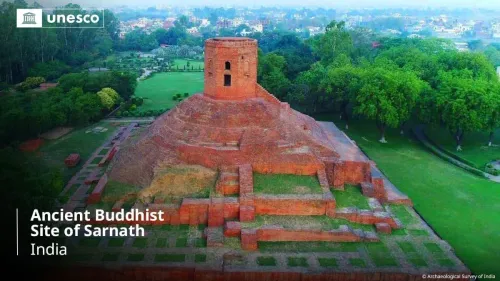
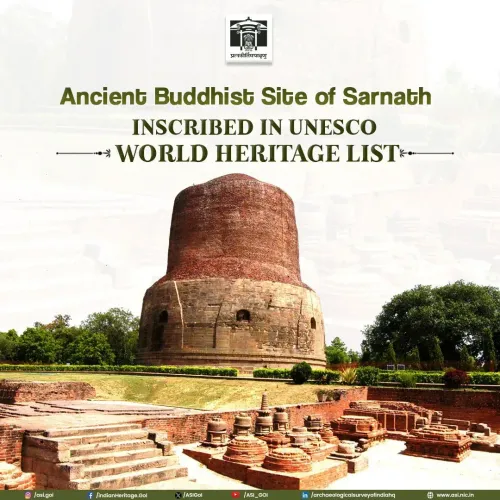
Sonowal hails Sarnath's UNESCO World Heritage inscription
Synopsis
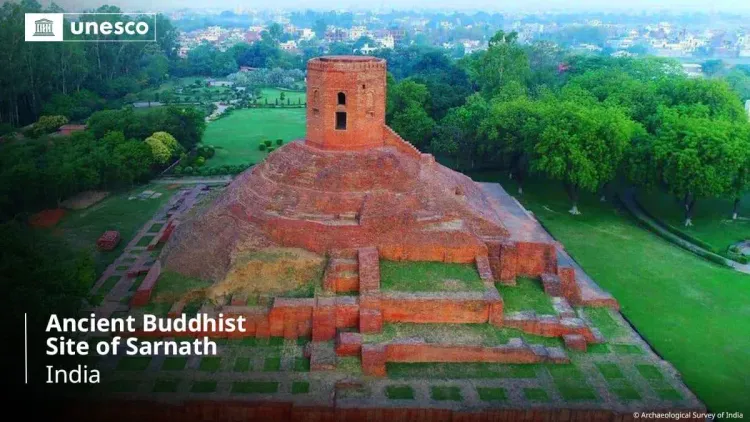
Union Minister Sarbananda Sonowal on 26 July 2026 celebrated Sarnath's inscription on the UNESCO World Heritage List, crediting PM Modi's cultural preservation drive. The ancient Buddhist site in Uttar Pradesh, where Buddha delivered his first sermon, joins India's growing roster of internationally recognised heritage sites.
Key Takeaways
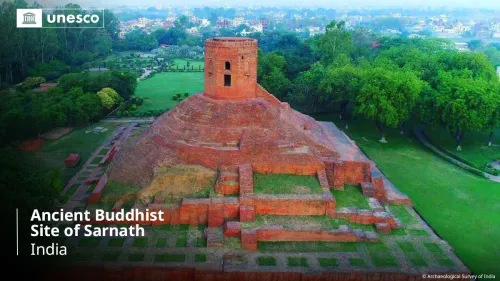
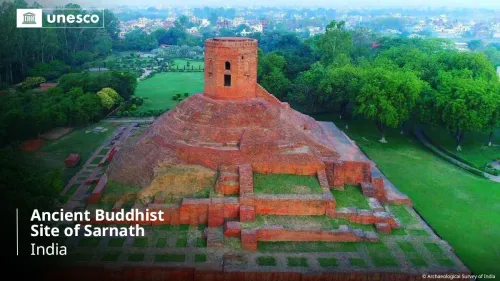
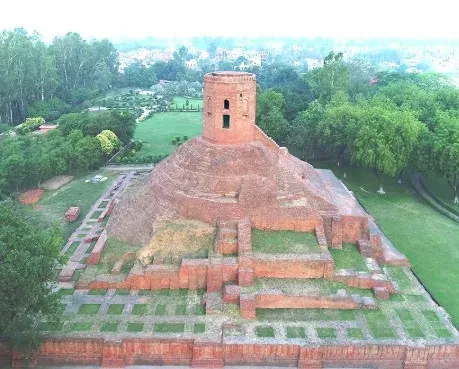
Sarnath in Uttar Pradesh has been inscribed on the UNESCO World Heritage List , as announced on 26 July 2026 .
Union Minister Sarbananda Sonowal hailed the recognition as 'a proud moment for every Indian.' Sarnath is the site where Gautama Buddha delivered his first sermon, making it one of Buddhism's holiest locations.
India's Swadesh Darshan and PRASAD schemes have channelled infrastructure investment into Buddhist heritage sites including Sarnath since 2014-15 .
The inscription is expected to boost inbound religious tourism from East and Southeast Asia and increase central funding for site conservation.
Union Minister of Ports, Shipping and Waterways Sarbananda Sonowal on Sunday, 26 July 2026, welcomed the inscription of Sarnath in Uttar Pradesh on the UNESCO World Heritage List, calling it 'a proud moment for every Indian' and linking the recognition to Prime Minister Narendra Modi's commitment to preserving India's cultural legacy.
Context
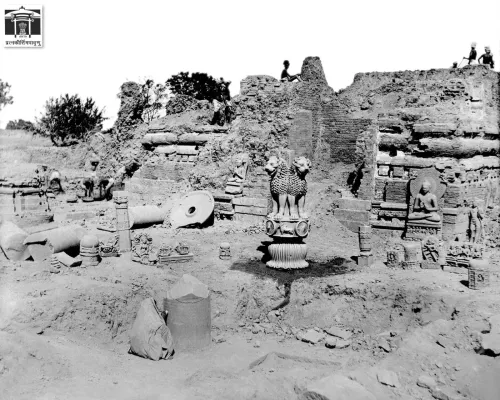
Sarnath, located near Varanasi in Uttar Pradesh, is one of the most sacred sites in Buddhism. It is the place where Gautama Buddha delivered his first sermon — the Dhammacakkappavattana Sutta (Setting the Wheel of Dhamma in Motion) — after attaining enlightenment, making it a destination of deep spiritual significance for millions of Buddhists worldwide. Sonowal described the site as having 'a deep sacred bond with Lord Buddha' and expressed hope that the UNESCO status would 'inspire even more people globally to visit the site and seek peace.'
The inscription adds to India's growing tally on the UNESCO World Heritage List, which stood at 40 sites as per the most recent publicly available records before this recognition. Uttar Pradesh already hosts several inscribed sites, and Sarnath's addition reinforces the state's position as a cornerstone of India's heritage tourism map.
Policy Backdrop
The recognition aligns with a sustained policy push by the Government of India to document, conserve, and internationally project ancient cultural and Buddhist heritage sites. The Swadesh Darshan scheme, launched in 2014-15, specifically included a Buddhist Circuit covering sites such as Sarnath, Bodh Gaya, and Kushinagar, channelling infrastructure investment into pilgrimage destinations.
The PRASAD scheme (Pilgrimage Rejuvenation and Spiritual Augmentation Drive), introduced in 2015, further supplemented this effort by improving amenities at religiously significant locations. Together, these programmes built the conservation and visitor-infrastructure foundation that underpins India's nomination pipeline for international recognition.
Sonowal's post frames the inscription explicitly as evidence of PM Modi's 'commitment to preserving and promoting our rich cultural legacy,' situating the UNESCO milestone within the ruling dispensation's broader cultural diplomacy narrative.
Stakeholders and Impact
Buddhist pilgrims from across East and Southeast Asia — including from Sri Lanka, Thailand, Japan, South Korea, Myanmar, and China — are among the primary beneficiaries of enhanced international visibility for Sarnath. The UNESCO inscription is expected to accelerate inbound religious tourism, with direct economic implications for the local hospitality, transport, and artisan sectors in and around Varanasi.
For the Indian tourism industry more broadly, a new World Heritage tag typically triggers increased foreign tourist arrivals and justifies higher central and state budget allocations for site management. Archaeological and conservation bodies will also come under greater international scrutiny, raising standards for site upkeep.
What's Next
Attention will now turn to tourism infrastructure upgrades at Sarnath and whether the Union Budget will include fresh allocations under the Buddhist Circuit or related heritage schemes to capitalise on the UNESCO recognition. Diplomatic engagements with Buddhist-majority nations, a recurring feature of India's foreign-policy calendar, are also likely to reference the inscription as a symbol of civilisational continuity. The government's ability to translate the UNESCO tag into measurable visitor growth and conservation outcomes will be the longer-term test of this milestone's impact.
Point of View
Allowing it to present UNESCO recognition as validation of its decade-long investment in Buddhist Circuit infrastructure and heritage conservation. Sonowal's post — attributing the milestone directly to PM Modi — is consistent with a pattern of centralising credit for heritage achievements within the prime minister's personal brand. The timing is also strategically useful for India's outreach to Buddhist-majority nations in Southeast and East Asia, where Sarnath carries profound religious weight. Whether the government can now translate the UNESCO tag into tangible conservation upgrades and sustained tourist growth will determine its lasting political and economic dividend.
NationPress
26 Jul 2026
Frequently Asked Questions
Why has Sarnath been given UNESCO World Heritage status?
Sarnath has been inscribed on the UNESCO World Heritage List in recognition of its outstanding universal value as the site where Gautama Buddha delivered his first sermon, marking it as a place of exceptional spiritual and historical significance to Buddhism and to human civilisation broadly.
Where is Sarnath located?
Sarnath is located in Uttar Pradesh , near the city of Varanasi , in northern India.
What is the significance of Sarnath in Buddhism?
Sarnath is the place where Gautama Buddha gave his first sermon after attaining enlightenment, an event known as the 'Setting the Wheel of Dhamma in Motion.' It is considered one of the four holiest sites in Buddhism.
How many UNESCO World Heritage Sites does India have?
India had 40 UNESCO World Heritage Sites as per the most recent publicly available records before the 2026 inscription of Sarnath, which adds to that total.
What government schemes have supported Sarnath's development?
The Swadesh Darshan scheme (launched 2014-15 ), which included a dedicated Buddhist Circuit , and the PRASAD scheme (launched 2015 ) have both directed infrastructure and conservation investment towards Sarnath and other Buddhist pilgrimage sites across India.