Tharoor Traces Thailand's Role in India's Freedom Struggle
Synopsis
Congress MP Dr. Shashi Tharoor has published an article marking the 84th anniversary of the 1942 Bangkok Conference, tracing Thailand's pivotal but overlooked role in establishing the Indian Independence League and, subsequently, the Indian National Army.
Key Takeaways
Shashi Tharoor published an article on 15 June 2026 on Thailand's connection to India's independence movement.
The piece marks the 84th anniversary of the Bangkok Conference of June 1942 , which established the Indian Independence League .
The Indian Independence League served as the direct organisational precursor to the Indian National Army (INA) , later led by Subhas Chandra Bose .
Thailand's nominal independence during World War II gave Indian nationalists organisational space unavailable in British-controlled territories.
The article aligns with India's Act East Policy , which uses shared anti-colonial history to strengthen ties with ASEAN nations.
Tharoor, a former UN Under-Secretary-General , has consistently championed underrepresented chapters of India's colonial history.
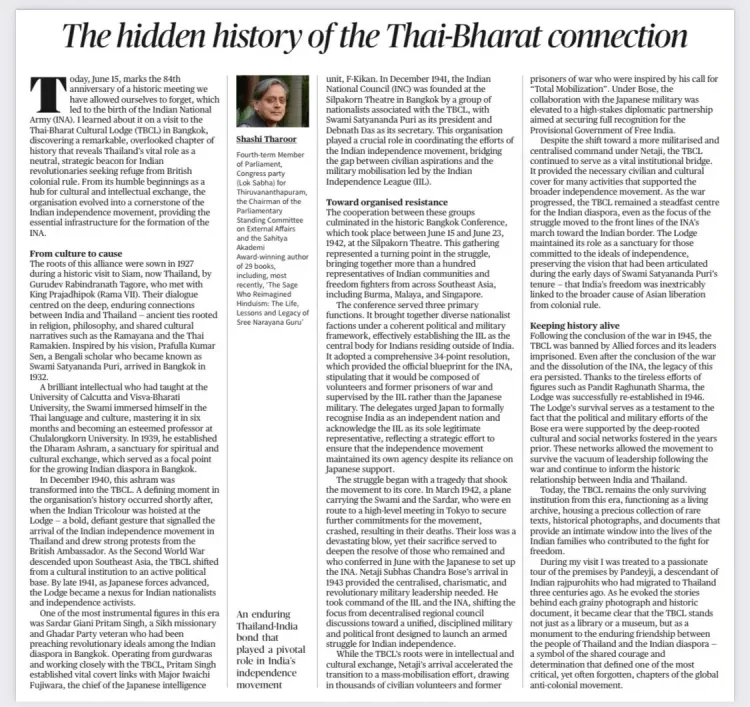
Congress MP Dr. Shashi Tharoor on Monday, 15 June 2026, published an article uncovering the largely overlooked history of Thailand's contribution to India's independence movement, marking the 84th anniversary of a landmark conference that laid the groundwork for the Indian National Army (INA).
Context
In his post on X, Tharoor wrote: 'My article in The Hindu today traces the hidden history of Thailand's connection to India's freedom struggle. Today marks the 84th anniversary of a conference that eventually birthed the INA.' The piece draws public attention to a chapter of anti-colonial history that rarely features in mainstream Indian historiography, situating Thailand as a critical node in the network of Indian revolutionary activity during World War II.
The conference Tharoor references is the Bangkok Conference of June 1942, a gathering of Indian nationalists on Thai soil that resulted in the formal establishment of the Indian Independence League. That organisation provided the political and organisational scaffolding upon which the INA was subsequently built.
Policy Backdrop
The Indian National Army was formed in 1942 among Indian prisoners of war and civilians across Southeast Asia, and later came under the command of Subhas Chandra Bose. Its founding is inseparable from the role played by the Indian diaspora then resident in Thailand, Malaya, and Burma, who supplied funds, recruits, and logistical support to the anti-British cause.
Thailand occupied a unique position in this wartime geography. Unlike territories under direct colonial administration, it retained nominal independence and thus offered Indian nationalists a degree of organisational freedom unavailable elsewhere in the region. The Bangkok Conference exploited this opening to convene leaders who would go on to shape the INA's structure and ideology.
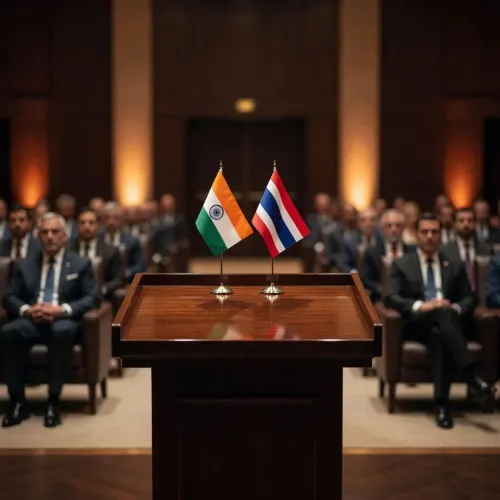
India's Act East Policy, which deepens strategic and cultural ties with ASEAN nations, has increasingly drawn on shared anti-colonial narratives to reinforce contemporary bilateral relationships. Invoking the wartime solidarity between Indian nationalists and Southeast Asian host communities fits squarely within this diplomatic framework, lending historical depth to what are otherwise primarily economic and security-driven partnerships.
Stakeholders and Impact
The article is likely to resonate with historians, archivists, and the Indian diaspora in Southeast Asia, communities that have long sought greater recognition of their ancestors' contributions to the freedom movement. For New Delhi and Bangkok, the narrative also carries soft-power value: bilateral relations between India and Thailand have grown steadily under the Act East framework, and shared historical memory can serve as a people-to-people bridge.
Tharoor, a former UN Under-Secretary-General and former Union Minister of State for External Affairs, has consistently used his platform to rehabilitate underrepresented figures and episodes from India's colonial past. His intervention adds a parliamentarian's visibility to what has largely been an academic conversation about the INA's Southeast Asian roots.
What's Next
The 84th anniversary of the Bangkok Conference could prompt commemorative statements from the Ministry of External Affairs or cultural organisations active in Thailand. Bilateral events under the ASEAN-India framework may increasingly incorporate references to the 1942 wartime network as India seeks to deepen historical bonds with member states. Archival cooperation between New Delhi and Bangkok on INA-era documents remains an area where both governments could act on the momentum generated by renewed public interest.
Point of View
He effectively argues that India-Thailand ties are not merely transactional but rooted in a shared anti-colonial struggle — a framing that carries diplomatic utility as much as historical value. For the Congress party, elevating INA history also reinforces a political lineage that connects the independence movement to the party's own legacy. The piece is a reminder that public intellectuals within Parliament can shape foreign-policy narratives in ways that formal diplomatic channels rarely do.
NationPress
14 Sept 2026
Frequently Asked Questions
What was the Bangkok Conference of 1942?
The Bangkok Conference of June 1942 was a meeting of Indian nationalists held in Thailand that formally established the Indian Independence League, the organisational precursor to the Indian National Army (INA).
What is the Indian National Army and what does it have to do with Thailand?
The Indian National Army was an armed force formed in 1942 by Indian prisoners of war and civilians in Southeast Asia to fight British colonial rule. Thailand played a key role by hosting the Bangkok Conference that created its founding organisation, the Indian Independence League.
Why did Shashi Tharoor write about Thailand and India's freedom struggle?
Tharoor published the article to mark the 84th anniversary of the 1942 Bangkok Conference and to highlight Thailand's largely overlooked contribution to India's independence movement, a history he describes as 'hidden.'
How does Thailand's wartime history connect to India's Act East Policy?
India's Act East Policy uses shared historical and cultural ties with ASEAN nations to deepen present-day relations. Thailand's role in hosting Indian nationalist networks during World War II provides a historical foundation that supports ongoing cultural diplomacy and people-to-people exchanges between New Delhi and Bangkok.
Who is Shashi Tharoor?
Dr. Shashi Tharoor is a Congress MP from Thiruvananthapuram, a former Union Minister of State for External Affairs, and a former UN Under-Secretary-General. He is widely known for his writing on Indian history, foreign policy, and the legacy of British colonialism.