CM Yogi: UP installs 450 weather stations, 5 Doppler radars
Synopsis
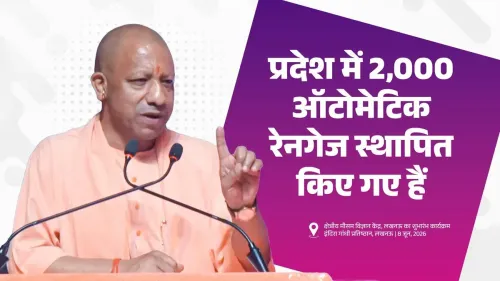
Uttar Pradesh has installed 450 automatic weather stations and 2,000 block-level rain gauges, Chief Minister Yogi Adityanath announced. X-Band Doppler Weather Radars are being deployed in phases across Azamgarh, Varanasi, Aligarh, Jhansi, and Lucknow to monitor storms, heavy rain, and hailstorms.
Key Takeaways
450 Automatic Weather Stations have been installed across Uttar Pradesh so far.
2,000 Automatic Rain Gauges have been deployed at the block level across the state.
X-Band Doppler Weather Radars are being installed in phases in Azamgarh , Varanasi , Aligarh , Jhansi , and Lucknow .
The radars will help monitor storms, heavy rainfall, and hailstorms — weather events that regularly affect Uttar Pradesh during the monsoon season.
Block-level rain gauge data supports both localised disaster response and agricultural advisories in the state.
The rollout is part of a broader national drive to modernise meteorological infrastructure for early warning of extreme weather events.
The Chief Minister's Office of Uttar Pradesh announced on Monday, June 8, 2026 that the state has deployed 450 Automatic Weather Stations and 2,000 Automatic Rain Gauges at the block level, alongside a phased rollout of X-Band Doppler Weather Radars across five districts.
What was announced
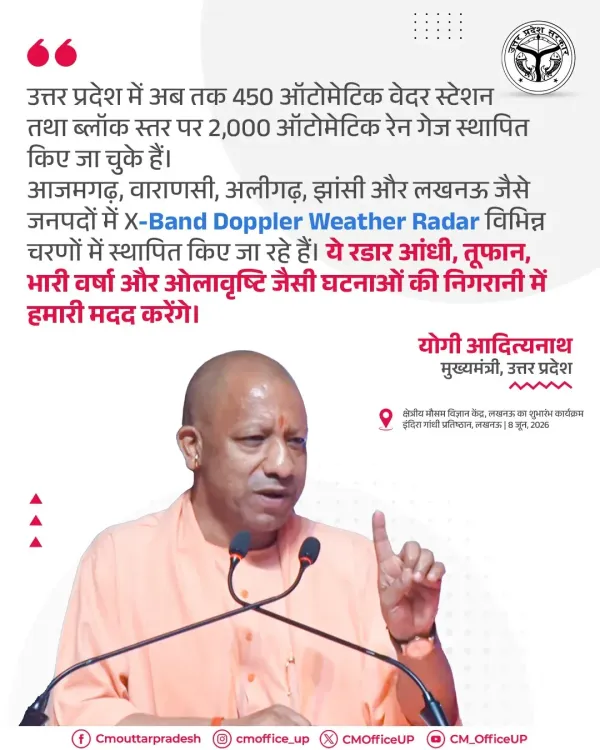
Chief Minister Yogi Adityanath stated that Uttar Pradesh has so far installed 450 automatic weather stations and 2,000 automatic rain gauges at the block level across the state. The announcement, attributed directly to the Chief Minister, read: 'उत्तर प्रदेश में अब तक 450 ऑटोमेटिक वेदर स्टेशन तथा ब्लॉक स्तर पर 2,000 ऑटोमेटिक रेन गेज स्थापित किए जा चुके हैं' ('In Uttar Pradesh, 450 automatic weather stations and 2,000 automatic rain gauges at the block level have been installed so far').
In addition, X-Band Doppler Weather Radars are being installed in various phases across five districts: Azamgarh, Varanasi, Aligarh, Jhansi, and Lucknow. These radars are designed to monitor severe weather events including storms, heavy rainfall, and hailstorms.
Context
Uttar Pradesh is India's most populous state and is acutely vulnerable to monsoon-related extreme weather — including flash floods, severe thunderstorms, and hailstorms — that cause significant agricultural and human losses each year. Granular, real-time meteorological data has historically been sparse at the sub-district level in the state.
Block-level rain gauges and automatic stations address this gap by enabling localised data collection, which is critical for both disaster response and farm-level advisories in a state where agriculture remains the primary livelihood for a large share of the population.
Policy backdrop
India's meteorological modernisation drive, led in part by the India Meteorological Department, has progressively expanded the Doppler Weather Radar network across states since the early 2000s to improve short-range forecasting of convective weather events. X-Band Doppler radars are particularly suited to detecting localised, high-intensity weather phenomena such as hailstorms and microbursts that conventional surface observations often miss.
Similar radar upgrades are underway in other Indian states as part of a broader national effort to strengthen nowcasting capabilities and build climate resilience. The Uttar Pradesh rollout, spanning five geographically spread districts from eastern UP (Azamgarh, Varanasi) to central (Lucknow), western (Aligarh), and Bundelkhand (Jhansi), suggests an intent to achieve statewide coverage over successive phases.
Stakeholders and impact
Farmers stand to benefit most directly: timely, hyper-local weather alerts can inform sowing and harvesting decisions, and could eventually be linked to crop insurance trigger mechanisms. Disaster management authorities will gain improved lead time for evacuations and emergency deployment ahead of severe weather events.
The 2,000 block-level rain gauges are especially significant because they enable granular rainfall mapping — data that is essential for flood forecasting models and for equitable distribution of drought-relief resources across Uttar Pradesh's more than 800 development blocks.
What's next
The key milestones to watch are the operational commissioning of the X-Band Doppler radars in all five named districts and their integration with the state's disaster alert and early-warning systems. Further district-level expansions and potential linkages with crop-advisory platforms and agricultural insurance schemes will determine how broadly the benefits reach the state's farming communities.
As extreme weather events grow more frequent and unpredictable, the depth and speed of this infrastructure buildout will be a critical test of Uttar Pradesh's readiness to protect both lives and livelihoods during future monsoon seasons.
Point of View
Which could eventually underpin both crop insurance triggers and real-time flood alerts. The geographic spread of the five radar districts — spanning eastern UP, the capital, western UP, and Bundelkhand — suggests a deliberate attempt at statewide coverage rather than a showcase installation in a single urban centre. Whether these investments translate into measurable reductions in weather-related agricultural losses will be the true measure of this infrastructure push.
NationPress
23 Oct 2026
Frequently Asked Questions
How many automatic weather stations has Uttar Pradesh installed?
According to the Chief Minister's Office, Uttar Pradesh has installed 450 Automatic Weather Stations across the state so far.
Where are X-Band Doppler Weather Radars being installed in UP?
X-Band Doppler Weather Radars are being installed in phases in Azamgarh , Varanasi , Aligarh , Jhansi , and Lucknow .
What is the purpose of automatic rain gauges at the block level in UP?
The 2,000 block-level Automatic Rain Gauges enable granular, real-time rainfall data collection that supports localised flood forecasting, disaster response, and agricultural advisories across Uttar Pradesh's development blocks.
How will Doppler radars help farmers and disaster authorities in Uttar Pradesh?
X-Band Doppler radars can detect localised severe weather events — including hailstorms, heavy rain, and thunderstorms — with greater precision and lead time, allowing disaster authorities to issue early warnings and helping farmers protect crops.
Is this weather infrastructure part of a national programme?
Yes, the installations align with India's broader national effort, led in part by the India Meteorological Department , to expand the Doppler Weather Radar network and modernise meteorological infrastructure for improved nowcasting and climate resilience.