Beijing park trees die en masse as groundwater rebound floods roots
Synopsis
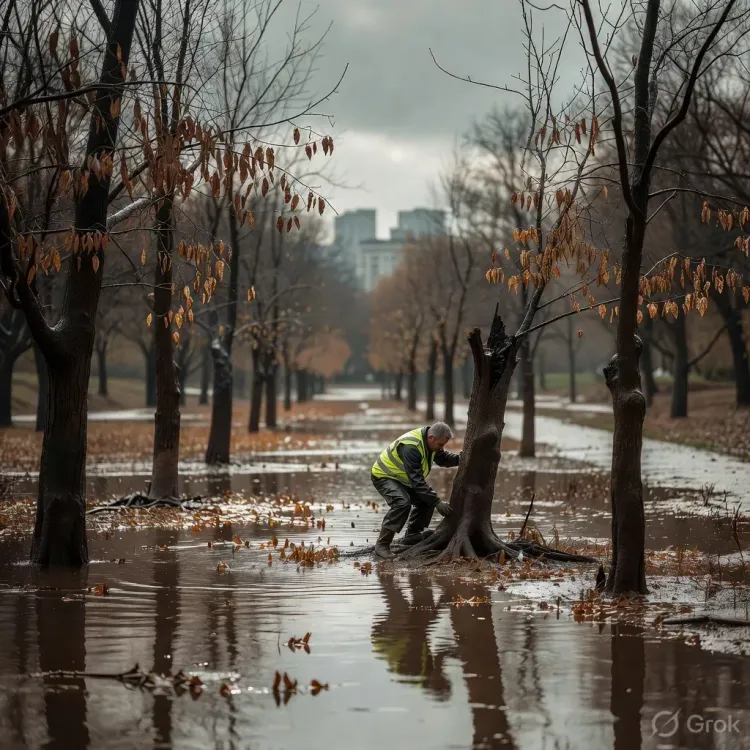
Thousands of trees — including 20-year-old specimens — have died in a flagship Beijing wetland park because rising groundwater levels waterlogged their roots, exposing a paradox at the heart of China's celebrated aquifer-recovery programme.
Key Takeaways
Thousands of locust, poplar, willow, ginkgo and pine trees have died across four wooded areas of Jinzhandian Park in Beijing's Chaoyang district .
Some of the dead trees were approximately 20 years old and had been thriving before the die-off.
The Chaoyang district water bureau attributed the deaths to rising groundwater levels suffocating root systems through prolonged waterlogging.
The park, nicknamed Beijing's 'Little Lake Baikal' , opened in September 2025 and is a flood-storage wetland site.
Remediation efforts include growth-promoting treatments and drainage for trees showing signs of survival, with a full tree count still under assessment as of 12 August 2026 .
Thousands of trees across Jinzhandian Park in Beijing's Chaoyang district have withered and died during what should be peak growing season, with officials pointing to rapidly rising groundwater levels as the most likely cause. The large-scale die-off, reported on Monday, 12 August 2026, has raised fresh concerns about the unintended ecological consequences of the Chinese capital's aggressive water-table recovery efforts.
Scale of the die-off
The casualties span just four wooded areas near the water's edge inside the park, which opened in September last year and is nicknamed Beijing's 'Little Lake Baikal' for its lake and extensive woodlands. Species affected include locust, poplar, willow, ginkgo and pine. While the majority of dead trees were newly planted saplings, some were approximately 20 years old and had previously been thriving, according to Beijing Daily, the city's official newspaper.
What officials say
A staff member from the park's administrative town told Beijing Daily that the large-scale die-off along the shore was 'most likely due to prolonged waterlogging.' An official at the Chaoyang district water bureau — the body responsible for planting and maintaining the saplings — attributed the damage to rising groundwater. 'When the groundwater table rises, it can have an impact on tree growth and the trees do not grow well,' the water bureau official said.
Why it matters
Beijing has spent years engineering a recovery of its depleted aquifers, drawing on diverted water from the South-to-North Water Diversion Project and restricting industrial extraction. That recovery, while celebrated as a policy success, is now exposing a paradox: roots adapted to dry or moderately moist soil are being suffocated by waterlogged conditions they were never designed to tolerate. The incident illustrates a broader tension in rapid environmental remediation — restoring one system can destabilise another.
Assessment and remediation underway
The Chaoyang district water bureau said it was still assessing the total number of dead trees and deciding how to address the issue. For trees showing signs of potential survival, the bureau has stepped up maintenance measures, including the use of growth-promoting treatments and drainage interventions. No timeline for full remediation or replanting has been announced.
What's next
The episode is likely to prompt a reassessment of species selection and planting depth protocols in parks across the North China Plain, where groundwater tables are recovering at rates that outpace existing urban greening guidelines. How Beijing reconciles its twin mandates of water security and urban forestry expansion will be closely watched by city planners across water-stressed Asia.
Point of View
Restored wetlands — can create second-order ecological failures that planners did not model. China's South-to-North Water Diversion Project is one of the largest hydrological interventions in history, and its downstream effects on soil saturation and urban root ecology are only beginning to surface. Mainstream coverage tends to celebrate the groundwater rebound as an unqualified success; this incident suggests the transition curve is steeper and less predictable than official narratives acknowledge. City planners across water-stressed Asia — from Jakarta to Chennai — who are pursuing similar aquifer-restoration programmes should treat Chaoyang as a live case study.
NationPress
26 Sept 2026
Frequently Asked Questions
Why are trees dying in Beijing's Jinzhandian Park?
Thousands of trees in Jinzhandian Park are dying because rising groundwater levels have waterlogged the soil around their roots for extended periods. Officials at the Chaoyang district water bureau confirmed that when the groundwater table rises rapidly, it can suffocate root systems and prevent normal tree growth.
How many trees have died and which species are affected?
The exact count is still being assessed by the Chaoyang district water bureau as of 12 August 2026 . Affected species include locust, poplar, willow, ginkgo and pine , spread across four wooded areas near the water's edge, with some victims being approximately 20-year-old established trees.
What is Beijing doing to fix the tree die-off?
The Chaoyang district water bureau is implementing growth-promoting treatments and drainage measures for trees that show signs of survival. A full assessment of the total number of dead trees is ongoing, and no replanting timeline has been announced.
Is Beijing's groundwater recovery causing ecological problems?
The Jinzhandian Park incident suggests that rapid groundwater rebound can create unintended consequences for urban vegetation not adapted to waterlogged conditions. It highlights a tension between Beijing's water-security goals — boosted by the South-to-North Water Diversion Project — and the city's urban forestry expansion targets.
What is Jinzhandian Park and why is it significant?
Jinzhandian Park is a flood-storage wetland park in Beijing's Chaoyang district , nicknamed Beijing's 'Little Lake Baikal' for its lake and extensive woodlands. It opened in September 2025 and has attracted large numbers of visitors, making the mass tree die-off both ecologically and publicly significant.