Nvidia Unveils Vera CPU to Fix Agentic AI Bottlenecks
Synopsis
Nvidia announced NVIDIA Vera on July 7, 2026, positioning it as the world's fastest single-threaded CPU at scale. The chip targets a critical flaw in agentic AI pipelines where slow CPUs stall sequential reasoning steps and leave expensive GPUs idle, extending Nvidia's push to own the full AI compute stack.
Key Takeaways
Nvidia announced NVIDIA Vera on July 7, 2026 , describing it as the maximum single-threaded CPU designed to operate at scale.
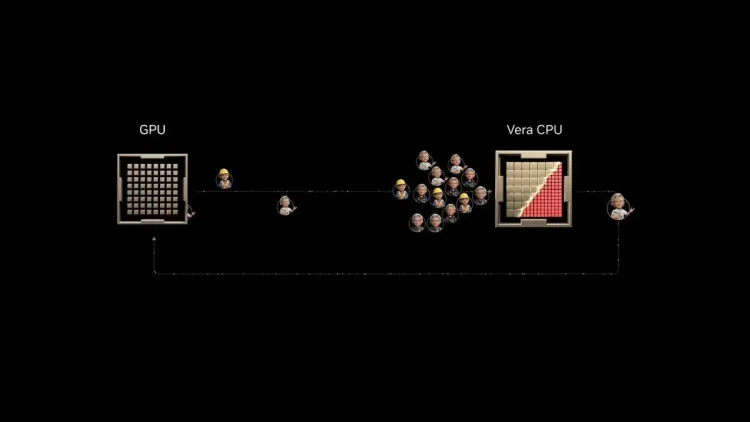
Agentic AI systems execute tasks sequentially — each reasoning step, tool call, and code execution runs on the CPU one at a time, making single-thread speed a critical bottleneck.
Slow CPUs in agentic pipelines leave GPUs underutilized , wasting expensive accelerator capacity in data centres.
Vera builds on Nvidia's Grace CPU roadmap, first announced in 2021 , which introduced Arm-based data-centre processors designed to integrate tightly with Nvidia GPUs.
The announcement extends Nvidia's strategy of controlling the entire AI compute stack, posing a competitive challenge to incumbent CPU makers in the data-centre market.
No commercial availability date or pricing has been disclosed; further details are expected at future GTC conferences or earnings briefings.
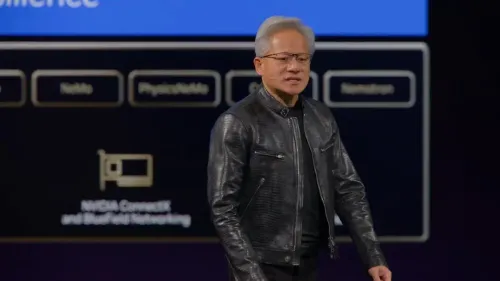
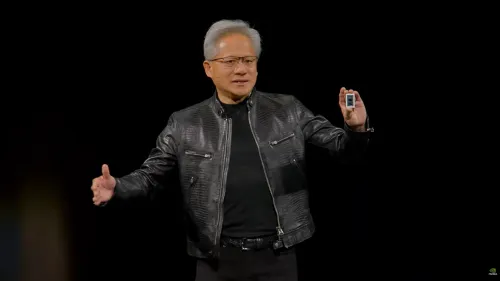
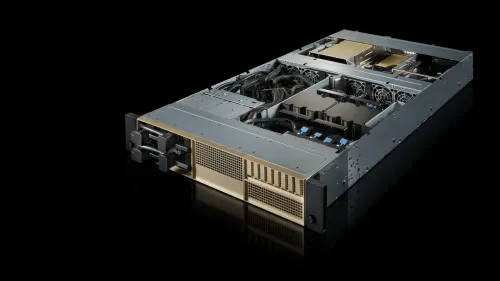
Chip giant Nvidia on Tuesday, July 7, 2026, announced NVIDIA Vera, describing it as the highest single-threaded CPU designed to operate at scale, aimed squarely at resolving a critical performance bottleneck in agentic artificial intelligence systems.
Context
In its post, Nvidia explained the core problem that Vera is built to solve: 'Agentic AI systems run sequentially — each reasoning step, tool call, and code execution happens one at a time on the CPU. When that CPU slows under load, the entire agentic loop slows and valuable GPUs go underutilized.' The company positioned Vera as a direct answer to this single-thread bottleneck that has long constrained modern AI pipelines.
Agentic AI refers to autonomous systems that chain together multiple reasoning and decision-making steps — think AI agents that browse the web, write and execute code, and call external tools in sequence. Unlike batch inference workloads, these tasks are inherently serial, placing unusually high demand on single-threaded CPU performance rather than the parallel throughput that GPUs excel at.
Policy Backdrop
Nvidia first signalled its ambitions in the CPU space in 2021 with the announcement of the Grace CPU, an Arm-based data-centre processor designed to pair tightly with its GPUs in full-stack AI systems. Grace was conceived to cut the data-movement overhead between CPU and GPU — a persistent drag on AI supercomputer efficiency.
Vera appears to be the next step in that roadmap, extending Nvidia's strategy of controlling the entire AI compute stack: from networking and memory to CPUs, GPUs, and the software layers above them. By addressing the CPU bottleneck in agentic workloads specifically, Nvidia is signalling that the next frontier of AI infrastructure is not just raw GPU throughput but the orchestration layer that drives it.
Stakeholders and Impact
AI developers, cloud providers, and data-centre operators stand to be most directly affected by the Vera announcement. For hyperscalers running large fleets of GPU clusters, idle GPU time translates directly into wasted capital expenditure — a problem that becomes more acute as GPU prices remain elevated.
If Vera delivers on its promise of maximising single-threaded performance at scale, operators could see meaningful improvements in the throughput of agentic AI pipelines without adding more GPU capacity. For enterprises building AI agents for customer service, software development, and research automation, faster CPU execution could reduce latency in real-time applications and lower the overall cost per task.
The announcement also carries competitive implications. Intel and AMD have traditionally dominated data-centre CPU supply, and Nvidia's entry into this segment — backed by deep integration with its own GPU and networking silicon — represents a structural challenge to that duopoly.
What's Next
Nvidia has not yet disclosed a commercial availability date or pricing for Vera. Industry observers will be watching the company's forthcoming GTC conferences and quarterly earnings briefings for detailed technical specifications, benchmark data, and partnership announcements with major cloud providers.
The broader trajectory is clear: as agentic AI workloads move from research labs into production deployments, the CPU layer of the AI stack is becoming a strategic battleground. Nvidia's move to own that layer — rather than cede it to third-party silicon — could reshape procurement decisions across the global data-centre industry for years to come.
Point of View
The one segment the company had historically left to others. By framing the problem as GPU underutilization caused by CPU slowness, Nvidia is effectively telling hyperscalers that their existing CPU investments are the weakest link in their AI infrastructure. This mirrors the playbook Nvidia used with the Grace CPU in 2021: identify a system-level bottleneck, name it publicly, and then sell the solution. As agentic AI moves from prototype to production at scale, the company that owns the CPU-GPU integration layer will hold significant pricing and architectural leverage over the entire industry.
NationPress
7 Jul 2026
Frequently Asked Questions
What is NVIDIA Vera and what does it do?
NVIDIA Vera is a CPU announced by Nvidia on July 7, 2026, designed to deliver the highest single-threaded performance at scale. It is built specifically to eliminate the CPU bottleneck in agentic AI systems, where sequential reasoning steps, tool calls, and code execution slow down the entire AI pipeline and leave GPUs idle.
Why does agentic AI need a faster CPU?
Agentic AI systems execute tasks one step at a time — each reasoning step or tool call runs on the CPU sequentially rather than in parallel. This makes single-threaded CPU speed the critical constraint: a slow CPU stalls the entire agentic loop and prevents expensive GPUs from being used efficiently.
How is Nvidia Vera different from the Grace CPU?
Nvidia's Grace CPU, announced in 2021, was an Arm-based data-centre processor designed to reduce data-movement overhead between CPU and GPU in AI supercomputers. Vera appears to be the next step in that roadmap, specifically targeting the single-threaded performance demands of agentic AI workloads rather than general CPU-GPU bandwidth.
When will NVIDIA Vera be available to buy?
Nvidia has not yet announced a commercial availability date or pricing for Vera as of the July 7, 2026 announcement. Further details are expected at upcoming GTC conferences or the company's quarterly earnings briefings.
Which companies will be most affected by the Nvidia Vera CPU?
Cloud providers, data-centre operators, and AI developers running large GPU clusters stand to benefit most. If Vera eliminates CPU-side bottlenecks, these organisations could improve agentic AI throughput and reduce idle GPU time without adding more accelerator capacity. The announcement also poses a competitive challenge to established data-centre CPU makers.