China's coastal nuclear plants shielded from climate disruption hitting Europe
Synopsis
While Europe's river-cooled nuclear plants lost over 20% of France's nuclear capacity to drought and jellyfish invasions, China's coastally sited reactors are structurally insulated — a design edge that could reshape how the world builds nuclear plants in a warming climate.
Key Takeaways
France recorded a nuclear capacity shortfall of more than 20 per cent this summer, with outages tied to drought, extreme heat, and jellyfish — reported by Le Monde on August 11 .
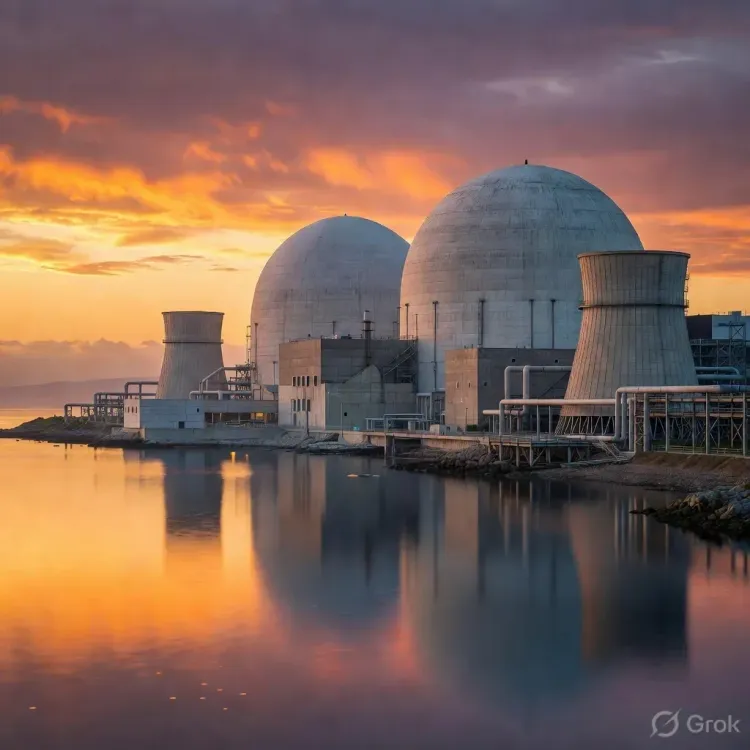
China 's nuclear reactors are built along the coast and use open seawater for cooling, making them less vulnerable to the freshwater scarcity disrupting European plants.
Francois Morin , China Director of the World Nuclear Association , said typhoons do not pose a serious threat to China 's coastal nuclear fleet.
China General Nuclear Power Group and China National Nuclear Corporation operate key facilities, with projects such as the Lufeng project in Shanwei , Guangdong , advancing the domestic pipeline.
The domestically developed Hualong One reactor design is central to China 's global nuclear ambitions as climate stress exposes weaknesses in ageing river-cooled fleets.
China's nuclear power expansion is unlikely to be derailed by climate extremes, even as unusually hot and dry conditions force reactor shutdowns across Europe, according to an industry specialist. The key differentiator: China has built its nuclear fleet along the coast rather than inland waterways, making it structurally less exposed to the droughts and heatwaves hammering European facilities.
Europe's nuclear crisis in numbers
France — where nuclear energy accounts for around 70 per cent of total electricity generation — recorded a shortfall of more than 20 per cent in nuclear-based capacity during the current summer season, according to reports citing Le Monde on August 11. Outages were linked to drought, extreme heat, and an invasion of jellyfish. Reactors across the continent, from France to Romania, have been forced to curtail or halt operations as river levels have fallen and water temperatures have risen beyond safe operating limits.Why China's coastal design matters
Francois Morin, China Director of the World Nuclear Association — an international industry body — said that using open seawater for cooling makes Chinese reactors considerably less vulnerable to droughts and heatwaves. Unlike Europe's reactor fleet, which is predominantly sited along rivers, China's nuclear power plants have been deliberately constructed along the coastline. This design philosophy insulates them from the freshwater scarcity and elevated river temperatures that are currently throttling European output.Typhoon risk: managed, not ignored
Coastal siting does introduce its own set of climate-related risks, including tropical storms and long-term sea-level rise. However, Morin noted that China has a well-established understanding of typhoon behaviour and that these storms do not pose a serious threat to its nuclear reactor fleet. Robust engineering standards and decades of operational experience in typhoon-prone regions have informed the design of facilities run by major operators including China General Nuclear Power Group and China National Nuclear Corporation.The competitive backdrop
China is the world's most aggressive builder of new nuclear capacity, with domestically developed reactor designs such as the Hualong One being deployed at home and marketed internationally. Projects including the Lufeng project in Shanwei, Guangdong, are part of a pipeline that positions China as a dominant force in next-generation nuclear technology, at a time when climate stress is exposing the structural weaknesses of ageing, river-cooled fleets in Europe and parts of the United States.What's next
As climate volatility intensifies, the siting strategy of nuclear fleets will become an increasingly critical variable in energy security planning globally. Countries reviewing new nuclear builds — guided in part by frameworks from the International Atomic Energy Agency — are likely to scrutinise coastal versus inland siting more closely. China's experience could serve as a reference model, even as questions around sea-level rise and storm surge demand continued monitoring.Point of View
The ability to operate reliably through climate extremes is becoming as commercially decisive as reactor efficiency or construction cost. Mainstream coverage focuses on China's nuclear build-out in terms of geopolitical ambition and technology export; what it underplays is that China's climate-resilient siting strategy could become a powerful sales argument for the Hualong One in markets from the Middle East to Southeast Asia. The deeper risk for Europe is that its river-dependent fleet, already ageing, faces mounting stranded-asset pressure at exactly the moment nuclear is supposed to anchor the low-carbon grid.
NationPress
27 Aug 2026
Frequently Asked Questions
Why is China's nuclear power sector less affected by climate extremes than Europe's?
China 's nuclear reactors are built along the coast and use open seawater for cooling, making them far less susceptible to the river-level drops and water temperature spikes that have forced shutdowns across Europe . Europe 's fleet is predominantly sited along rivers, which are increasingly stressed by drought and heatwaves.
How badly has the 2026 summer heat affected European nuclear power?
France — where nuclear supplies around 70 per cent of electricity — experienced a record shortfall of more than 20 per cent in nuclear-based capacity, according to reports citing Le Monde on August 11, 2026 . Outages stretched from France to Romania , caused by drought, extreme heat, and even jellyfish invasions blocking cooling water intakes.
Do typhoons threaten China's coastal nuclear plants?
Francois Morin , China Director of the World Nuclear Association , said typhoons do not pose a serious threat to China 's nuclear reactors. He noted that China has a well-established understanding of typhoon patterns, and facilities are engineered accordingly.
What is the Hualong One and why does it matter?
The Hualong One is China 's domestically developed third-generation pressurised water reactor, deployed by operators including China General Nuclear Power Group and China National Nuclear Corporation . It is central to China 's strategy to expand nuclear capacity at home and compete in international reactor export markets.
Which Chinese nuclear projects are currently under development?
The Lufeng project in Shanwei , Guangdong is among the active developments advancing China 's nuclear pipeline. China remains the world's most prolific builder of new nuclear capacity, with multiple units under construction or in planning across its coastline.