China Links Trigger US Lawmakers' Alert Over Arizona Copper Deal

Synopsis
US Democratic lawmakers are demanding a CFIUS national security review of Arizona's Oak Flat copper site transfer to BHP and Rio Tinto — both heavily tied to China — located within 100 miles of Luke Air Force Base and near a potential hypersonic missile facility. The deal could hand Beijing indirect leverage over America's largest untapped copper reserve.
Key Takeaways
Congresswoman Maxine Waters and three other senior Democratic lawmakers have urged Treasury Secretary Scott Bessent to direct CFIUS to immediately review the Oak Flat land transfer in Arizona .
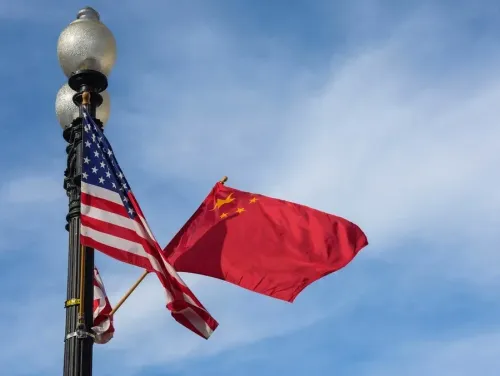
Resolution Copper Mining, LLC is owned by BHP and Rio Tinto , both of which earn more than half their revenue from exporting minerals to China ; Rio Tinto's largest shareholder is a Chinese state-owned enterprise .
The Oak Flat site is located within 100 miles of Luke Air Force Base , a major US military training facility, triggering federal foreign investment proximity rules.
A hypersonic missile manufacturing and testing facility may be developed near the Oak Flat site, significantly escalating national security concerns about foreign-linked activity in the region.
Current US law does not require copper extracted from Oak Flat to be processed or sold within the United States , creating a critical supply chain security loophole.
Separately, Republican lawmakers warned the State Department that gaps in oversight of US-China Science and Technology Agreements (STAs) leave American intellectual property vulnerable to Chinese exploitation.
Washington, April 25 — Senior Democratic lawmakers in the United States have raised urgent national security alarms over the transfer of federally owned land in Arizona to a foreign-controlled mining company, warning that the deal hands control of one of America's largest untapped copper deposits to an entity with deep financial ties to China. The lawmakers have formally demanded an immediate review by the Committee on Foreign Investment in the United States (CFIUS), citing both strategic mineral risks and proximity to critical US military infrastructure.
Lawmakers Demand CFIUS Review of Resolution Copper Deal
In a formal letter addressed to Treasury Secretary Scott Bessent, Congresswoman Maxine Waters and three other senior ranking members called for an emergency review of the transfer of thousands of acres of US Forest Service land to Resolution Copper Mining, LLC. The site in question, known as Oak Flat, sits in Arizona and holds one of the nation's most significant undeveloped reserves of copper and other critical minerals.
The lawmakers argued that the land transfer effectively places a strategically vital resource under the operational influence of companies with substantial commercial exposure to Beijing. Their letter stated that the statutory language authorizing the transfer "explicitly failed to acknowledge" the true ownership structure behind Resolution Copper.
BHP and Rio Tinto's Deep China Connections Under Scrutiny
Resolution Copper Mining, LLC is jointly owned by global mining behemoths BHP and Rio Tinto — two of the world's largest foreign mining corporations. The lawmakers pointed out that both BHP and Rio Tinto generate more than half of their revenue from exporting minerals to the People's Republic of China (PRC), creating a structural dependency on Chinese markets.
More critically, the letter highlighted that Rio Tinto's largest single shareholder is a Chinese state-owned enterprise, raising concerns that Beijing could exert indirect influence over decisions affecting the Oak Flat mining project. This detail, lawmakers argued, transforms what appears to be a routine land transfer into a potential foreign influence operation over American critical mineral infrastructure.
This development comes amid a broader pattern of congressional scrutiny over Chinese investment in US resource sectors. Notably, similar concerns were raised in 2023 over Chinese-linked entities acquiring land near military bases in states including North Dakota and Texas, prompting bipartisan legislative pushback.
Military Proximity and Emerging Weapons Infrastructure Raise Stakes
The Oak Flat site is located within 100 miles of Luke Air Force Base, one of the US military's premier fighter pilot training facilities. Federal regulations governing foreign investment explicitly flag proximity to sensitive defence installations as a key risk factor in CFIUS evaluations.
The lawmakers further warned that planned mining operations at the site would require extensive underground infrastructure — including tunnels, transport corridors, and electrical grid systems — that could introduce exploitable vulnerabilities in a region of growing strategic importance.
Adding another layer of concern, the letter noted that a hypersonic missile manufacturing and testing facility may be developed in the vicinity of Oak Flat, dramatically elevating the national security calculus around foreign-linked industrial activity in the area. The convergence of critical mineral extraction, military training operations, and next-generation weapons development in the same geographic zone is what the lawmakers describe as a "potential major national security concern."
Copper's Critical Mineral Status and the Domestic Processing Gap
Copper has been formally designated a critical mineral by the US Geological Survey, underscoring its indispensable role in defence manufacturing, electric vehicles, power grid infrastructure, and advanced electronics. The metal is foundational to the US military's modernization agenda and the broader green energy transition.
However, the lawmakers flagged a significant legal loophole: current US law does not require copper extracted from the Oak Flat site to be processed or sold within the United States. This means that even as American land and resources are used for mining, the resulting output could legally be exported — potentially to China itself — without any domestic economic or security benefit.
This gap in the law mirrors a wider vulnerability that analysts have long flagged in US critical mineral policy, where extraction rights do not automatically guarantee domestic supply chain security. Critics argue this structural flaw undermines the very rationale for designating minerals as "critical" in the first place.
Parallel Alarm Over US-China Science and Technology Agreements
In a separate but related development, Republican lawmakers sent a letter to the State Department raising concerns about oversight gaps in US-China Science and Technology Agreements (STAs). They warned that there is currently "no centralized system in the US government which tracks these sub-agreements," leaving American research and intellectual property exposed.
The Republican letter stated that China has "historically weaponized science and technology cooperation to steal Intellectual Property (IP) and trade secrets" from partner nations, and that existing STA frameworks provide insufficient safeguards against such exploitation.
Taken together, the dual congressional warnings — one from Democrats on mining, one from Republicans on science — reflect a rare moment of bipartisan convergence on the threat posed by Chinese access to American strategic assets, whether physical or intellectual.
As CFIUS comes under renewed pressure from both sides of the aisle, analysts expect the Biden-era land transfer authorization to face intensified legal and legislative scrutiny in the coming weeks. The outcome of any CFIUS review could set a landmark precedent for how the US government evaluates foreign-linked access to critical mineral deposits on federal land going forward.
Point of View
Yet existing law allows federally owned deposits to be mined by foreign-controlled entities and exported without any domestic processing mandate. The bipartisan alarm — Democrats on mining, Republicans on science agreements — signals that China's multi-vector approach to accessing US strategic assets is finally being recognized as a systemic threat rather than isolated incidents. What's striking is that the legal framework authorizing this land transfer reportedly never disclosed the BHP-Rio Tinto-China ownership chain to Congress — a transparency failure that, if true, represents either negligence or deliberate obfuscation. The CFIUS review, if initiated, will be a test of whether America's foreign investment screening apparatus is capable of closing loopholes that adversaries have long learned to exploit.
NationPress
7 Oct 2026
Frequently Asked Questions
Why are US lawmakers concerned about the Resolution Copper deal in Arizona?
US lawmakers are concerned because Resolution Copper Mining is owned by BHP and Rio Tinto, both of which have major financial ties to China, with Rio Tinto's largest shareholder being a Chinese state-owned enterprise. The mine site, Oak Flat, is also located within 100 miles of Luke Air Force Base, raising foreign investment security concerns.
What is CFIUS and why is a review being demanded?
CFIUS, the Committee on Foreign Investment in the United States, is a federal body that reviews transactions for national security risks involving foreign entities. Lawmakers are demanding a CFIUS review because the Oak Flat land transfer involves companies with deep China ties near sensitive US military infrastructure.
What is the Oak Flat site and why does it matter?
Oak Flat is a federally owned site in Arizona that holds one of the largest undeveloped copper and critical mineral deposits in the United States. Copper is designated a critical mineral by the US Geological Survey due to its essential role in defence manufacturing, power infrastructure, and advanced electronics.
Can the copper mined at Oak Flat be exported to China?
Yes — current US law does not require copper extracted from the Oak Flat site to be processed or sold within the United States, meaning it could legally be exported abroad, including to China. This legal gap is a central concern raised by the Democratic lawmakers in their letter to Treasury Secretary Scott Bessent.
What concerns did Republican lawmakers raise about US-China science agreements?
Republican lawmakers warned the State Department that there is no centralized US government system to track sub-agreements under Science and Technology Agreements (STAs) with China. They stated that China has historically used such cooperation to steal intellectual property and trade secrets from partner nations.