National Ayush Mission: Centre releases ₹6,407 crore to states, UTs in FY15–FY26

Synopsis
Over eleven years and ₹6,407 crore later, the National Ayush Mission has placed Ayush services in over 13,000 public health facilities and funded more than 30,000 practitioners — and a first-of-its-kind insurance empanelment deal in February 2026 means cashless Ayush treatment is now a reality for insured patients across India.
Key Takeaways
The Centre disbursed ₹6,406.99 crore through the National Ayush Mission to states and UTs between FY2014–15 and FY2025–26 .
Nearly 12,260 Ayushman Arogya Mandirs were operational as of 19 September 2026 , against a target of 12,500 .
Ayush services are now co-located in 13,249 public health facilities under the NHM.
Government funds salaries of 25,322 Ayush doctors and 5,666 Ayush paramedics .
The AIIA–GIC MoU signed in February 2026 is the first universal cashless-treatment empanelment for an Ayush institution, covering all 32 general insurers .
AYURGYAN research funding totals ₹17.79 crore across 34 projects , with Ayurveda receiving ₹9.38 crore for 17 projects .
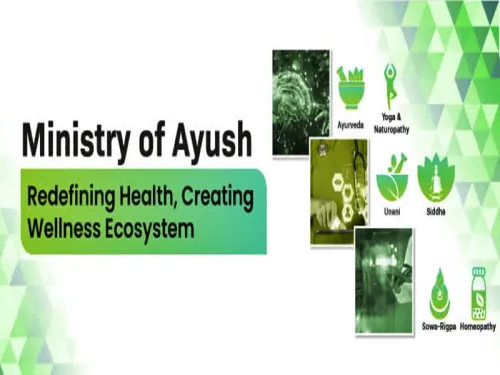
The Centre has disbursed ₹6,406.99 crore through the National Ayush Mission (NAM) to states and Union Territories between financial years 2014–15 and 2025–26, according to an official factsheet released on Tuesday, 22 September 2026. The funds are aimed at expanding and integrating Ayush healthcare — covering Ayurveda, Yoga, Unani, Siddha, and Homoeopathy — into India's mainstream public health infrastructure.
Scale of the Mission on the Ground
As of 19 September 2026, nearly 12,260 Ayushman Arogya Mandirs (Ayush AAMs) were operational — close to the NAM target of 12,500. In parallel, the National Health Mission (NHM) now offers Ayush services alongside standard care in 13,249 public health facilities across the country. The co-location model is designed to give patients access to traditional remedies without requiring them to visit separate facilities.
Workforce and Educational Infrastructure
The government currently funds salaries for 25,322 Ayush doctors and 5,666 Ayush paramedics deployed across various states and Union Territories. On the education front, 17 new Ayush colleges have been approved for establishment under the NAM, of which 12 will impart Ayurvedic education. As of 13 March 2026, India had 593 Ayurveda colleges with 45,245 undergraduate seats and 5,673 postgraduate seats, with the number of both public and private institutions continuing to grow, according to the factsheet.
Insurance Breakthrough for Ayush Patients
In a notable first for the sector, the All-India Institute of Ayurveda (AIIA) signed a Common Empanelment Memorandum of Understanding (MoU) with the General Insurance Council (GIC) in February 2026, bringing it under the fold of all 32 general insurance companies in India. This marks the first time an Ayush institution has entered a universal empanelment agreement enabling cashless treatment for insured patients. The AIIA also launched a dedicated Ayush Health Insurance Helpline to assist beneficiaries with insurance-related queries and improve awareness of Ayush coverage options.
Research Funding Through AYURGYAN
The AYURGYAN scheme, run by the Ministry of Ayush, provides financial backing for research and development projects within the sector. Out of a total research pool of ₹17.79 crore spanning 34 projects, Ayurveda commands the largest share — receiving ₹9.38 crore across 17 dedicated projects, accounting for roughly half the portfolio.
The data collectively signals a steady institutional push to bring Ayush services from the margins of Indian healthcare into its public-health core — with insurance integration and workforce expansion among the most tangible recent milestones. Whether the infrastructure build-out translates into measurable health outcomes will be the benchmark that shapes future allocations.
Point of View
407 crore over eleven years — is modest relative to India's overall health budget, yet the real story is structural integration: placing Ayush services inside 13,249 NHM facilities rather than running them as a parallel system is a fundamentally different strategy from earlier years. The AIIA cashless insurance deal is the single most consequential development in this data drop, because insurance linkage is what historically mainstreamed allopathic specialists into the payment ecosystem. The gap to watch is outcomes: the government has detailed inputs — money, colleges, doctors, facilities — but has not yet published patient-utilisation rates or clinical efficacy benchmarks. Without that, the expansion risks becoming a supply-side story that does not demonstrably move population health indicators.
NationPress
22 Sept 2026
Frequently Asked Questions
How much has the Centre released to states for Ayush healthcare since FY2014–15?
The Centre has released ₹6,406.99 crore through the National Ayush Mission between financial years 2014–15 and 2025–26. The funds have been used to modernise clinics, co-locate services in public facilities, and establish new traditional medical colleges.
How many Ayush wellness centres are functional in India right now?
As of 19 September 2026, nearly 12,260 Ayushman Arogya Mandirs (Ayush AAMs) were operational across India, out of a NAM target of 12,500. Additionally, Ayush services are offered alongside standard care in 13,249 NHM public health facilities.
What is the significance of the AIIA–GIC MoU signed in February 2026?
The MoU between the All-India Institute of Ayurveda and the General Insurance Council marked the first time an Ayush institution was universally empanelled with all 32 general insurance companies in India, enabling cashless treatment for insured patients — a first for the sector.
How many Ayush doctors and paramedics does the government currently fund?
The government funds salaries for 25,322 Ayush doctors and 5,666 Ayush paramedics working across various states and Union Territories, according to the official factsheet released on 22 September 2026.
What is the AYURGYAN scheme and how is its research budget allocated?
AYURGYAN is a Ministry of Ayush scheme that finances research and development projects within traditional medicine. Its total funding pool is ₹17.79 crore across 34 projects, with Ayurveda receiving the largest share — ₹9.38 crore for 17 dedicated projects.