AI in courts best for routine work, says ex-CJI Chandrachud

Synopsis
Former CJI D.Y. Chandrachud says the best use of AI in courts is ‘the boring one’ — transcription, translation and case listing. With courts already encountering AI-fabricated citations, including invented passages attributed to real Supreme Court rulings, he insists every output be human-verified and every verdict remain a judge's own.
Key Takeaways
Chandrachud backed AI for routine court functions on 28 November 2026 in New Delhi .
He said tasks like transcription, translation, case listing and procedural scrutiny suit AI, but decisions must stay with judges.
Courts have encountered AI-fabricated citations, including non-existent judgments and invented passages attributed to real Supreme Court rulings.
The Supreme Court's AI Committee published draft regulations earlier this year for courts and tribunals.
He outlined five principles : human oversight, liberty protection, transparency, access to justice and data security.
More than 5.6 crore cases are pending across Indian courts.
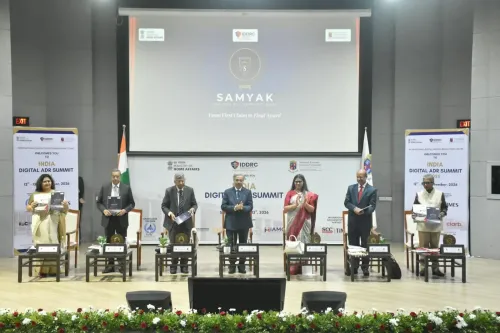
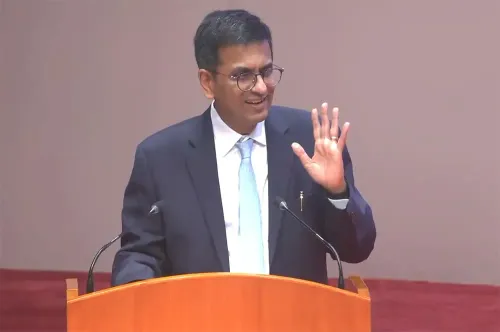
Former Chief Justice of India D.Y. Chandrachud on Saturday, 28 November 2026, endorsed the use of artificial intelligence (AI) in the judiciary for administrative and routine tasks, but warned that judicial decision-making must stay firmly with human judges. Speaking at an event in New Delhi, he said AI could sharply improve court efficiency by handling transcription, translation, case listing and the scrutiny of procedural defects.
His remarks come as Indian courts face a backlog of more than 5.6 crore pending cases and a significant shortage of judges, a combination that has made technology adoption one of the most closely watched debates in the justice system.
Key Remarks on AI in the Judiciary
Addressing the event titled “AI for All: AI Governance and Trust, the Case for Judicial Access and an Empowered India”, Chandrachud argued that judges are too often weighed down by clerical work.
“The tragedy of the Indian judicial system is that judges spend their time doing work which should least occupy their time. Their focus should be on real-time decision-making,” he said.
According to the former CJI, AI's greatest value lies in supporting courts with routine work rather than making substantive legal determinations. “I have come to think that the best use of AI in a court is the boring one. The trouble begins when the technology is asked to do something more interesting,” he said.
Fabricated Citations and the Need for Human Verification
Notably, Chandrachud flagged recent cases in which fabricated legal citations generated by technology made their way into judicial proceedings. He said courts had encountered both non-existent judgments and invented passages attributed to genuine Supreme Court rulings.
He stressed that every AI-generated citation, translation or research output must be checked by human beings. “A human being decides and signs. The decision and the reasons for it must belong to the judge,” Chandrachud said.
He added that a language model cannot be held accountable through appellate scrutiny and does not carry the constitutional responsibility entrusted to judges — a distinction that goes to the heart of why accountability, not capability, remains the limiting factor for AI in adjudication.
Draft Regulations and Five Guiding Principles
The former CJI revealed that the Supreme Court's AI Committee had published draft regulations earlier this year to govern the use of artificial intelligence across courts and tribunals.
He also outlined five guiding principles for judicial AI use:
- Human oversight of every decision
- Protection of individual liberty
- Transparency regarding AI deployment
- Wider access to justice
- Strong data security safeguards
Chandrachud further made a case for sovereign legal databases and India-developed AI models to support the judiciary, signalling concern over dependence on foreign platforms for sensitive legal data.
What It Means for Access to Justice
With more than 5.6 crore cases pending across courts, Chandrachud said technology could play an important role in widening access to justice, provided it remains a tool that assists judges rather than replacing them.
The coming months will show how the Supreme Court's draft regulations are finalised and whether courts adopt the safeguards Chandrachud has laid out as AI tools spread through India's legal system.
Point of View
Which means the risk is not hypothetical but present. Draft regulations matter little unless they carry enforceable consequences for lawyers and litigants who file unverified AI output. And his push for sovereign legal databases is a reminder that India's 5.6 crore-case backlog cannot be fixed by importing tools whose training data and accountability lie outside the country.
NationPress
28 Nov 2026
Frequently Asked Questions
What did former CJI Chandrachud say about AI in courts?
He said AI is best suited for routine court work such as transcription, translation, case listing and checking procedural defects, but judicial decisions must remain with human judges. He said the decision and its reasons must belong to the judge.
Why does Chandrachud oppose AI deciding cases?
He said a language model cannot be held accountable through appellate scrutiny and does not carry the constitutional responsibility entrusted to judges. He also pointed to instances of AI-generated fake citations entering court proceedings.
What are the five principles for judicial AI use outlined by Chandrachud?
They are human oversight of every decision, protection of individual liberty, transparency regarding AI deployment, wider access to justice and strong data security safeguards.
Has the Supreme Court issued rules on AI use?
The Supreme Court's AI Committee published draft regulations earlier this year to govern the use of artificial intelligence across courts and tribunals, according to Chandrachud.
How many cases are pending in Indian courts?
More than 5.6 crore cases are pending across Indian courts, according to figures cited by Chandrachud. He said technology could help improve access to justice amid a significant shortage of judges.