India targets $500 billion electronics output by 2030 under Viksit Bharat plan
Synopsis
India has put a number on its electronics ambition: $500 billion in annual production by 2030, scaling to as much as $8 trillion by 2047. With the DPIIT framing this as a Viksit Bharat milestone — not just an aspiration — the question is whether India's deregulation drive and global supply-chain realignment can turn a striking target into a structural shift.
Key Takeaways
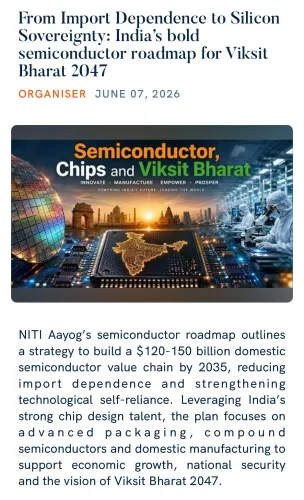
India targets $500 billion in annual electronics and semiconductor production by 2030 , up from a current baseline of around $330 billion .
The longer-term goal is between $5.3 trillion and $8 trillion in output by 2047 , India's centenary of Independence.
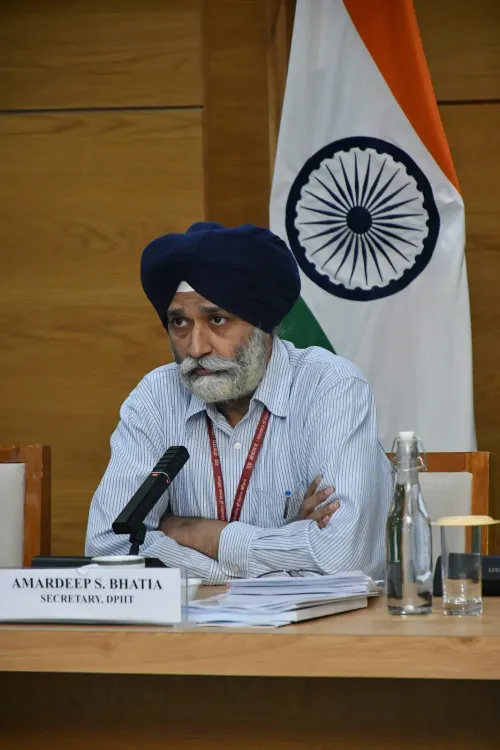
DPIIT Secretary Amardeep Singh Bhatia outlined the targets at the IGCC Dialogue 2026 in New Delhi on 30 July 2026 .
A deregulation cell in the Cabinet Secretariat is working with states to ease business regulations.
The Indo-German Chamber of Commerce has over 2,500 members ; India and Germany share more than 25 years of strategic partnership.
India is targeting annual electronics and semiconductor production worth $500 billion by 2030 as part of its Viksit Bharat roadmap, which envisions the country's transformation into a developed nation by 2047, a senior government official said on Thursday, 30 July 2026. The target was outlined at the Indo-German Chamber of Commerce (IGCC) Dialogue 2026 in New Delhi.
The Scale of Ambition
Department for Promotion of Industry and Internal Trade (DPIIT) Secretary Amardeep Singh Bhatia said India aims to scale annual electronics and semiconductor production from its current baseline of around $330 billion to $500 billion by 2030. The longer arc is more striking: the government projects output to reach between $5.3 trillion and $8 trillion by 2047, the centenary of India's Independence.
'These targets will unlock significant manufacturing opportunities,' Bhatia said, adding that the government's long-term plans span both economic and social sectors and are designed to accelerate industrial growth.
Viksit Bharat: Vision Into Action Plans
Bhatia said the Viksit Bharat roadmap has translated the 2047 vision into sector-specific action plans with clearly defined milestones for 2030. He noted that reform efforts have gathered further momentum over the last three years through high-level committees working on sector-specific initiatives.
He also highlighted the role of a deregulation cell in the Cabinet Secretariat, which is working with states to simplify regulations and improve the ease of doing business — a structural effort to reduce friction for both domestic and foreign investors.
India-Germany Economic Ties in Focus
Bhatia underscored the depth of the India-Germany bilateral relationship, noting more than 25 years of strategic partnership and 75 years of diplomatic relations, with business engagement stretching back over a century. He pointed out that several German companies had established operations in India even before Independence.
The Indo-German Chamber of Commerce, with more than 2,500 members, was cited as a strong platform to deepen economic cooperation further. Bilateral business delegations and investments have reportedly increased in recent years.
Why This Matters
Electronics manufacturing has emerged as a strategic priority for India as it seeks to reduce dependence on Chinese supply chains and position itself as a global alternative for semiconductor and consumer electronics production. This comes amid a broader global realignment of technology supply chains, with the United States and European Union actively encouraging allied nations to build domestic manufacturing capacity.
India's current $330 billion baseline — while significant — still trails China, South Korea, and Taiwan by a wide margin. Closing that gap by 2030 will require sustained policy momentum, infrastructure investment, and skilled workforce development, analysts note.
What Comes Next
The government has indicated that sector-specific milestones under the Viksit Bharat framework are already being tracked. The focus on deregulation and ease of doing business signals that the Centre intends to address long-standing structural barriers alongside headline investment targets. Industry observers will watch whether the ambition translates into verifiable production benchmarks in the near term.
Point of View
But the gap between India's current $330 billion baseline and the 2030 goal is not the hardest part — the $5.3-to-$8 trillion projection for 2047 is where scrutiny belongs. India has announced large manufacturing targets before; what has historically lagged is the ecosystem: skilled labour at scale, reliable power, and semiconductor-grade infrastructure. The deregulation cell in the Cabinet Secretariat is a meaningful institutional signal, but working with states on ease of doing business is a process that has moved slowly for years. The IGCC forum was a natural venue for this announcement given Germany's engineering depth, but translating bilateral goodwill into hard foreign direct investment commitments will require more than milestone charts. The real test will be the 2030 scorecard.
NationPress
14 Sept 2026
Frequently Asked Questions
What is India's electronics manufacturing target for 2030?
India is targeting annual electronics and semiconductor production worth $500 billion by 2030, up from a current baseline of around $330 billion. The target is part of the Viksit Bharat roadmap, which also projects output of between $5.3 trillion and $8 trillion by 2047.
What is the Viksit Bharat roadmap?
Viksit Bharat is the Indian government's framework to transform India into a developed nation by 2047, the centenary of Independence. It translates this long-term vision into sector-specific action plans with defined milestones for 2030.
Who announced the electronics production target?
DPIIT Secretary Amardeep Singh Bhatia announced the target on 30 July 2026 while addressing the Indo-German Chamber of Commerce Dialogue 2026 in New Delhi.
What role does the deregulation cell play in this plan?
A deregulation cell within the Cabinet Secretariat is working with state governments to simplify regulations and improve ease of doing business, aiming to reduce structural barriers for both domestic and foreign manufacturers.
How strong are India-Germany economic ties?
India and Germany share more than 25 years of strategic partnership and 75 years of diplomatic relations, with business engagement spanning over a century. The Indo-German Chamber of Commerce has more than 2,500 members and serves as a key platform for bilateral economic cooperation.