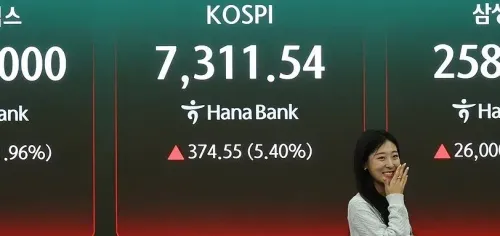
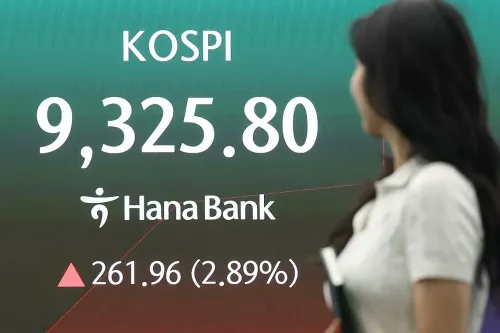
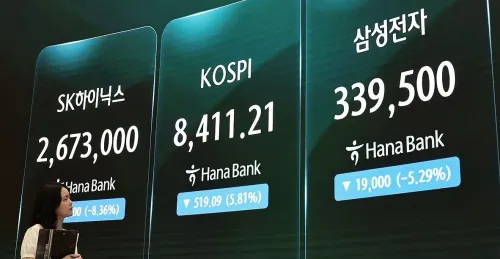
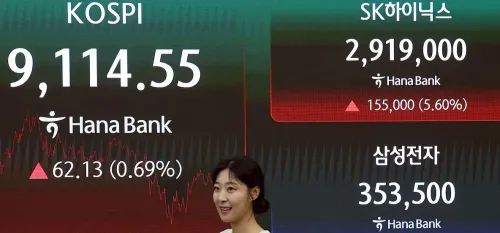
KOSPI plunges 8.95% as tech stocks crash amid Middle East strikes
Synopsis
South Korea's KOSPI suffered one of its steepest single-day falls in recent memory — down nearly 9% — as leveraged ETFs amplified a tech selloff triggered by SK hynix profit-rotation and fresh US-Iran strikes near the Strait of Hormuz. The circuit breaker fired for the seventh time this year, signalling that Seoul's market is operating under sustained structural stress, not just a one-off shock.
Key Takeaways
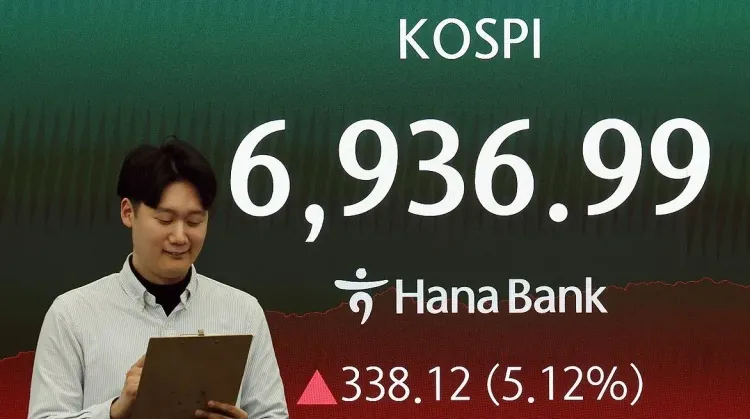
The KOSPI fell 669.01 points (8.95%) to close at 6,806.93 on 13 July — one of its sharpest single-day declines.
Samsung Electronics plunged 10.7% to 254,500 won ; SK hynix crashed 15.37% to 1,845,000 won .
A circuit breaker halted trading for 20 minutes — the seventh such activation this year.
Leveraged single-stock ETFs linked to Samsung and SK hynix reportedly amplified the volatility, according to Samsung Securities .
Fresh US-Iran strikes over the Strait of Hormuz deepened investor anxiety and weighed on sentiment.
The Korean won slipped to 1,503.4 per US dollar ; three-year bond yields rose 4.1 basis points to 3.809% .
South Korea's benchmark Korea Composite Stock Price Index (KOSPI) collapsed 669.01 points, or 8.95 percent, to close at 6,806.93 on Monday, 13 July, as investors aggressively offloaded technology shares for profit-taking while fresh Middle East tensions rattled global sentiment. The Korean won also weakened against the US dollar, compounding the market stress.
Scale of the Selloff
The KOSPI touched an intraday low of 6,783.43 before recovering marginally to close at 6,806.93. Trade volume stood at 469.86 million shares worth 39.8 trillion won (approximately US$26.5 billion), with decliners overwhelming gainers at a ratio of 713 to 179.
Institutional investors offloaded a net 2.22 trillion won worth of shares, while foreign investors sold a net 1.7 trillion won. Retail buyers absorbed the bulk of the selling, purchasing a net 3.9 trillion won — a sign of domestic investors stepping in at lower levels even as large players exited.
Circuit Breaker Triggered
After opening 0.85 percent lower, the KOSPI's losses accelerated sharply, triggering a circuit breaker that halted trading in KOSPI-listed stocks for 20 minutes. According to reports, this marked the seventh activation of the circuit breaker mechanism this year alone — a frequency that underscores the extraordinary volatility gripping South Korean equities in 2025.
Tech Stocks Bear the Brunt
Technology shares led the decline. Market bellwether Samsung Electronics plunged 10.7 percent to 254,500 won, while chipmaking rival SK hynix plummeted 15.37 percent to 1,845,000 won. Analysts noted that SK hynix's sharp fall came despite a successful US market debut — the company's American depositary receipts (ADRs) on the Nasdaq had closed at US$168 each on Friday, well above the offering price of US$149. Investors reportedly rotated out of Seoul-listed SK hynix shares and into its ADRs, accelerating the domestic selloff.
Samsung Securities flagged in a research note that newly introduced single-stock leveraged exchange-traded funds linked to Samsung Electronics and SK hynix 'continued to fuel volatility in the stock market.' The leveraged ETF dynamic amplified directional moves, turning a profit-taking episode into a near-rout.
Beyond chipmakers, top carmaker Hyundai Motor fell 2.95 percent to 444,000 won, and defence conglomerate Hanwha Aerospace declined 3.21 percent to 936,000 won. Not all counters ended in the red: leading battery maker LG Energy Solution rose 0.77 percent, and refiner SK Innovation climbed 7.09 percent to 110,200 won.
Middle East Tensions Add to Pressure
Investor sentiment was further weighed down by escalating geopolitical uncertainty after the United States and Iran reportedly exchanged fresh strikes over the status of the Strait of Hormuz. The Strait is a critical global oil chokepoint, and any disruption there carries immediate implications for energy prices and supply chains — particularly for import-dependent economies like South Korea.
This comes amid a broader pattern of risk-off episodes this year, with the KOSPI circuit breaker having already been triggered six times before Monday's session. The convergence of domestic tech profit-taking, leveraged ETF volatility, and an external geopolitical shock created an unusually severe one-day drawdown.
Currency and Bond Markets React
The Korean won was quoted at 1,503.4 won per US dollar at 3:30 pm local time, down 2 won from the previous session. Bond yields rose as prices fell: the yield on three-year Treasury bonds climbed 4.1 basis points to 3.809 percent, while the five-year government bond yield rose 3.3 basis points to 4.041 percent.
Markets will be watching closely for any further developments in the Middle East, the trajectory of SK hynix ADRs on the Nasdaq, and whether leveraged ETF flows continue to amplify volatility in Seoul's technology-heavy index.
Point of View
And the leveraged single-stock ETF mechanism is now an accelerant that regulators appear to have underestimated. SK hynix's ADR success on Wall Street turning into a domestic selloff is a textbook arbitrage rotation, but when it combines with Middle East shock and leveraged ETF feedback loops, the result is a near-9% drawdown that overshoots fundamentals. South Korean authorities face a genuine policy question: whether the leveraged ETF framework introduced to deepen liquidity is instead systematically destabilising the market it was meant to serve.
NationPress
13 Jul 2026
Frequently Asked Questions
Why did the KOSPI fall nearly 9% on 13 July?
The KOSPI fell 8.95% to 6,806.93 on 13 July due to a combination of profit-taking in technology stocks, investor rotation from Seoul-listed SK hynix shares into its Nasdaq ADRs, and heightened geopolitical anxiety after the United States and Iran reportedly exchanged strikes over the Strait of Hormuz. Leveraged single-stock ETFs linked to Samsung Electronics and SK hynix amplified the downward move, according to a Samsung Securities research note.
What is a circuit breaker and why was it triggered?
A circuit breaker is a regulatory mechanism that temporarily halts stock trading when prices fall too sharply, to prevent panic-driven freefall. On 13 July, the KOSPI's accelerating losses triggered a 20-minute trading halt — the seventh such activation this year — reflecting the extreme volatility in South Korean equities over recent months.
How much did Samsung Electronics and SK hynix fall?
Samsung Electronics plunged 10.7% to 254,500 won, while SK hynix fell even steeper at 15.37% to 1,845,000 won. SK hynix's domestic decline was particularly notable given that its Nasdaq ADRs had closed at US$168 on Friday, well above the US$149 offering price, suggesting investors rotated profits from Seoul shares into the ADRs.
How did the Middle East situation affect South Korean markets?
Reports of fresh strikes exchanged between the United States and Iran over the Strait of Hormuz — a critical global oil shipping lane — stoked uncertainty about energy supply chains. South Korea is heavily dependent on imported energy, making it particularly sensitive to any Strait of Hormuz disruption, which compounded existing selling pressure from the tech sector.
Were there any stocks that gained on the day?
Yes, not all stocks fell. LG Energy Solution rose 0.77%, and SK Innovation climbed 7.09% to 110,200 won, bucking the broader market trend. However, these gains were far outweighed by the losses across the index, with decliners outnumbering gainers 713 to 179.