Balochistan crisis: Poor governance, not just security, fuelling unrest, report finds
Synopsis
A new Afghan Diaspora Network report lays bare the contradiction at the heart of Pakistan's Balochistan policy: a resource-rich province where 47% of people live below the poverty line, its wealth flowing to China and other Pakistani provinces, while Islamabad doubles down on military operations and ignores the governance failures driving the insurgency.
Key Takeaways
An Afghan Diaspora Network report finds poor governance — not militancy alone — as the primary driver of instability in Balochistan .
47 per cent of Balochistan residents live below the poverty line, the highest rate in Pakistan.
Key assets including Gwadar port and the Saindak copper and gold mine are operated by China , with profits bypassing the local population.
Journalist Kadeem Baloch argues that Operation Shaban cannot deliver lasting peace without addressing root causes such as federalism and resource distribution.
The Baloch Republican Guards (BRG) claimed responsibility for destroying two 220 kV electricity towers in Nasirabad , vowing further attacks.
Pakistan's Balochistan province remains mired in instability and deprivation primarily because of poor governance, with the federal government in Islamabad treating the crisis as a security problem while ignoring its deeper social, economic, and political dimensions, according to a report by the Afghan Diaspora Network published on 9 August. Despite being one of Pakistan's most resource-rich regions, the province's own people see little of its wealth.
A Resource-Rich Province Left Behind
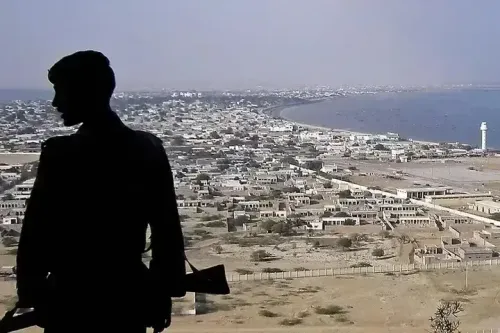
Balochistan is home to major strategic assets, including the Gwadar port and the Saindak copper and gold mine — both largely operated by China. According to the report, profits from these projects flow primarily to Chinese interests and to residents of Pakistan's Punjab and Sindh provinces, bypassing the local Baloch population entirely.
The province currently records the highest poverty rate in Pakistan, with 47 per cent of its residents living below the poverty line. Basic infrastructure — including gas connections, clean drinking water, and employment opportunities — remains absent across large swathes of the region, even as mega extraction projects operate on its soil.
Security-First Approach Failing, Experts Argue
Kadeem Baloch, a freelance journalist based in Pakistan who authored the Afghan Diaspora Network report, argues that the state's response has been dangerously narrow. 'Experts blame poor governance as a main culprit behind instability and deprivation. Quick to resort to repression, the state has considered Balochistan unidimensional as a security issue, ignoring the underlying social, economic, and political causes of the crisis,' he wrote.
Baloch specifically called out Operation Shaban, the ongoing military campaign in the province, noting that while it 'might hit the headlines for killing terrorists, it fails to ensure any sustainable peace and stability.' Experts cited in the report argue that military operations cannot deliver durable peace without addressing core grievances — including federalism, identity, and equitable distribution of resource revenues.
Militant Groups Escalate Infrastructure Attacks
Against this backdrop, armed groups continue to strike at the province's infrastructure. On Saturday, the Baloch Republican Guards (BRG) claimed responsibility for destroying two 220 kV electricity towers in the Nasirabad district, according to local media reports.
BRG spokesperson Dosteen Baloch said in a statement that BRG members blew up the towers at the Piru Pul area near Mir Hassan in Nasirabad — towers that carry power from the Och Power Plant to Punjab. Two towers collapsed entirely while two others sustained severe damage. The spokesperson stated that 'such operations will continue until the independence of Balochistan from Pakistan.'
Pakistan's Denial and the Ground Reality
Pakistan's federal government has consistently denied that the people of Balochistan are discontented, even as the province's poverty indicators and militant activity paint a starkly different picture. The majority of Balochistan's population, the report states, lives in extreme deprivation of resources, human rights, and educational access.
The report notes that marginalised residents, with few avenues for political or economic redress, have increasingly turned to militancy as a means of expressing grievance against what they describe as exploitation by outsiders. With Operation Shaban ongoing and armed groups vowing continued attacks, the cycle of repression and retaliation shows little sign of abating without a fundamental shift in Islamabad's approach.
Point of View
Operation Shaban will be followed by Operation Something Else, with the same result.
NationPress
23 Sept 2026
Frequently Asked Questions
Why is Balochistan considered unstable despite being resource-rich?
According to an Afghan Diaspora Network report, poor governance and a security-centric federal approach have left Balochistan's wealth — from assets like Gwadar port and the Saindak mine — flowing to Chinese operators and residents of Punjab and Sindh rather than to the local Baloch population. With 47 per cent of residents below the poverty line and basic infrastructure absent, deprivation has fuelled both grievance and militancy.
What is Operation Shaban in Balochistan?
Operation Shaban is an ongoing Pakistani military campaign in Balochistan targeting militant groups. Critics cited in the Afghan Diaspora Network report argue that while the operation may neutralise individual threats, it cannot produce sustainable peace because it does not address the root causes of unrest — including governance failures, identity disputes, and inequitable resource distribution.
Who are the Baloch Republican Guards and what did they do?
The Baloch Republican Guards (BRG) is an armed separatist group operating in Balochistan. On Saturday, the BRG claimed responsibility for blowing up two 220 kV electricity towers in the Nasirabad district, with two more sustaining severe damage. The group's spokesperson said the attacks would continue until Balochistan's independence from Pakistan.
What share of Balochistan residents live below the poverty line?
According to the Afghan Diaspora Network report, 47 per cent of Balochistan's residents live below the poverty line — the highest poverty rate of any province in Pakistan. The province also lacks basic infrastructure such as gas connections and clean drinking water despite hosting major extraction and infrastructure projects.
How does China factor into Balochistan's resource crisis?
The majority of major development projects in Balochistan, including the strategic Gwadar port and the Saindak copper and gold mine, are operated by China. The Afghan Diaspora Network report states that profits from these ventures accrue to Chinese interests and to people from Punjab and Sindh, rather than to the local Baloch population, deepening economic resentment.