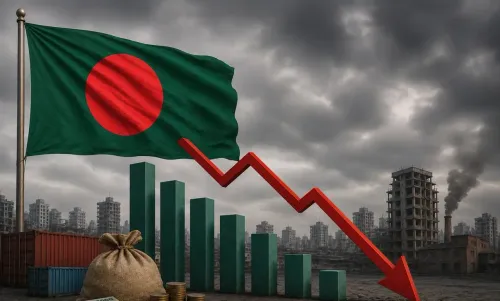
Bangladesh gas crisis: 1,380 MMcfd shortfall exposes LNG chain weakness

Synopsis
Bangladesh's gas crisis isn't just an energy story — it's a supply-chain stress test that the country failed. With a 1,380 MMcfd shortfall and two FSRUs at a single island gateway supplying over a third of national gas needs, one fire and one weather delay were enough to bring factories, homes, and power plants to their knees. The structural fix is clear; the political will to fund redundancy is not.
Key Takeaways
Bangladesh's gas availability stood at 2,420 MMcfd in mid-August against national demand of 3,800 MMcfd — a shortfall of nearly 1,380 MMcfd .
Excelerate Energy's FSRU went offline after a fire and technical problems; a separate terminal exhausted inventory due to weather-related unloading delays.
Bangladesh's two FSRUs at Moheshkhali Island supply an estimated 30–37% of national gas needs, creating dangerous concentration risk.
Factories, CNG filling stations, households, and power plants were all affected by the supply disruption.
Declining domestic gas production makes Bangladesh increasingly vulnerable to international LNG price swings and maritime disruptions.
Bangladesh is grappling with a severe gas supply crisis, with total availability standing at approximately 2,420 million cubic feet per day (MMcfd) in mid-August against a national demand of roughly 3,800 MMcfd — a shortfall of nearly 1,380 MMcfd. According to a report by Dhaka-based The Daily Star, the crisis is fundamentally a logistics failure compounded by dangerous concentration risk in the country's LNG import infrastructure.
How the Crisis Unfolded
The supply disruption traces back to cascading failures in Bangladesh's LNG import chain rather than any single procurement lapse. Excelerate Energy's Floating Storage and Regasification Unit (FSRU) went offline following a fire and subsequent technical problems. Separately, weather-related unloading delays at a second terminal left inventories exhausted and supplies interrupted.
'Excelerate's terminal later also exhausted its LNG inventory while waiting for its next cargo. These were separate incidents, but together they exposed the same weakness: the country's LNG supply chain does not have enough redundancy,' The Daily Star report stated.
The Anatomy of a Fragile Supply Chain
LNG imports must travel through an intricate physical chain: procurement, cargo nomination, shipping, vessel scheduling, and navigation through international sea routes. Once at sea, cargoes must arrive at Moheshkhali Island, be transferred to an FSRU, stored, regasified, and then transmitted through high-pressure pipelines before reaching power plants, industries, refuelling stations, and households.
Bangladesh currently operates two FSRUs off Moheshkhali Island, which together supply an estimated 30–37 per cent of national gas needs. The report notes that this concentration creates a single-point vulnerability — a technical failure, marine accident, or shipping delay at Moheshkhali can rapidly cascade through the entire economy.
Sectors Hit by the Shortfall
The supply gap has rippled across critical segments of the Bangladeshi economy. Factories, CNG filling stations, households, and power plants have all been affected, according to the report. For a manufacturing-dependent economy — particularly one reliant on its garment export sector — sustained gas shortages carry significant production and export risk.
Structural Risks Beyond the Immediate Crisis
The report also flagged a longer-term structural concern: domestic gas production in Bangladesh continues to decline, making the country increasingly dependent on imported LNG. This shift exposes the economy to international price volatility, foreign exchange pressures, and maritime disruption risks simultaneously.
'A port operator would hesitate to route a critical share of national trade through only two pieces of infrastructure located at essentially the same gateway,' the report observed, underlining the systemic nature of the vulnerability.
What Needs to Change
Analysts cited in the report argue that Bangladesh urgently needs to build redundancy into its LNG supply architecture — whether through additional FSRUs, diversified import terminals, or strategic gas reserves. Without structural reform, any single link failure in the procurement-to-distribution chain risks triggering economy-wide disruption, as the mid-August crisis demonstrated.
Point of View
But when. What is striking is that the two triggering events, a fire and a weather delay, were entirely routine hazards in LNG logistics. The deeper problem is that domestic production decline is accelerating import dependence faster than redundancy infrastructure is being built. Without a credible plan for additional terminals or strategic reserves, Bangladesh is one cargo delay away from repeating this crisis.
NationPress
13 Oct 2026
Frequently Asked Questions
What caused Bangladesh's gas crisis in August 2025?
Bangladesh's gas crisis was caused by cascading failures in its LNG import chain. Excelerate Energy's FSRU at Moheshkhali Island went offline following a fire and technical problems, while a second terminal exhausted its LNG inventory due to weather-related unloading delays. Together, these separate incidents created a combined supply shortfall of nearly 1,380 MMcfd against national demand.
How severe is Bangladesh's gas supply shortfall?
Gas availability in Bangladesh stood at approximately 2,420 MMcfd in mid-August against a national demand of about 3,800 MMcfd — a gap of nearly 1,380 MMcfd. The shortfall has affected factories, CNG filling stations, households, and power plants across the country.
Why is Bangladesh's LNG supply chain considered high-risk?
Bangladesh routes an estimated 30–37% of its national gas supply through just two FSRUs located at Moheshkhali Island, creating a single-point vulnerability. Any technical failure, marine accident, or shipping delay at that single gateway can rapidly cascade through the entire economy, as the August crisis demonstrated.
What is an FSRU and why does it matter for Bangladesh?
A Floating Storage and Regasification Unit (FSRU) is a ship-shaped vessel that stores imported LNG and converts it back into gas for pipeline distribution. Bangladesh's two FSRUs at Moheshkhali Island are central to its gas import infrastructure, making them critical — and currently under-redundant — links in the national energy supply chain.
What structural changes does Bangladesh need to prevent future gas crises?
According to the report, Bangladesh needs to build redundancy into its LNG supply architecture through additional FSRUs, diversified import terminals, or strategic gas reserves. The country's declining domestic production is increasing its dependence on imported LNG, making supply chain resilience a matter of national economic security.