Bangladesh repays $1.35 billion in Q1 FY27, twice foreign loans received
Synopsis
Bangladesh paid out $2.04 for every dollar it borrowed in Q1 FY27, as debt servicing hit $1.35 billion while foreign loan disbursements collapsed 42.3% to $662 million. With repayment obligations locked in by past contracts and new inflows drying up, Bangladesh faces a fiscal squeeze that could force inflationary central-bank borrowing or crowd out private credit.
Key Takeaways
Bangladesh paid $1.35 billion in debt servicing in Q1 FY27 (July–September) , more than double the $662.31 million received in foreign loan disbursements.
The repayment-to-receipt ratio stood at approximately $2.04 for every dollar received from external lenders.
Debt servicing rose 5.6% year-on-year; foreign loan disbursements fell 42.3% from nearly $1.15 billion in Q1 FY26.
Principal repayments increased to $858.92 million and interest payments to $492.31 million during the quarter.
Economist Mustafa K Mujeri warned that domestic borrowing to cover the gap could fuel inflation and reduce private sector credit .
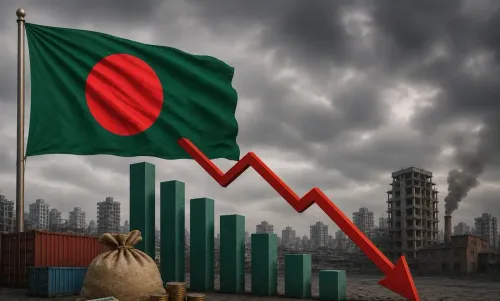
Bangladesh repaid more than twice the foreign loans it received in the first quarter of FY27 (July–September 2025), according to provisional data cited by a report, underscoring mounting pressure on the country's external finances. Total debt servicing reached $1.35 billion against foreign loan disbursements of just $662.31 million — a repayment-to-receipt ratio of approximately $2.04 for every dollar received.
Debt Servicing by the Numbers
According to provisional data from Bangladesh's Economic Relations Division (ERD), cited in a report by Dhaka-based The Business Standard, debt servicing rose 5.6% year-on-year from $1.28 billion in the same quarter of FY26. Principal repayments climbed to $858.92 million from $816.99 million, while interest payments increased to $492.31 million from $462.96 million.
Of the total funds disbursed during the quarter, $541.74 million arrived as loans and $110.57 million as grants, according to the same data.
Foreign Loan Disbursements Fall Sharply
Foreign loan disbursements dropped 42.3% year-on-year, falling from nearly $1.15 billion in Q1 FY26 to $662.31 million in Q1 FY27. The sharp contraction significantly narrows the government's access to external financing for development priorities at a time when repayment obligations are rising. This comes amid broader fiscal stress in Bangladesh, where revenue collection and budget implementation have faced persistent headwinds.
Economist Warns of Domestic Borrowing Risk
Economist Mustafa K Mujeri, executive director of the Institute for Inclusive Finance and Development (InM), said these dynamics are creating 'enormous financial pressure' on the government. He warned that if the authorities turn to domestic borrowing to fill the gap, the consequences could ripple through the broader economy.
According to Mujeri, increased borrowing from the central bank risks fuelling inflation, while heavier reliance on commercial banks could crowd out credit for private businesses — ultimately hurting investment and employment. He attributed the rising repayment burden to the volume of loans contracted in prior years, noting that the associated principal and interest obligations are legally binding: 'There is no scope to reduce or increase the repayment obligations,' he was quoted as saying.
Context and What to Watch
The data reflects a structural shift in Bangladesh's debt cycle — the country is now firmly in a repayment phase for loans taken during years of heavier external borrowing. Notably, the simultaneous drop in new disbursements and rise in outflows marks a rare double squeeze. Going forward, whether Bangladesh can negotiate accelerated disbursements from development partners or restructure portions of its obligations will determine how much fiscal space remains for growth spending.
Point of View
As Mujeri correctly flags, is fiscal substitution — replacing cheaper external debt with costlier, inflation-prone domestic borrowing. Mainstream coverage tends to report the headline number without tracing the second-order effects on private investment and employment, which are where ordinary Bangladeshis will feel this most acutely.
NationPress
28 Oct 2026
Frequently Asked Questions
How much did Bangladesh repay in foreign debt in Q1 FY27?
Bangladesh repaid $1.35 billion in principal and interest on foreign loans during July–September 2025 (Q1 FY27) , according to provisional data from the Economic Relations Division (ERD). This was more than double the $662.31 million in foreign loan disbursements received during the same period.
Why have Bangladesh's foreign loan disbursements fallen so sharply?
Foreign loan disbursements dropped 42.3% year-on-year to $662.31 million in Q1 FY27, down from nearly $1.15 billion in Q1 FY26. The decline reduces the government's access to external financing for development needs at a time when repayment obligations are simultaneously rising.
What risks does rising debt servicing pose to Bangladesh's economy?
Economist Mustafa K Mujeri of the Institute for Inclusive Finance and Development (InM) warned that the government may be forced to rely more on domestic borrowing to cover the shortfall. Borrowing from the central bank could fuel inflation, while heavier use of commercial banks could crowd out credit for private businesses, dampening investment and employment.
Can Bangladesh reduce its current repayment obligations?
According to Mujeri, the repayment obligations are contractually fixed and cannot be reduced or increased. The current burden reflects the volume of loans contracted with development partners in prior years, all of which must be repaid per agreed terms.
What was the breakdown of foreign funds received by Bangladesh in Q1 FY27?
Of the total $662.31 million disbursed to Bangladesh in Q1 FY27, $541.74 million came as loans and $110.57 million as grants, according to ERD provisional data.