Pakistan elite flee abroad as 1.87 million citizens migrate amid deepening crisis

Synopsis
A Centre for Peace Studies report reveals that Pakistan's ruling elite — bureaucrats, politicians, and military brass — are quietly securing exit routes abroad while over 1.87 million citizens have already migrated since 2024. With nearly 100 million trapped in poverty, Pakistan topping the Global Terrorism Index 2026, and the Senate gifting retired lawmakers lifetime blue passports, the gap between elite impunity and mass despair has rarely been so nakedly documented.
Key Takeaways
Over 1.87 million Pakistanis migrated between 2024 and 2026 ; more than 317,000 left for work abroad in the first half of 2026 alone.
More than 2,500 active federal officers hold dual nationality, with hundreds allegedly concealing foreign assets, per federal audits reported on 5 October .
Nearly 100 million Pakistanis are in acute multidimensional poverty, with up to 7.5 million rural citizens facing acute hunger, per the UNDP 2026 Global Multidimensional Poverty Index .
Pakistan topped the Global Terrorism Index 2026 for the first time, becoming the world's most terrorism-affected country.
The Punjab government under CM Maryam Nawaz Sharif acquired a Gulfstream G500 jet valued at $38–42 million , the report stated.
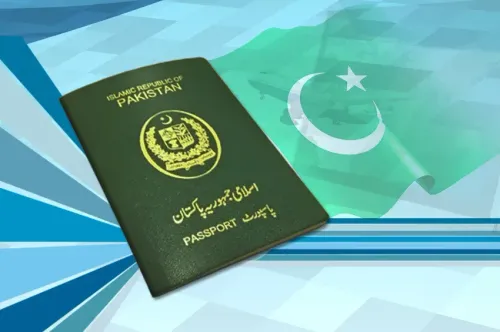
Pakistan's Senate passed the Passports (Amendment) Bill, 2026 on 19 October , granting retired lawmakers lifetime official blue passports.
Pakistan is experiencing a deepening national crisis as its ruling elite reportedly accumulates wealth and secures escape routes abroad, while nearly 100 million citizens remain trapped in acute multidimensional poverty, according to a report by the Centre for Peace Studies. The findings, authored by Imran Khurshid, Associate Research Fellow at the Centre, paint a stark picture of institutional decay, military dominance, and political misrule accelerating Pakistan's slide toward what the report describes as a 'breaking point.'
Scale of the Exodus
Official figures presented to Pakistan's National Assembly show that more than 317,000 Pakistanis left the country for employment abroad in just the first half of 2026 alone. Between 2024 and 2026, over 1.87 million citizens migrated, according to the report. The scale of departures signals not just an economic squeeze but a broader collapse of confidence in the state's ability to deliver stability or opportunity.
Federal audits reported on 5 October revealed that more than 2,500 active federal officers hold dual nationality, with hundreds of senior bureaucrats allegedly concealing foreign assets. Portugal has emerged as a preferred destination for Pakistan's elite, the report noted, with residency-by-investment schemes drawing high-ranking officials seeking a secure exit.
Elite Impunity and Political Response
Pakistan's own Defence Minister Khawaja Asif acknowledged the scale of the problem, stating: 'They [bureaucrats] prepared for this while they were employed by the Government of Pakistan, doing so under a deliberate plan. This raises questions about their commitment to their homeland and their jobs during their tenure.'
The report also highlighted that Pakistan's Senate passed the Passports (Amendment) Bill, 2026, on 19 October, permanently granting retired parliamentarians and senators the right to retain gratis official blue passports for life — a move critics argue entrenches elite privilege even as ordinary citizens face austerity driven by IMF conditions.
Separately, the government of Punjab Chief Minister Maryam Nawaz Sharif acquired a Gulfstream G500 private jet valued at between $38 million and $42 million, according to the report — a purchase that has drawn sharp scrutiny given the country's fiscal constraints.
Military's Role and Resource Extraction
The report is particularly pointed about the Pakistani military's economic footprint. 'The military makes enormous amounts of money by running Pakistan like a real estate company,' Khurshid wrote. Under General Asim Munir, the military is reportedly engaged in aggressive extraction of Khyber Pakhtunkhwa's rare-earth minerals and critical metals through the Special Investment Facilitation Council (SIFC) and the Frontier Works Organisation (FWO).
'This rapid resource exploitation allows the military to embezzle most of the profits, leaving the local population with nothing but environmental destruction, disease, and only a small fraction of the wealth,' the report stated. This comes amid violent insurgencies reportedly spanning Pakistan-occupied Kashmir (PoK), Khyber Pakhtunkhwa, Balochistan, and Sindh.
Poverty, Hunger, and Global Rankings
According to the UNDP 2026 Global Multidimensional Poverty Index, nearly 100 million Pakistanis are trapped in acute multidimensional poverty. Up to 7.5 million rural citizens are experiencing acute hunger. The report also noted that Pakistan has topped the Global Terrorism Index 2026 for the first time, becoming the world's most terrorism-affected country — a designation that compounds investor anxiety and diplomatic isolation.
Former Prime Minister Imran Khan remains detained at Adiala Jail, according to the report, as political polarisation deepens alongside the security and economic crises. The report's conclusion is unambiguous: 'A country cannot sustain itself indefinitely when its elite accumulates the means to escape while its citizens are denied the means to live with dignity.'
What Lies Ahead
The report offers no immediate resolution, and the structural forces it identifies — military economic dominance, elite capital flight, and IMF-imposed austerity borne by ordinary citizens — show few signs of abating. How Pakistan navigates its next IMF review, manages escalating internal insurgencies, and addresses the accountability deficit among its civil and military leadership will be closely watched by regional observers, including India.
Point of View
Federal audits, Senate votes. The pattern it describes is not novel, but the scale documented for 2024–2026 suggests acceleration rather than a chronic slow bleed. What is striking is the synchronicity: the Senate legislating lifetime passport privileges for retired lawmakers on 19 October while 100 million citizens live in acute poverty is not a contradiction — it is a system working exactly as designed. For India's strategic community, a Pakistan where the military doubles as a resource-extraction enterprise and the state loses its educated, mobile middle class is not a stable neighbour; it is a source of compounding regional risk.
NationPress
7 Nov 2026
Frequently Asked Questions
How many Pakistanis have migrated abroad between 2024 and 2026?
Over 1.87 million Pakistani citizens migrated between 2024 and 2026, according to official figures presented to Pakistan's National Assembly cited in the Centre for Peace Studies report. More than 317,000 of those departures occurred in the first half of 2026 alone for employment purposes.
What is the Centre for Peace Studies report about Pakistan?
The report, authored by Imran Khurshid, Associate Research Fellow at the Centre for Peace Studies, documents how Pakistan's ruling elite — bureaucrats, politicians, and military leadership — are accumulating wealth and securing exit routes abroad while ordinary citizens face poverty, hunger, and loss of institutional protection. It draws on official Pakistani government data, federal audits, and international indices.
Why has Pakistan topped the Global Terrorism Index 2026?
Pakistan topped the Global Terrorism Index 2026 for the first time, becoming the world's most terrorism-affected country, according to the report. The Centre for Peace Studies report attributes this in part to violent insurgencies across Pakistan-occupied Kashmir, Khyber Pakhtunkhwa, Balochistan, and Sindh.
What role does the Pakistani military play in the economic crisis?
According to the report, the Pakistani military under General Asim Munir is aggressively extracting rare-earth minerals and critical metals from Khyber Pakhtunkhwa via the Special Investment Facilitation Council (SIFC) and the Frontier Works Organisation (FWO), with the report alleging that most profits are embezzled, leaving local populations with environmental damage and little economic benefit.
What is the Passports (Amendment) Bill, 2026 passed by Pakistan's Senate?
Pakistan's Senate passed the Passports (Amendment) Bill, 2026 on 19 October, permanently granting retired parliamentarians and senators the right to retain gratis official blue passports for life. Critics argue the legislation entrenches elite privilege at a time when the government is imposing IMF-driven austerity measures on ordinary citizens.