Pakistan's 25 million out-of-school children: A self-inflicted economic crisis
Synopsis
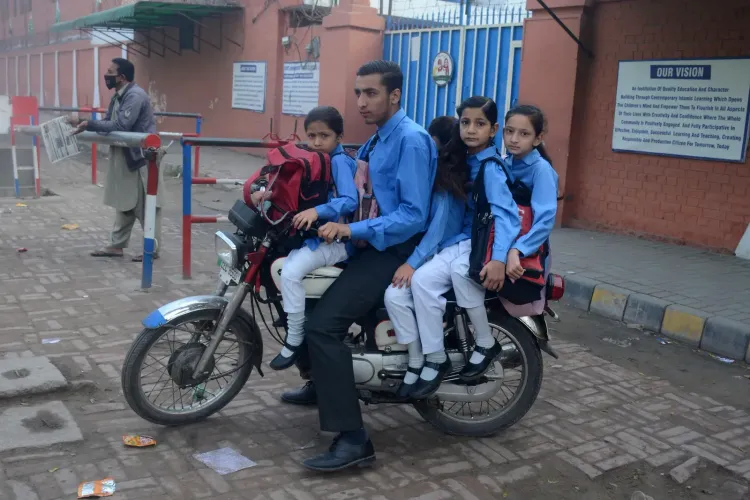
Pakistan has 25 million children out of school — a number matching Australia's entire population. With Balochistan at 64% non-enrollment and families spending up to PKR 30,000 just to enrol one child, analysts argue this is not bad luck but a structural, self-inflicted economic failure that compounds poverty across generations.
Key Takeaways
25 million children aged 5–16 years are out of school in Pakistan — roughly the population of Australia.
Balochistan has nearly 64% of school-age children not enrolled; Sindh stands at 47% .
Enrolling one child costs families between PKR 20,000 and PKR 30,000 , covering fees, books, uniform, shoes, and a bag.
A 40% shortage of new textbooks was reported in Pakistan's market in 2025 .
Parents allege rising costs are intentional, aimed at restricting low-income children to basic education only.
Analyst Waleed Rabbani describes the crisis as an 'economic self-inflicted wound' trapping families in a poverty-illiteracy cycle.
Pakistan is home to 25 million children aged 5 to 16 years who are not enrolled in school — a figure roughly equivalent to the entire population of Australia — making the country's out-of-school crisis one of the most severe in the world. According to an opinion piece published in The News International, this is not merely a social failure but an economic wound that Pakistan has, in effect, inflicted upon itself.
The Poverty-Illiteracy Trap
Writer Waleed Rabbani, in his analysis for The News International, described the crisis as a self-reinforcing cycle: poverty drives children out of classrooms, and the absence of education locks families into poverty for another generation. 'A child who never learns to read cannot fill out a job application. A girl kept home cannot become the nurse or entrepreneur her community needs,' Rabbani wrote, adding that research consistently shows each additional year of schooling raises individual earnings — returns that compound across households and generations.
Rabbani further noted that 'national averages mask brutal local realities,' pointing to a deep geographic unevenness that policymakers have historically lacked the data to address.
Provincial Disparities Paint a Grim Picture
The crisis is not uniformly distributed. Balochistan has nearly 64 per cent of its school-age children out of school, while Sindh records a figure of 47 per cent. These numbers highlight how provincial underdevelopment compounds the national average, and why centralised planning has repeatedly failed to close the gap.
Soaring Costs Price Out Low-Income Families
Families in Pakistan reported last month that enrolling a single child in school costs between PKR 20,000 and PKR 30,000, covering first-month fees, textbooks, notebooks, uniform, shoes, and a school bag. According to The Express Tribune, school uniforms cost around PKR 3,000, shoes range from PKR 2,500 to PKR 5,000, and a basic school bag starts at PKR 1,500. Larger notebooks and registers cost between PKR 120 and PKR 130, with rising paper costs pushing up prices across all stationery categories.
Compounding the problem, a 40 per cent shortage of new textbooks was reported in Pakistan's market this year, leaving parents scrambling even when they can afford to pay.
Parents Allege Systemic Exclusion of the Poor
Some parents have gone further, alleging that the escalating costs are not incidental but deliberate — designed, they contend, to restrict children from low-income households to only basic levels of education. Families have pointed out that education is free or heavily subsidised in many parts of the world, arguing that Pakistan has made schooling structurally inaccessible for its poorest citizens. Protests against rising education costs have been reported across the country.
What Needs to Happen Next
Rabbani's analysis underscores that solutions must be targeted at the local level rather than driven by national aggregates. Without granular, province-level data and a policy response that accounts for the cost burden on families, Pakistan risks deepening a crisis that is already costing it human capital on a generational scale. Observers note that without structural intervention — on both the supply side (schools, teachers, textbooks) and the demand side (affordability, incentives) — the 25 million figure is unlikely to fall meaningfully in the near term.
Point of View
Yet the policy response has remained trapped in the same cycle as the families it is supposed to help — reactive, aggregate, and underfunded. The Balochistan figure of 64% is not a statistic; it is a governance indictment. What is new in this cycle is the cost dimension: when enrolling one child requires PKR 20,000–30,000 upfront, the problem is no longer just about school availability — it is about whether the state has effectively priced its own citizens out of the constitutional right to education. The textbook shortage compounds this, suggesting supply-side failure at the most basic level. Without a provincial-level, cost-sensitive intervention framework, Pakistan will continue to report the same headline number a decade from now.
NationPress
23 Sept 2026
Frequently Asked Questions
How many children are out of school in Pakistan?
As of 2025, approximately 25 million children aged 5 to 16 years are not enrolled in school in Pakistan. This figure is comparable to the total population of Australia and represents one of the largest out-of-school populations in the world.
Which provinces in Pakistan have the highest out-of-school rates?
Balochistan has the highest rate, with nearly 64% of school-age children not enrolled. Sindh follows at 47%. These provincial figures are significantly higher than the national average, reflecting deep regional disparities in education access.
Why is enrolling a child in school so expensive in Pakistan?
Families in Pakistan reported last month that enrolling a single child costs between PKR 20,000 and PKR 30,000, covering first-month fees, textbooks, notebooks, uniform, shoes, and a school bag. Rising paper costs have also pushed up stationery prices, while a 40% textbook shortage has added further strain.
What is the link between Pakistan's education crisis and poverty?
Analyst Waleed Rabbani, writing in The News International, described the crisis as a self-reinforcing trap: poverty pulls children out of school, and lack of education reproduces poverty in the next generation. Research consistently shows that each additional year of schooling raises individual earnings, making the loss of schooling a long-term economic cost for households and the country.
What are parents and citizens saying about the cost of education in Pakistan?
Parents have alleged that rising school costs are not accidental but deliberate, designed to limit low-income children to only basic education. Protests against escalating education costs have been reported. Families have argued that while education is free or subsidised in many countries, Pakistan has made it structurally inaccessible for its poorest citizens.