Trump: Iran Must Never Have Nuclear Weapon, Enters Situation Room
Synopsis
President Trump declared on 29 May 2026 that Iran must agree to never possess a nuclear weapon or bomb, and announced he was entering the Situation Room to make a 'final determination' — signalling a potential inflection point in US-Iran nuclear diplomacy.
Key Takeaways
Trump stated on 29 May 2026 that Iran 'must agree that they will never have a Nuclear Weapon or Bomb.' Trump announced he was proceeding to the Situation Room to make a 'final determination,' indicating an active national security deliberation.
The statement revives Trump 's maximum pressure posture from his first term, when he withdrew the US from the JCPOA in 2018 .
The Situation Room is the White House 's secure facility used for real-time crisis decision-making by the President and senior national security officials.
Any outcome from this meeting could have direct implications for India 's energy imports, the Chabahar corridor, and broader West Asian stability.
Formal readouts from the meeting and responses from the IAEA and P5+1 capitals are awaited.
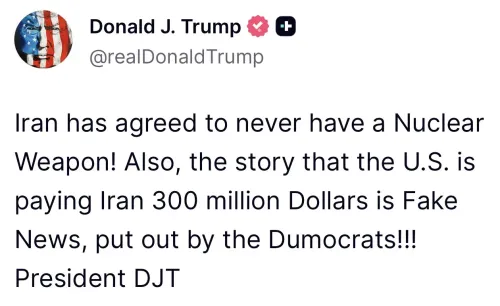
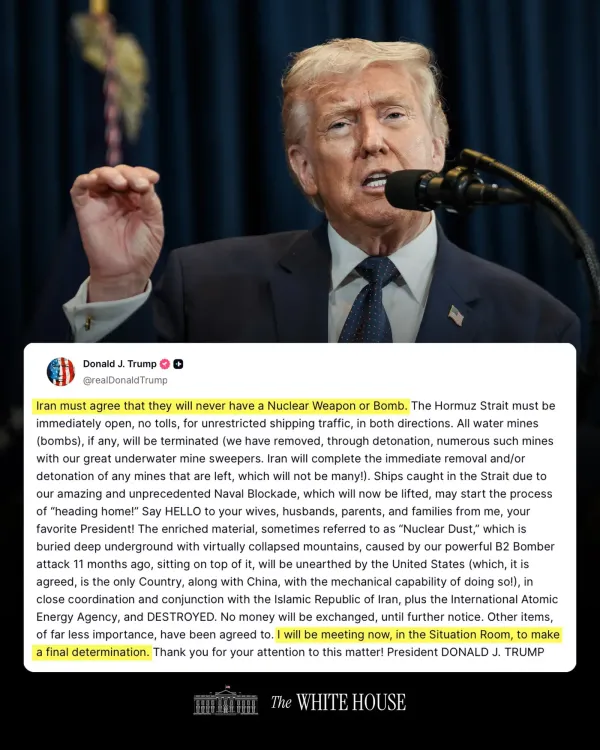
Washington DC, 29 May 2026 — The White House on Friday quoted President Donald J. Trump as declaring that Iran 'must agree that they will never have a Nuclear Weapon or Bomb,' and announced that he was proceeding to the Situation Room to make what he described as a 'final determination' on the matter.
Context
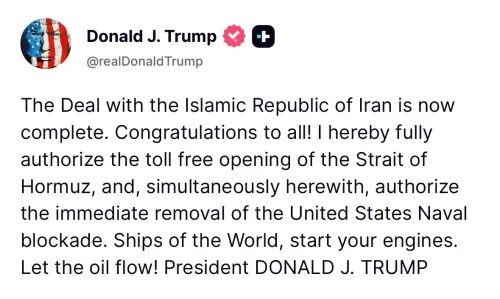
The statement, posted on the official White House account, carries direct language from President Trump himself. Quoting him verbatim, the post reads: 'Iran must agree that they will never have a Nuclear Weapon or Bomb... I will be meeting now, in the Situation Room, to make a final determination.' The invocation of the Situation Room — the White House's secure crisis-management facility — signals that the administration regards the current Iran nuclear situation as an active national security matter requiring immediate high-level deliberation.
The Situation Room is reserved for real-time decision-making during crises and is typically convened with the President's senior national security team, including the National Security Advisor, Secretary of State, Secretary of Defense, and intelligence chiefs.
Policy Backdrop
During his first term, President Trump withdrew the United States from the Joint Comprehensive Plan of Action (JCPOA) — the 2015 multilateral nuclear agreement between Iran and six world powers — and reimposed sweeping economic sanctions under a 'maximum pressure' strategy. The JCPOA had placed verifiable limits on Iran's uranium enrichment in exchange for sanctions relief.
In January 2020, the US carried out a drone strike that killed Iranian Quds Force commander Qasem Soleimani, sharply escalating tensions between the two countries. Iran's nuclear enrichment activities have been under international monitoring since the early 2000s, and successive US administrations of both parties have maintained the core objective of preventing Tehran from acquiring nuclear weapons through a combination of sanctions, diplomacy, and military deterrence.
Trump's current statement revives the unilateral pressure posture of his earlier term while aligning with the broader, bipartisan American non-proliferation objective. It comes against a backdrop of periodic spikes in US-Iran confrontation tied to enrichment levels, proxy conflicts in the region, and longstanding Israeli security concerns over Iran's nuclear ambitions.
Stakeholders and Impact
US national security officials, Iranian leadership, and regional allies are the immediate stakeholders. For India, which maintains significant energy and trade ties with Iran while also deepening its strategic partnership with the United States, any escalation in the US-Iran standoff carries direct implications — from oil supply chains to the operability of the Chabahar Port corridor.
Allies in the Gulf, Europe, and Israel will be closely watching any readout from the Situation Room meeting for signals about whether the US is moving toward a diplomatic ultimatum, fresh sanctions, or a more kinetic option. The International Atomic Energy Agency (IAEA) and P5+1 capitals are also expected to respond to any formal announcement.
What's Next
The administration has not yet released a formal readout from the Situation Room meeting referenced in President Trump's statement. Observers will watch for any subsequent executive orders, diplomatic communications to Tehran, or statements from the IAEA and allied governments that may clarify the 'final determination' Trump alluded to.
The framing of a 'final determination' suggests the White House may be at a decision point between escalating diplomatic pressure and other measures — a juncture that could reshape the geopolitical landscape across West Asia and reverberate through global energy markets.
Point of View
A tactic he employed extensively in his first term. The phrase 'final determination' is notably loaded: it implies a decision threshold has been reached, raising the stakes beyond routine diplomatic posturing. For the broader non-proliferation architecture, the statement underscores that the US remains committed to keeping Iran non-nuclear regardless of the diplomatic vehicle — JCPOA or otherwise. The timing and framing will be parsed carefully in Tehran, Jerusalem, Riyadh, and New Delhi as a potential precursor to either a coercive deal or a sharper confrontation.
NationPress
20 Sept 2026
Frequently Asked Questions
What did Trump say about Iran's nuclear programme on 29 May 2026?
President Trump stated that Iran 'must agree that they will never have a Nuclear Weapon or Bomb' and said he was entering the Situation Room to make a 'final determination' on the matter.
What is the White House Situation Room?
The Situation Room is a secure facility inside the White House used by the President and senior national security officials for real-time crisis management and high-stakes decision-making.
What is the JCPOA and why did Trump leave it?
The JCPOA, signed in 2015, was a multilateral agreement that limited Iran's nuclear enrichment in exchange for sanctions relief. President Trump withdrew the US from the deal in 2018, arguing it was insufficient, and reimposed broad economic sanctions on Iran.
How does the US-Iran nuclear standoff affect India?
India has significant energy and trade ties with Iran, including the strategic Chabahar Port corridor. Any escalation in US-Iran tensions can affect Indian oil imports, trade routes, and its balancing act between Washington and Tehran.
What happens after Trump's Situation Room meeting on Iran?
No formal readout has been released yet. Observers are watching for executive orders, diplomatic communications to Tehran, or statements from the IAEA and allied governments that would clarify the 'final determination' Trump referenced.