White House Says Walmart to Cut Prices Sharply
Synopsis
The White House quoted President Trump on 6 July 2026 announcing that Walmart, America's largest retailer, will lower prices significantly. The post frames the move as a product of the administration's trade and economic agenda, with CPI data and earnings reports set to test the claim.
Key Takeaways
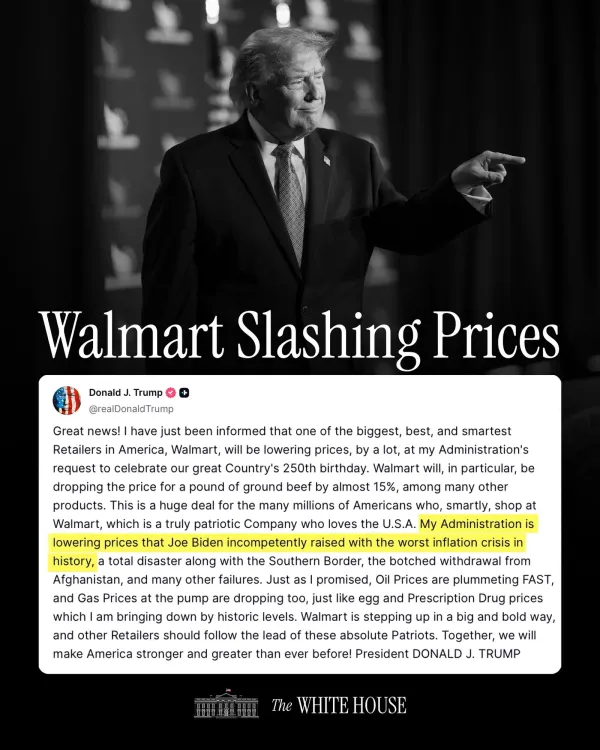
President Trump announced on 6 July 2026 that Walmart will lower prices 'by a lot,' according to a White House post on X.
Walmart is the largest private employer and retailer in the United States , making its pricing decisions a major consumer-cost indicator.
The White House framed the announcement as a direct outcome of the administration's tariff and economic pressure strategy.
The administration's economic toolkit includes the Tax Cuts and Jobs Act (2017) and tariffs on Chinese imports first imposed in 2018-2019 .
Upcoming US CPI releases and Walmart quarterly earnings will be the key data points to verify whether the price cuts materialise at scale.
The move could pressure competing retailers and affect global supply chains, including Indian exporters supplying Walmart .
The White House, the official communications account of the Executive Office of the President of the United States, posted on X on Monday, 7 July 2026, quoting President Donald J. Trump announcing that retail giant Walmart will be lowering prices 'by a lot.' The post frames the development as a direct outcome of the administration's economic agenda.
Context
In the post, President Trump stated: 'Great news! I have just been informed that one of the biggest, best, and smartest Retailers in America, Walmart, will be lowering prices, by a lot... Together, we will make America stronger and greater than ever before!' The announcement was shared widely on the evening of 6 July 2026 (US time), accompanied by an image.
Walmart is the largest private employer and retailer in the United States, making its pricing decisions a significant bellwether for American household costs. Any broad-based price reduction by the chain would affect tens of millions of consumers who shop there weekly.
Policy Backdrop
The announcement fits a pattern established across both of Trump's terms of publicly crediting private-sector price moves to presidential trade and economic pressure. During his 2024 campaign, Trump repeatedly pledged to bring down grocery and retail prices through renewed tariff policy and direct engagement with large retailers.
The administration's broader economic toolkit has included the Tax Cuts and Jobs Act of 2017, which was framed as spurring domestic investment and wage growth, as well as tariffs on Chinese imports first imposed in 2018-2019 and expanded in the second term. The White House has consistently argued that this combination of trade pressure and deregulation creates conditions for lower consumer costs.
The second-term White House has made a practice of amplifying corporate commitments — whether on hiring, investment, or pricing — as validation of its economic strategy, particularly ahead of key inflation data releases.
Stakeholders and Impact
American consumers, especially lower- and middle-income households that rely heavily on Walmart for everyday essentials, stand to benefit most directly if the price cuts are broad and sustained. Walmart's scale means its pricing decisions ripple through competing retailers, potentially prompting wider market-level adjustments.
Retail supply chains — many of which source goods from China and other import-heavy corridors — will be closely watched to understand how Walmart absorbs or passes on the cost of existing tariffs while simultaneously cutting shelf prices. Suppliers and smaller competing retailers could face margin pressure if Walmart uses its purchasing power to force down wholesale costs.
For Indian exporters and global supply chain participants, any structural shift in how Walmart sources and prices goods carries downstream implications for trade volumes and contract negotiations.
What's Next
Upcoming monthly US Consumer Price Index (CPI) releases will be the first objective measure of whether announced price cuts are feeding into broader inflation data. Walmart's quarterly earnings reports will offer further detail on the scope, categories, and duration of any price reductions.
Congressional deliberations on new tariff legislation could further shape the import-cost environment that underpins retail pricing. If the Walmart move is followed by similar announcements from other major chains, it could become a defining data point in the administration's economic narrative heading into the second half of 2026.
Point of View
The administration signals direct corporate engagement, a tactic it has used since the first term to create political momentum around cost-of-living promises. The move puts Walmart in a delicate position: publicly associated with a presidential win, the retailer now faces consumer and investor expectations it must manage carefully. Whether the cuts prove durable or narrow in scope will shape the credibility of the White House's broader inflation narrative in the second half of 2026.
NationPress
5 Oct 2026
Frequently Asked Questions
Why did Trump announce Walmart price cuts?
President Trump stated he was 'just informed' that Walmart would lower prices significantly, and the White House framed the move as a result of the administration's trade and economic policies. No further details on the specific commitment were provided in the post.
Which products will Walmart reduce prices on?
The White House post did not specify which product categories would see price reductions. Details are expected to emerge through Walmart's own communications and upcoming quarterly earnings reports.
How does Walmart's price cut affect Indian exporters?
Walmart sources a significant volume of goods from global supply chains, including Indian manufacturers. Any structural shift in how Walmart prices or sources products could affect order volumes and contract terms for Indian suppliers.
Will other US retailers also cut prices?
The White House post referred only to Walmart. However, given Walmart's scale and market influence, competing retailers often adjust pricing in response to moves by the chain, which could prompt broader market-level changes.
When will we know if Walmart's price cuts are real?
Upcoming US Consumer Price Index releases and Walmart's quarterly earnings reports will be the primary data points to assess whether the announced price reductions materialise at scale and are sustained over time.