US Issues Strong Warning to Iran Amid Naval Blockade
Synopsis
In a significant escalation, the US has enforced a sweeping naval blockade against Iran, warning it to choose wisely. Defence Secretary Pete Hegseth confirmed that American forces are prepared for military action if necessary, signaling a critical moment in regional tensions.
Key Takeaways
US Naval Blockade: A sweeping blockade is enforced against Iran.
Military Preparedness: US forces are ready to escalate actions if needed.
Geopolitical Impact: Significant implications for global energy supplies.
Ceasefire Status: A fragile ceasefire currently exists.
Regional Partnerships: US maintains strong alliances with Middle Eastern countries.
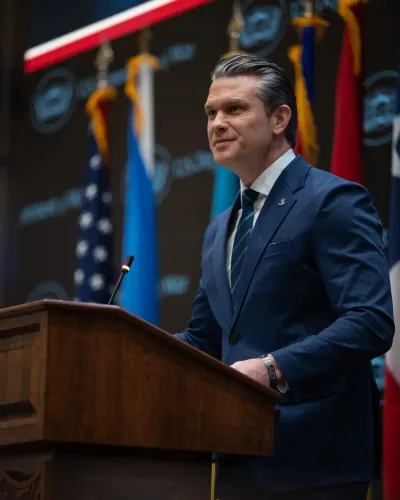
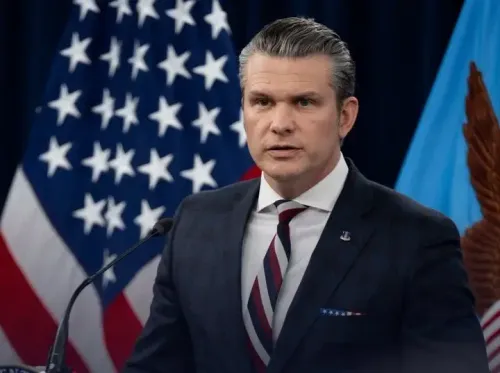
Washington, April 16 (NationPress) The United States issued a strong advisory to Iran on Thursday, urging it to “make prudent decisions” as it implemented an extensive naval blockade. Defence Secretary Pete Hegseth emphasized that American military forces are currently “ready and prepared” to escalate military operations if necessary.
During a Pentagon briefing, Hegseth was accompanied by Air Force General Dan Caine, the Chairman of the Joint Chiefs of Staff, and Admiral Bradley Cooper, who is in charge of US Central Command (CENTCOM) overseeing military activities in the Middle East.
This situation is of particular interest to India due to its reliance on Gulf energy resources and the critical importance of the Strait of Hormuz, a vital maritime route for global oil transportation.
Hegseth stated that the blockade affecting Iranian ports is already operational and could remain in place indefinitely. “Your energy is immobilized and will remain so; we can maintain this for an extended period,” he noted, categorizing it as “a diplomatic approach to the situation.”
He delivered a direct message to Iran’s military authorities, asserting that US forces are monitoring ground movements and maintain the capability to target essential infrastructure. “We are prepared to act on your critical dual-use facilities… we hope it won’t come to that, but we are ready,” he stated.
This warning is issued amidst a precarious ceasefire that has temporarily halted major combat, following what US officials labeled as Operation Epic Fury. Caine affirmed that US forces are poised “to resume significant combat operations at a moment’s notice.”
He provided insights into the blockade, indicating it encompasses all vessels traveling to or from Iranian ports, regardless of their nationality. The enforcement extends into Iran’s territorial waters as well as international waters, backed by naval, aerial, and intelligence capabilities.
US officials reported that vessels attempting to violate the blockade have been cautioned and redirected. “Do not attempt to breach the blockade… vessels will be subject to boarding for interdiction and seizure,” read a standard communication to ships.
As per military reports, 13 vessels have already altered their course. Officials note that no ship has yet prompted a confrontation requiring boarding or seizure.
Despite the cessation of hostilities, Hegseth remarked that Iran’s command and control capabilities have been significantly diminished. “Their communication, surveillance, and detection abilities are at an unprecedented low,” he observed, while acknowledging Tehran's strong incentives to uphold the ceasefire.
Cooper indicated that US forces across the Middle East remain highly motivated, utilizing this ceasefire window to enhance their preparedness. “We’re rearming, reconfiguring, and modifying our strategies,” he explained.
He also referenced a wide network of regional allies, including Bahrain, Saudi Arabia, Qatar, and the UAE, as “exceptional partners” in joint operations and regional defense.
Cooper highlighted the integration of advanced technologies in recent operations, including artificial intelligence for processing extensive battlefield data. “Humans are always involved in the decision-making process,” he emphasized, ensuring control over critical decisions.
Officials underscored the challenges of enforcing the blockade in crowded waters, with Caine likening operations to “maneuvering a sports car through a supermarket parking lot on a busy weekend.”
Hegseth reiterated that Washington favors a diplomatic solution but cautioned of repercussions should negotiations falter. “We prefer a peaceful resolution… or we can pursue a more forceful approach,” he concluded.
Point of View
The situation warrants serious attention due to its potential ramifications on geopolitical stability. The US's assertive posture towards Iran reflects broader strategic interests in the region and raises questions about the future of diplomatic relations and energy security.
NationPress
19 Sept 2026
Frequently Asked Questions
What prompted the US naval blockade against Iran?
The US enforced a naval blockade against Iran as a response to escalating tensions and military threats, aimed at restricting Iranian energy exports and military movements.
How long can the US maintain the blockade?
According to Defence Secretary Pete Hegseth, the blockade is currently in effect and can be sustained indefinitely.
What are the implications of the blockade for global oil supplies?
The blockade affects the Strait of Hormuz, a crucial maritime corridor for oil shipments, which may lead to disruptions in global energy supplies.
What military readiness measures are being taken by US forces?
US forces are enhancing their readiness during the ceasefire, rearming, retooling, and adjusting tactics in preparation for any escalation.
What is the current state of US-Iran relations?
US-Iran relations remain tense, with the US warning Iran amid a fragile ceasefire, highlighting the potential for renewed conflict.