White House Backs Tax-Energy Link via Rep. Mackenzie Post

Synopsis
The White House on 8 July 2026 amplified a post by Rep. Mackenzie arguing that the Working Families Tax Cuts — rooted in the 2017 Tax Cuts and Jobs Act — directly enabled the restoration of American Energy Dominance through expanded domestic fossil fuel production and LNG exports.
Key Takeaways
The White House reshared Rep.
Mackenzie's commentary on 8 July 2026 linking tax policy to U.S. energy output.
The Working Families Tax Cuts reference points to provisions of the Tax Cuts and Jobs Act , enacted in December 2017 .
The TCJA cut the corporate tax rate from 35 percent to 21 percent and introduced immediate capital expensing for energy investments.
U.S. crude oil and natural gas production reached record levels by 2019 , a milestone Republicans attribute partly to the 2017 tax law.
Key TCJA provisions — including 100 percent bonus depreciation — reduced upfront costs for oil and gas firms expanding capacity.
Several TCJA provisions are set to expire after 2025 , making their extension a live Congressional priority.
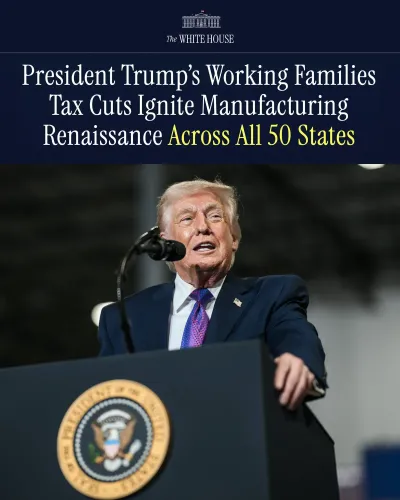
The White House, the official communications account of the Executive Office of the President of the United States, on Wednesday, 8 July 2026, reshared a post by Representative Mackenzie arguing that the Working Families Tax Cuts played a central role in restoring American Energy Dominance.
Context
The White House amplified Representative Mackenzie's commentary, which draws a direct line between tax legislation and the expansion of domestic energy output. The post carries the headline: 'How The Working Families Tax Cuts Helped Restore American Energy Dominance' — framing lower taxes as a catalyst for the United States becoming a net energy exporter.
The reference to Working Families Tax Cuts points to provisions within the Tax Cuts and Jobs Act (TCJA), enacted in December 2017, which lowered the corporate tax rate from 35 percent to 21 percent and introduced immediate expensing for capital investments in sectors including energy.
Policy Backdrop
The American Energy Dominance policy, a signature posture of the Trump administration, centred on expanding domestic fossil fuel production, boosting liquefied natural gas (LNG) exports, and rolling back regulatory constraints on drilling and pipeline development. Supporters of the policy have repeatedly cited the TCJA as a financial enabler of that expansion.
By 2019, U.S. crude oil and natural gas output had reached record levels, a milestone that Republican communications have consistently attributed, at least in part, to the investment incentives unlocked by the 2017 tax overhaul. The White House's decision to amplify Representative Mackenzie's piece continues a pattern of using third-party commentary to reinforce this policy narrative.
Key provisions relevant to the energy sector included 100 percent bonus depreciation for capital equipment purchases, which reduced the upfront cost burden for oil and gas firms investing in new drilling capacity and infrastructure.
Stakeholders and Impact
The primary beneficiaries cited in this framing are energy producers, oil and gas firms, and working families — the latter invoked through the name of the tax legislation itself. Proponents argue that energy sector growth translates into jobs, lower fuel costs, and broader economic activity that reaches household level.
Critics of this framing have historically noted that energy output growth during this period was also driven by technological advances in hydraulic fracturing and horizontal drilling, as well as global commodity price dynamics — factors independent of the tax changes. The debate over causation versus correlation in the tax-energy nexus remains active in policy circles.
What's Next
Congressional attention is now focused on whether to extend or modify the TCJA's individual and business provisions, several of which are scheduled to expire after 2025. The outcome of those deliberations will determine whether the investment incentives credited with spurring energy-sector activity remain in place.
Alongside the tax debate, any new permitting reforms or LNG export policy proposals from the administration are expected to shape the next chapter of the American Energy Dominance agenda. The White House's continued amplification of this narrative signals that the tax-energy connection will remain a central talking point heading into that legislative fight.
Point of View
Such as fuel prices and energy jobs. For Indian observers, the stakes are significant: U.S. energy export policy directly affects global LNG supply chains and crude benchmarks that India depends on. Whether Congress ultimately extends the TCJA's business provisions will be a key variable shaping American energy investment — and, by extension, global energy markets — through the late 2020s.
NationPress
7 Oct 2026
Frequently Asked Questions
What are the Working Families Tax Cuts?
The Working Families Tax Cuts refer to provisions within the Tax Cuts and Jobs Act of 2017 that lowered individual and corporate tax rates and introduced investment incentives such as immediate expensing of capital equipment, aimed at benefiting households and businesses.
How did the 2017 tax law affect U.S. energy production?
The TCJA reduced the corporate tax rate from 35 percent to 21 percent and allowed 100 percent bonus depreciation on capital investments, lowering costs for oil and gas firms. U.S. crude and natural gas output reached record levels by 2019 , though analysts note technological and market factors also contributed.
What is American Energy Dominance?
American Energy Dominance is a U.S. federal policy posture, prominent during the Trump administration , that prioritises expanding domestic fossil fuel production, boosting LNG exports, and reducing regulatory barriers to achieve and maintain net-exporter status.
Why is the White House sharing Rep. Mackenzie's post?
The White House is amplifying the commentary as part of a broader communications strategy to reinforce the narrative that Republican tax policy delivered concrete economic results — particularly in the energy sector — ahead of Congressional debates over extending expiring TCJA provisions.
When do the TCJA tax provisions expire?
Several key individual and business provisions of the Tax Cuts and Jobs Act are scheduled to expire after 2025 , making their extension or modification a major item on the Congressional legislative agenda.