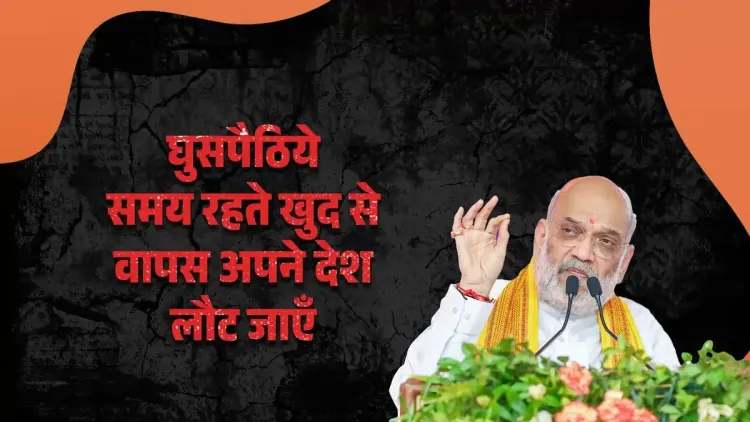
Amit Shah Warns Infiltrators to Leave India Voluntarily
Synopsis
Union Home Minister Amit Shah issued a direct public warning on 28 May 2026, telling illegal immigrants in India to return to their home countries voluntarily 'while there is still time.' The statement intensifies the BJP government's long-standing push on border security, NRC implementation, and deportation of undocumented migrants.
Key Takeaways
Amit Shah issued a direct public warning to illegal immigrants on 28 May 2026 , urging them to return home voluntarily.
The warning is rooted in the BJP government's citizenship architecture, anchored by the NRC (Assam, 2019) and the Citizenship Amendment Act, 2019 .
The Assam Accord of 1985 set 24 March 1971 as the legal cut-off for identifying foreigners in Assam.
Illegal immigration from Bangladesh into Assam and West Bengal is the primary policy flashpoint driving the statement.
The Home Ministry oversees an ongoing India-Bangladesh border fencing programme to check unauthorised crossings.
Follow-up enforcement action — including fresh deportation drives and state-level verification exercises — is anticipated.
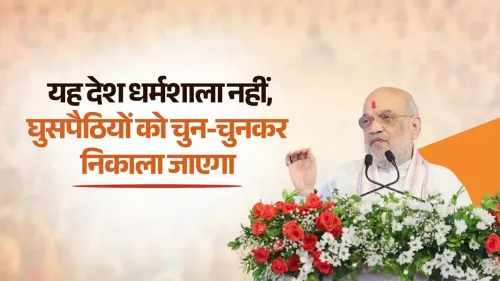
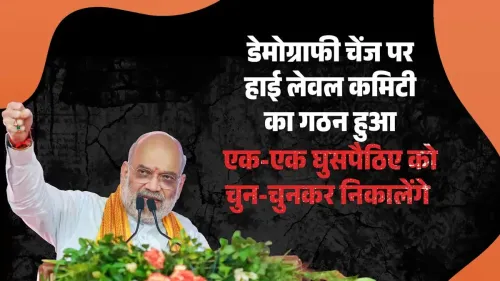
Union Home Minister Amit Shah issued a stern public warning to illegal immigrants on Thursday, 28 May 2026, telling them to return to their home countries on their own before it is too late. The statement, posted on his official X account, signals a sharp escalation in the government's rhetoric on cross-border infiltration.
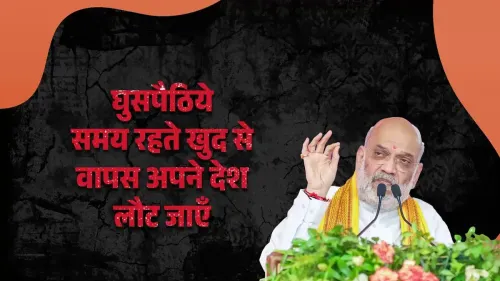
In the post, Shah said in Hindi: 'Main ghuspaiṭhiyoṃ se kahna chahta hūṃ ki samay rahte khud se apne desh wapas laut jao' — 'I want to tell infiltrators that while there is still time, return to your own country on your own.'
Context
The warning comes against the backdrop of a long-standing political and security debate in India over illegal immigration, particularly from Bangladesh into border states such as Assam and West Bengal. The Assam Accord of 1985 established 24 March 1971 as the legal cut-off date for identifying foreigners in the state. Successive governments have grappled with implementation, but the issue has intensified under BJP-led administrations.
Shah, as Home Minister, is the cabinet officer directly responsible for internal security, border management, and citizenship policy. His public address to infiltrators — framed as a personal warning — is unusual in its directness and carries the weight of the ministry's enforcement machinery.
Policy Backdrop
The National Register of Citizens (NRC), whose final list for Assam was published in 2019, was designed to separate citizens from undocumented residents. The exercise identified approximately 19 lakh individuals whose citizenship status required further adjudication. The process remains legally contested and administratively incomplete.
The Citizenship Amendment Act (CAA), 2019 created a parallel track by offering expedited citizenship to non-Muslim migrants from Pakistan, Bangladesh, and Afghanistan who entered India before 31 December 2014. Together, the NRC and CAA form the legislative spine of the BJP government's citizenship architecture. Shah has been the principal architect and defender of both measures.
The Home Ministry has also overseen an ongoing border-fencing programme along the India-Bangladesh frontier, with hundreds of kilometres of smart fencing sanctioned in recent years to check unauthorised crossings.
Stakeholders and Impact
The statement directly addresses undocumented migrants living in India, particularly those from Bangladesh, and is likely to reverberate in Assam, West Bengal, Tripura, and other northeastern states where the issue has acute electoral and demographic salience. Civil society groups and opposition parties have consistently argued that broad-brush immigration drives risk targeting long-settled communities and religious minorities.
State governments in West Bengal and parts of the Northeast have at times been at odds with the Centre over the pace and methodology of detection-and-deportation drives. Shah's warning may presage renewed coordination demands on state administrations to step up verification exercises.
What's Next
The Home Ministry is expected to follow up with operational directives to state police forces and border-guarding agencies. Possible next steps include fresh deportation drives, intensified NRC-linked proceedings in Assam, or a push to extend NRC-style exercises to other border states. Parliamentary proceedings in the upcoming session are likely to see opposition demands for specifics on timelines and due-process safeguards.
The statement marks a clear signal that illegal immigration will remain a central plank of the BJP government's governance and electoral messaging heading into the next political cycle.
Point of View
Direct-address framing — speaking 'to infiltrators' rather than about them — is a calculated rhetorical move that bypasses bureaucratic language and lands as a political signal. It reinforces the BJP's consistent positioning on illegal immigration as an existential security and demographic issue, particularly salient in Assam and West Bengal. The statement also functions as pressure on state governments, especially those not governed by the BJP, to align with Centre-driven enforcement. Timed outside any announced policy event, it suggests the party is keeping immigration at the top of its governance agenda ahead of the next electoral cycle.
NationPress
11 Oct 2026
Frequently Asked Questions
What did Amit Shah say about illegal immigrants in May 2026?
Amit Shah warned illegal immigrants in India to return to their home countries voluntarily 'while there is still time,' posting the message on his official X account on 28 May 2026.
Which country are most illegal immigrants in India said to be from?
Government statements and policy documents most frequently cite Bangladesh as the primary source of illegal immigration into India, particularly into Assam and West Bengal.
What is the NRC and how does it relate to illegal immigration?
The National Register of Citizens (NRC) is a registry exercise carried out in Assam whose final list was published in 2019 to distinguish citizens from undocumented residents; it is the main administrative tool for detecting illegal immigrants in the state.
What is the Citizenship Amendment Act and who does it cover?
The Citizenship Amendment Act, enacted in 2019, fast-tracks Indian citizenship for non-Muslim migrants from Pakistan, Bangladesh, and Afghanistan who entered India before 31 December 2014.
Can illegal immigrants be deported from India?
Yes, under Indian law, individuals identified as illegal immigrants through judicial or administrative processes can be detained and deported; the Home Ministry coordinates these operations with state police and border-guarding agencies.