Assam CM Office: Tap Water Homes Jump from 1.11L to 58.97L
Synopsis
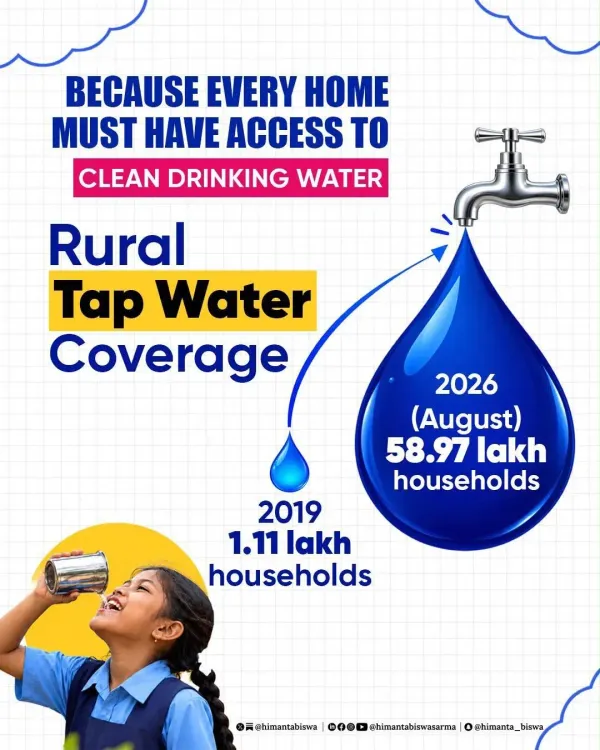
Assam's rural tap water coverage has grown from 1.11 lakh to 58.97 lakh households as of August 2026, the Chief Minister's Office announced, marking a 53-fold expansion under the Centre's Jal Jeevan Mission.
Key Takeaways
Assam's rural tap water connections have grown from 1.11 lakh to 58.97 lakh households — a roughly 53-fold increase.
The figure reflects progress recorded as of August 2026 and was announced by the Chief Minister's Office of Assam on October 23, 2026.
The expansion is part of the Jal Jeevan Mission , the Central government scheme launched in 2019 targeting universal rural tap water coverage.
The scheme replaced the older National Rural Drinking Water Programme under the Har Ghar Jal framework.
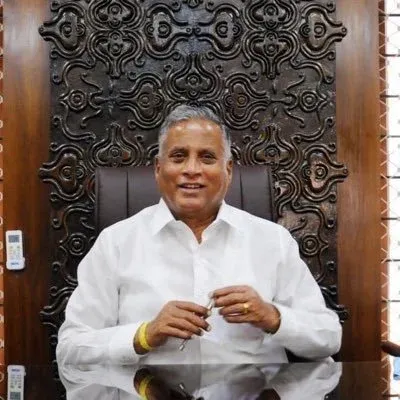
Chief Minister Himanta Biswa Sarma , in office since May 2021 , has made rural infrastructure a stated priority of his administration.
Future verification of functional water flow — beyond pipeline installation — will be tracked through the Ministry of Jal Shakti 's JJM dashboard.
From a baseline of just 1.11 lakh rural households, Assam has scaled tap water connections to 58.97 lakh rural households — a transformation that reaches deep into the state's villages and redraws what daily life looks like for millions of families. The Chief Minister's Office of Assam shared the milestone figure, citing progress recorded as of August 2026, in a post on X on Friday, October 23, 2026.
A 53-times surge: what the numbers actually mean
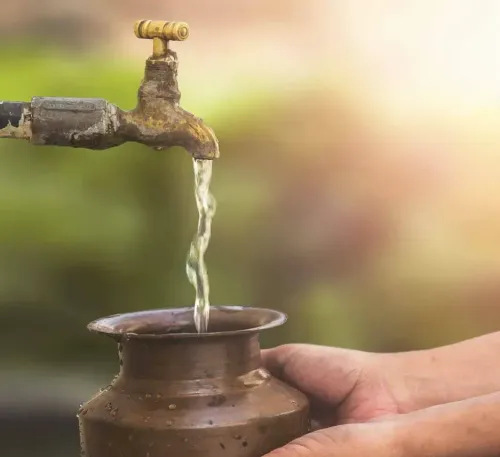
The jump from 1.11 lakh to 58.97 lakh households represents a roughly 53-fold increase in tap water coverage across Assam's rural belt. For context, that scale of expansion means tens of thousands of women who once walked to distant water sources now have a tap inside or right outside their homes. Clean water at the point of need is not a comfort — it is a public-health intervention. Waterborne diseases, child nutrition, and the burden on working-age women are all directly downstream of that single metric.
Jal Jeevan Mission: the policy engine behind Assam's expansion
The drive sits squarely inside the Jal Jeevan Mission (JJM), the Central government scheme launched in 2019 that replaced the older National Rural Drinking Water Programme with a singular, measurable goal: a functional household tap connection for every rural home in India under the banner Har Ghar Jal ('water in every home'). States report coverage figures periodically to the Ministry of Jal Shakti's JJM dashboard, which has become the primary national scorecard for this effort.
Chief Minister Himanta Biswa Sarma, who has led the Government of Assam since May 2021, has positioned rural infrastructure delivery — roads, water, housing — as a central pillar of the state's development agenda. The August 2026 figure is the latest data point in that trajectory.
What Assam's progress signals for the northeast
Assam is the gateway state of India's northeast — geographically large, demographically diverse, and historically among the more challenging terrains for last-mile infrastructure delivery. A coverage number approaching 59 lakh rural connections signals not just administrative reach but the logistical capacity to lay pipeline networks through flood plains, riverine islands, and hilly terrain that characterise much of the state. Whether that scale translates into sustained functional connections — water flowing, not just pipes laid — will be the question the next round of JJM dashboard updates will need to answer.
Point of View
And it tells voters that the Sarma government's infrastructure push is measurable. The gap between 'connections provided' and 'water actually flowing' — a distinction the JJM dashboard itself tracks — is where the mission's credibility will ultimately be tested. For the northeast more broadly, Assam's trajectory matters because it sets a benchmark; if a flood-prone, logistically complex state can achieve this scale, it raises expectations for its neighbours. The next critical data point is not another coverage number but a functionality audit.
NationPress
23 Oct 2026
Frequently Asked Questions
How many rural households in Assam have tap water connections as of 2026?
As of August 2026 , 58.97 lakh rural households in Assam have tap water connections, up from a baseline of 1.11 lakh .
What is the Jal Jeevan Mission and how does it relate to Assam's tap water progress?
The Jal Jeevan Mission is a Central government scheme launched in 2019 to provide functional tap connections to all rural households in India. Assam's expansion of coverage to 58.97 lakh homes is part of this nationwide rollout.
What is Har Ghar Jal?
Har Ghar Jal means 'water in every home' — it is the core objective of the Jal Jeevan Mission , which aims to ensure every rural household in India has a functional household tap connection.
Who is responsible for implementing Jal Jeevan Mission in Assam?
The Government of Assam , led by Chief Minister Himanta Biswa Sarma since May 2021 , is responsible for state-level execution of the Jal Jeevan Mission in coordination with the Ministry of Jal Shakti .
How is Jal Jeevan Mission progress tracked across India?
Progress is tracked through the Ministry of Jal Shakti 's JJM dashboard, where states report household connection figures periodically, covering both connections provided and functional water supply status.