Assam CM Himanta Outlines UCC Live-In Rights for Women
Synopsis
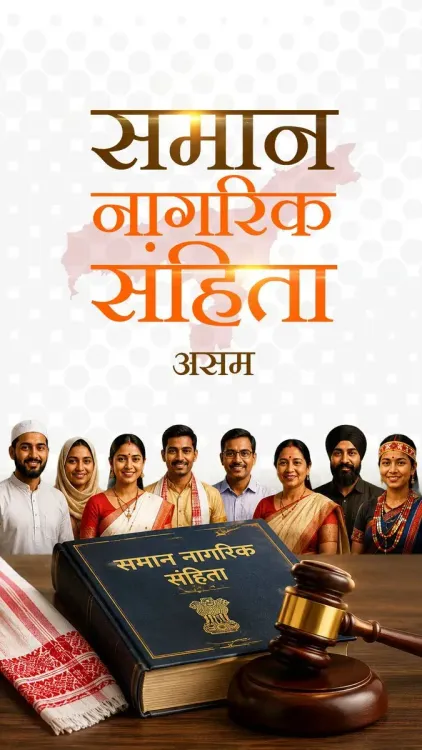
Assam Chief Minister Himanta Biswa Sarma on June 5, 2026 underscored a provision of the state's Uniform Civil Code that legally defines rights and responsibilities in live-in relationships, promising clear entitlements for women and a secure legal future for children from such unions.
Key Takeaways
Assam's Uniform Civil Code includes explicit provisions bringing live-in relationships under a legal framework for the first time in the state.
Women in live-in relationships will gain clearly defined rights, including maintenance and inheritance entitlements under the code.
Children born of live-in unions will receive legal parentage, securing their access to inheritance and government benefits.
Uttarakhand became the first Indian state to enact a UCC in February 2024 , establishing the legislative precedent Assam is following.
Possible exemptions for tribal communities in Assam and subsequent judicial challenges remain key issues to watch.
CM Himanta Biswa Sarma , as NEDA convenor, could influence similar UCC moves across other northeastern states.
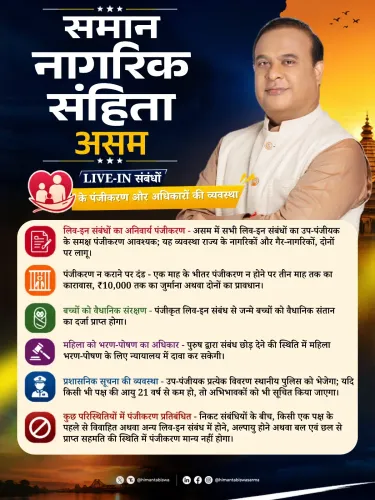
Assam Chief Minister Himanta Biswa Sarma on Friday, June 5, 2026, highlighted a key provision of the state's Uniform Civil Code (UCC) that brings live-in relationships under a defined legal framework, asserting that the code guarantees rights for women and legal security for children born of such unions.
Posting in Hindi, CM Sarma wrote: 'रिश्तों को कानूनी पहचान, महिलाओं को स्पष्ट अधिकार और बच्चों को सुरक्षित भविष्य' — 'Legal recognition for relationships, clear rights for women, and a secure future for children.' He added that Assam's UCC ensures that rights and responsibilities tied to live-in relationships are now 'clearly defined within the ambit of law.'
Context
The push for a Uniform Civil Code in India draws from Article 44 of the Constitution, which lists it as a Directive Principle of State Policy — a long-standing aspiration to replace religion-specific personal laws governing marriage, divorce, inheritance, and related matters with a single, uniform statute. For decades, the UCC remained a political aspiration rather than enacted law at the state level.
That changed in February 2024, when Uttarakhand became the first Indian state to pass a UCC, which included provisions mandating registration of live-in relationships and granting maintenance rights to women in such unions. The move set a legislative template that other BJP-governed states, including Assam, signalled an intent to follow.
Policy Backdrop
The Assam government had constituted an expert committee in 2023–2024 to draft a state-specific UCC. The live-in relationship provisions highlighted by CM Sarma are among the more socially significant elements of such codes: they typically require couples to register their union with authorities, entitling women to maintenance and inheritance claims, and establishing legal parentage for children — rights that previously had no clear statutory basis outside marriage.
Across BJP-ruled states, the UCC drive has been framed as a gender-equity measure, aimed at eliminating disparities that arise from separate Hindu, Muslim, Christian, and customary personal laws. Proponents argue that women from all communities gain equal and enforceable civil rights under a unified code.
Stakeholders and Impact
The most direct beneficiaries of the live-in provisions are women in unregistered live-in relationships, who currently have limited legal recourse in disputes over maintenance, property, or child custody. Children born of such relationships stand to gain formal legal parentage, which affects inheritance, educational records, and access to government schemes.
Civil society groups and legal experts have broadly welcomed maintenance and registration provisions, while some communities — particularly those covered by customary personal laws, including several tribal groups in Assam's hill districts — have raised concerns about potential exemptions or conflicts with existing traditions. Possible carve-outs for tribal areas remain a closely watched aspect of the final legislation.
What's Next
The final text of Assam's UCC bill, its passage in the state assembly, and the scope of any tribal-area exemptions will be the immediate milestones to watch. Once enacted, the law is likely to face scrutiny before the Gauhati High Court or the Supreme Court of India, as questions around states' legislative competence over personal law and fundamental rights are expected to be tested in court. Assam's experience will also inform the legislative calculus for other northeastern states where CM Sarma serves as convenor of the North-East Democratic Alliance (NEDA).
Point of View
A rhetorical choice that broadens the code's political appeal beyond the BJP's traditional base. By spotlighting live-in relationship provisions specifically, the Assam government is signalling that the UCC addresses contemporary social realities, not just conventional marriage law. This mirrors the strategy used in Uttarakhand, where registration and maintenance clauses were similarly foregrounded to deflect criticism that the UCC primarily targets Muslim personal law. The broader arc points to a coordinated BJP state-level legislative push that could build pressure on the central government to revive national UCC discussions ahead of future electoral cycles.
NationPress
19 Sept 2026
Frequently Asked Questions
What does Assam's Uniform Civil Code say about live-in relationships?
Assam's UCC provisions on live-in relationships mandate that rights and responsibilities in such unions — including maintenance for women and legal parentage for children — are clearly defined under state law, bringing these relationships into a formal legal framework for the first time.
Which was the first Indian state to implement a Uniform Civil Code?
Uttarakhand was the first Indian state to enact a Uniform Civil Code, passing the legislation in February 2024. Its provisions included registration of live-in relationships and maintenance rights for women.
What rights does the Assam UCC give to women in live-in relationships?
Under the Assam UCC, women in live-in relationships are entitled to clearly defined rights including maintenance and inheritance claims, rights that previously had limited statutory backing outside of formal marriage.
Will tribal communities in Assam be exempt from the UCC?
Possible exemptions for tribal communities in Assam's hill districts are among the most closely watched aspects of the final UCC bill. The exact scope of any such exemptions has not been officially confirmed and remains subject to the final legislative text.
Can the Assam UCC be challenged in court?
Yes. Once enacted, Assam's UCC is widely expected to face legal challenges before the Gauhati High Court or the Supreme Court of India on questions relating to states' legislative competence over personal law and potential conflicts with fundamental rights.