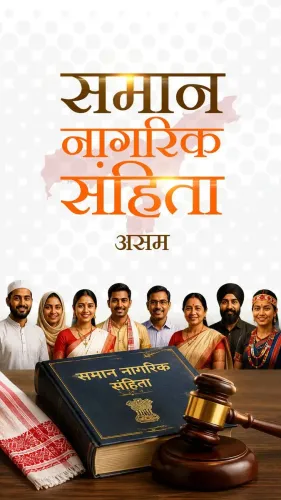
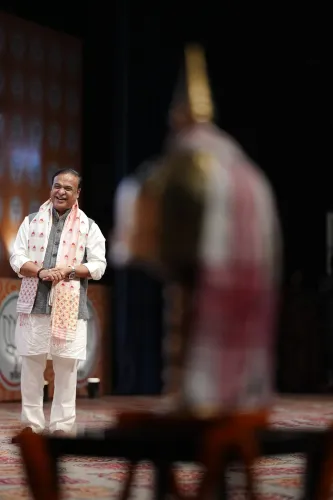
CM Himanta backs UCC for marriage, live-in registration in Assam Assembly

Synopsis
Chief Minister Himanta Biswa Sarma told the Assam Legislative Assembly on 27 May 2026 that the Uniform Civil Code will mandate registration of all marriages and live-in relationships, advancing legal clarity and accountability — marking a significant step in Assam's engagement with national personal law reform.
Key Takeaways
CM Himanta Biswa Sarma stated in the Assam Legislative Assembly on 27 May 2026 that the UCC will make registration of all marriages and live-in relationships mandatory.
The stated objective is to promote 'greater legal clarity and accountability' for citizens across Assam .
Article 44 of the Constitution of India has directed the State to secure a Uniform Civil Code since 1950 , but no national UCC law has been enacted.
Goa is currently the only Indian state operating under a common civil code, derived from Portuguese law since 1961 .
Key stakeholders include women , religious communities, and legal practitioners, all of whom would be directly affected by mandatory registration requirements.
A formal UCC bill in the Assam Assembly remains a possibility to watch, with potential coordination with the central law ministry .
The Chief Minister's Office of Assam announced on Wednesday, 27 May 2026 that Chief Minister Dr. Himanta Biswa Sarma stated in the Assam Legislative Assembly that the Uniform Civil Code (UCC) aims to make registration of all marriages and live-in relationships mandatory, with the goal of ensuring greater legal clarity and accountability for citizens.
Context
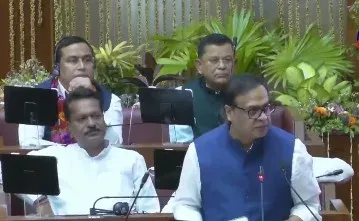
CM Himanta Biswa Sarma made the remarks on the floor of the Assam Legislative Assembly, framing the UCC as a tool for administrative accountability rather than solely a religious or ideological measure. He stated that the code would ensure 'mandatory registration of all marriages and live-in relationships, thereby promoting greater legal clarity and accountability.' The statement positions registration as a foundational civil-governance objective under the UCC framework.
The Assam government's articulation of UCC goals signals a deliberate effort to anchor the conversation in procedural and legal terms — emphasising documentation, state oversight, and citizen rights — rather than leading with the more contested question of harmonising religion-specific personal laws.
Policy Backdrop
Article 44 of the Constitution of India (1950) lists a Uniform Civil Code among the Directive Principles of State Policy, directing the State to endeavour to secure a common civil code for all citizens. Despite this constitutional directive, no nationwide UCC legislation has been enacted, leaving personal matters such as marriage, divorce, and inheritance governed by religion-specific laws.
The Bharatiya Janata Party (BJP) included UCC enactment in its national manifestos of 2014 and 2019, making it a long-standing party commitment. Goa remains the only Indian state currently operating under a common civil code, a legacy of Portuguese law dating to its integration with India in 1961. BJP-led state governments have increasingly explored state-level UCC measures as part of a wider governance agenda, with Assam emerging as an active participant in that conversation.
Stakeholders and Impact
The proposal to mandate registration of marriages and live-in relationships has direct implications for women, who would gain stronger legal standing in disputes over matrimonial property, maintenance, and inheritance. Legal practitioners note that a documented registration framework reduces evidentiary burdens in family courts and provides a clearer basis for adjudicating rights.
Religious communities across Assam — including Hindu, Muslim, Christian, and indigenous tribal groups — are key stakeholders, as UCC provisions would apply uniformly irrespective of faith. Civil society groups have historically debated whether uniform codes adequately accommodate customary practices, particularly those of Assam's diverse tribal communities whose personal laws are often rooted in tradition rather than statute.
What's Next
The immediate question is whether the Assam government will table a formal UCC bill in the Assam Legislative Assembly following CM Sarma's statement. Any draft legislation would likely require coordination with the central government's law ministry on model provisions, given that personal laws intersect with both state and concurrent legislative lists under the Constitution.
Should Assam proceed with legislation, it would become the first state in independent India to enact a self-styled UCC outside of Goa's inherited framework — a development that would carry significant implications for the national debate on personal law reform and could set a legislative template for other BJP-governed states.
Point of View
Making it harder to oppose on purely communal grounds. This approach mirrors a broader BJP-state pattern of advancing UCC incrementally through administrative rationale rather than ideological declaration. If Assam legislates, it would hand the central government a working state-level model at a politically significant moment. The statement also reinforces Sarma's positioning as a reform-forward chief minister willing to act on constitutional directives that the Centre has yet to translate into law.
NationPress
11 Oct 2026
Frequently Asked Questions
What did CM Himanta Biswa Sarma say about UCC in the Assam Assembly?
CM Himanta Biswa Sarma stated on 27 May 2026 that the Uniform Civil Code aims to make registration of all marriages and live-in relationships mandatory, promoting legal clarity and accountability.
Will Assam implement the Uniform Civil Code?
The Assam government has signalled intent by discussing UCC goals in the Legislative Assembly, but no formal bill has been tabled yet. A draft law and coordination with the central law ministry remain the next steps to watch.
What is the Uniform Civil Code and does India have one?
The Uniform Civil Code is a proposed common set of laws on marriage, divorce, inheritance, and adoption applicable to all citizens regardless of religion. India does not have a national UCC; Goa is the only state operating under a common civil code, inherited from Portuguese law since 1961.
Why does mandatory marriage registration matter under UCC?
Mandatory registration gives women and other parties legally documented proof of their marital or relationship status, strengthening their rights in disputes over property, maintenance, and inheritance in courts.
Which states in India are considering the Uniform Civil Code?
Several BJP-governed states have discussed UCC implementation as part of a wider governance agenda. Assam is among the most vocal, with CM Sarma making a direct statement in the state legislature in May 2026.