Shekhawat Backs Cabinet Move to Continue PDS Ration Logistics Scheme
Synopsis
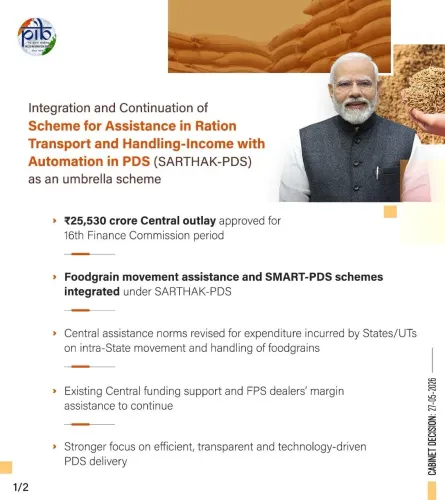
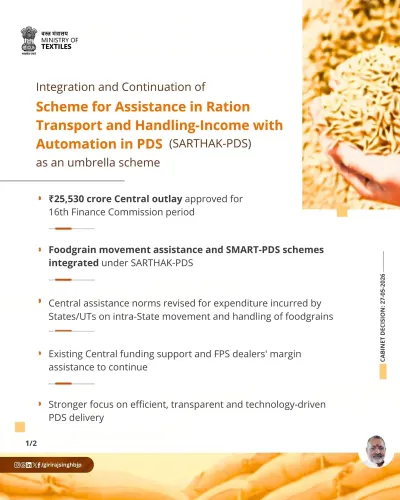
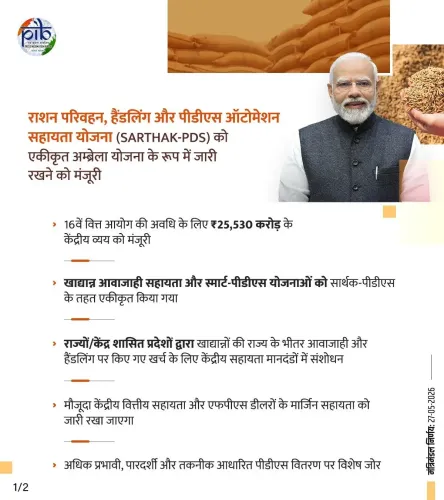
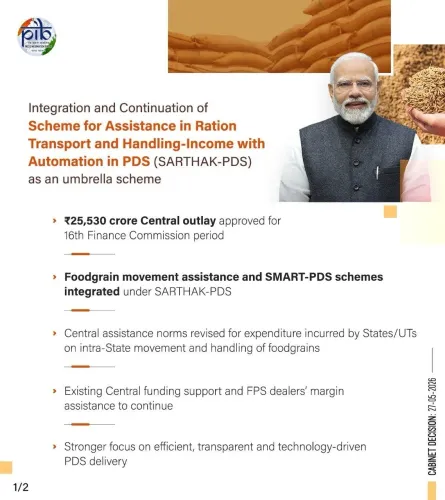
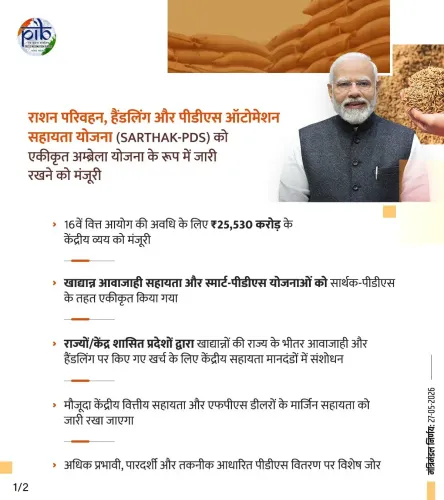
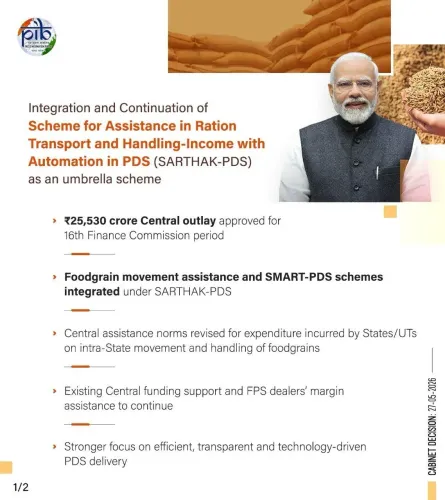
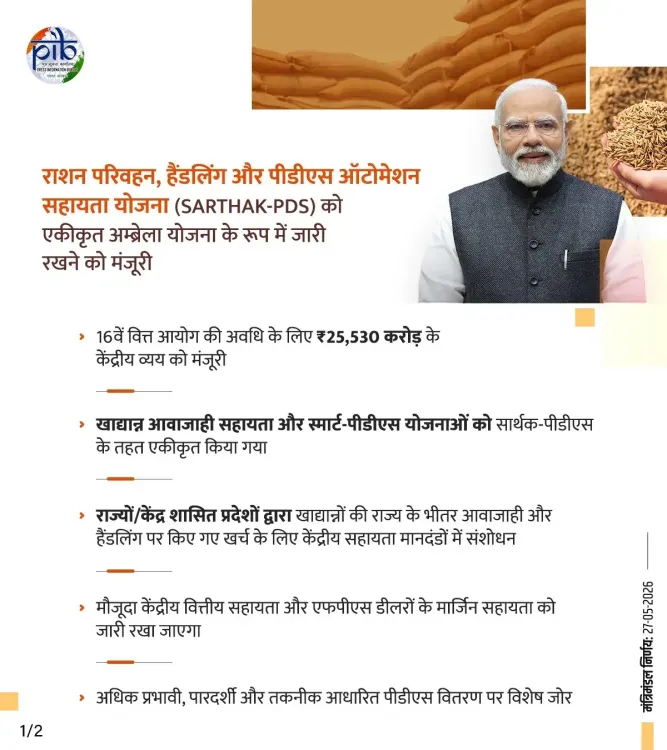
The Union Cabinet has decided to continue the scheme providing central assistance for ration transportation and handling under the PDS, with an outlay of ₹25,530 crore. Union Minister Gajendra Singh Shekhawat announced the decision on 27 May 2026, calling it a reflection of the Modi government's commitment to poor welfare.
Key Takeaways
The Union Cabinet has approved continuation of the PDS Ration Transport and Handling Assistance Scheme with an outlay of ₹25,530 crore .
Union Minister Gajendra Singh Shekhawat made the announcement via X on 27 May 2026 .
The scheme provides central financial support to states for the cost of moving subsidised food grains from central depots to fair price shops.
The National Food Security Act, 2013 entitles up to 75% of rural and 50% of urban population to subsidised food grains through the PDS.
The decision is part of a broader pattern of the Centre sustaining PDS logistics infrastructure alongside digitisation and Aadhaar-seeding of beneficiary rolls.
State food departments across India are the direct recipients of the central assistance, with benefits flowing to crores of NFSA-covered households.
Union Culture and Tourism Minister Gajendra Singh Shekhawat on Wednesday, 27 May 2026, welcomed the Union Cabinet's decision to continue the scheme providing central assistance for ration transportation and handling under the Public Distribution System (PDS), calling it a step toward ensuring timely food delivery to the poor across India.
Posting on X, Shekhawat wrote: 'केंद्रीय मंत्रिमंडल द्वारा "पीडीएस में राशन परिवहन एवं हैंडलिंग सहायता योजना" को जारी रखने का निर्णय लिया गया है' — ('The Union Cabinet has decided to continue the scheme for ration transport and handling assistance in the PDS'). He noted the scheme's outlay of ₹25,530 crore and said it would ensure timely delivery of rations to the poor.
Context
The scheme in question provides dedicated central financial support to states for the logistics costs involved in moving subsidised food grains from central depots to fair price shops under the PDS. Such logistics assistance has been a recurring feature of India's food security architecture, periodically renewed through cabinet approvals to keep state distribution machinery funded and functional.
Shekhawat attributed the decision to the welfare-first priorities of the government led by Prime Minister Narendra Modi, stating that the central government considers 'गरीब कल्याण' (welfare of the poor) its foremost priority and is implementing schemes at the ground level.
Policy Backdrop
The National Food Security Act (NFSA), 2013 created legal entitlements for subsidised food grains for up to 75 per cent of the rural population and 50 per cent of the urban population, making robust PDS logistics indispensable. The physical movement of grain from central stores to the last-mile fair price shop involves substantial transportation, storage, and handling costs borne primarily by states but supported through central schemes.
Since 2014, successive cabinet decisions have also pushed for digitisation of ration cards and Aadhaar-seeding of beneficiary databases to reduce leakages, while maintaining physical grain movement assistance to states. The PM Garib Kalyan Anna Yojana, launched in 2020 during the pandemic, further expanded the free ration umbrella and underscored the Centre's reliance on the PDS pipeline for welfare delivery.
Stakeholders and Impact
The primary beneficiaries of this scheme are the hundreds of millions of households covered under the NFSA who depend on fair price shops for subsidised grain. State food departments, which manage the last-mile logistics, stand to receive continued central reimbursement for transportation and handling costs, reducing the fiscal pressure on state budgets.
For Rajasthan and other large states with geographically dispersed populations, central logistics support is particularly significant in ensuring that remote and tribal communities receive their entitlements without disruption. The continuation of this scheme signals that the Centre intends to maintain the structural underpinning of food security delivery rather than wind down support.
What's Next
The formal gazette notification and operational guidelines for the continued scheme are expected to be issued by the Ministry of Consumer Affairs, Food and Public Distribution. Observers will watch whether the ₹25,530 crore outlay is disbursed over a fixed multi-year cycle or on an annual allocation basis, and whether any new conditions — such as enhanced digitisation benchmarks — are attached to state claims. Further announcements on food security logistics are likely to feature in upcoming parliamentary sessions and budget discussions.
Point of View
530 crore, the continuation signals that the Centre is not moving to devolve or defund the physical grain movement architecture even as digital direct-benefit transfers expand. The move also reinforces the Centre-state compact on food security, keeping states financially dependent on central reimbursements for last-mile delivery. In a broader arc, it reflects continuity in India's food policy: expanding legal entitlements under NFSA while sustaining the logistical backbone that makes those entitlements meaningful.
NationPress
11 Oct 2026
Frequently Asked Questions
What is the PDS ration transport and handling assistance scheme?
It is a central government scheme that reimburses state governments for the cost of transporting and handling subsidised food grains from central storage depots to fair price shops under India's Public Distribution System.
What is the outlay for the continued PDS logistics scheme?
Union Minister Gajendra Singh Shekhawat stated the scheme carries an outlay of ₹25,530 crore , though the disbursement timeline has not yet been officially detailed.
Who benefits from the PDS ration transport scheme?
The scheme benefits crores of households covered under the National Food Security Act, 2013 — up to 75% of rural and 50% of urban population — by ensuring subsidised grains reach fair price shops on time.
What is the National Food Security Act and how does it relate to PDS?
The National Food Security Act, 2013 gives legal entitlements to subsidised food grains for a large share of India's population, and the PDS is the delivery mechanism through which those grains are distributed via fair price shops.
Why does the Centre provide logistics support to states for PDS?
Transportation, storage and handling of food grains across India's vast and diverse geography is costly; central assistance ensures states — especially those with remote or tribal populations — can maintain uninterrupted last-mile delivery without bearing the full financial burden.