Rijiju: Cabinet clears ₹10,998 cr Varuna River corridor in UP
Synopsis
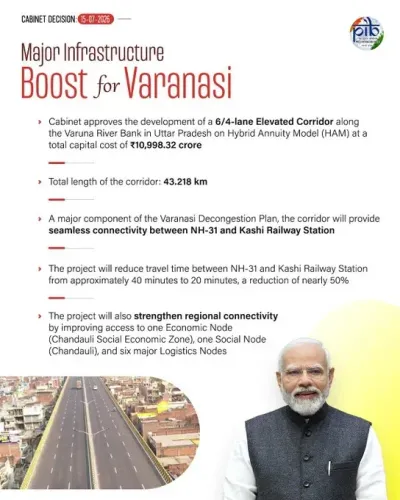
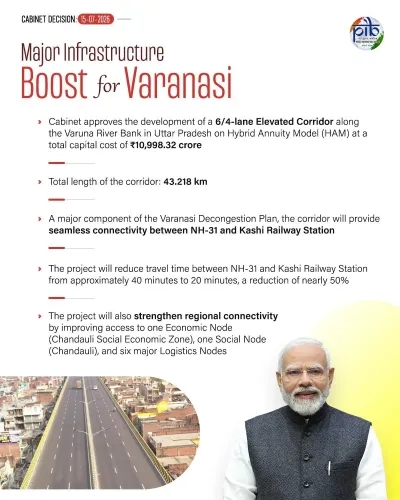
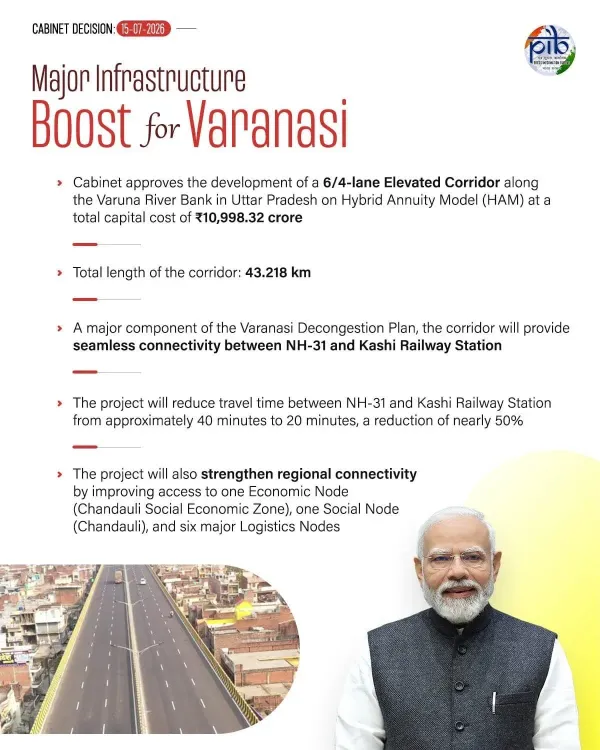
The Union Cabinet has approved a 6/4-lane elevated corridor along the Varuna River Bank in Uttar Pradesh at ₹10,998.32 crore under the Hybrid Annuity Model, Union Minister Kiren Rijiju announced on 16 July 2026. The project aims to ease congestion in Varanasi.
Key Takeaways
The Union Cabinet approved a 6/4-lane elevated corridor along the Varuna River Bank in Uttar Pradesh on 16 July 2026 .
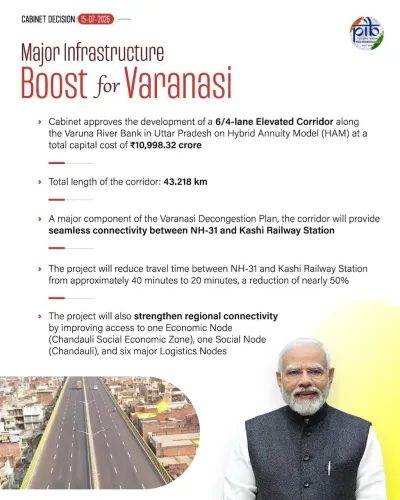
Total capital cost is ₹10,998.32 crore , to be executed under the Hybrid Annuity Model .
The corridor includes ramps and loops and is designed to relieve traffic congestion in and around Varanasi .
The Hybrid Annuity Model provides 40 per cent government funding during construction, with the rest recovered via annuity payments to the private developer.
The project aligns with Bharatmala Pariyojana , India's flagship national highway development programme launched in 2015 .
Next steps include issuance of tender documents and land acquisition in Varanasi district .
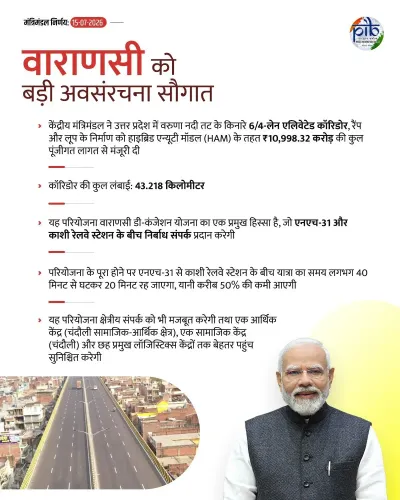
Union Parliamentary Affairs Minister Kiren Rijiju announced on Thursday, 16 July 2026 that the Union Cabinet, under the leadership of Prime Minister Narendra Modi, has approved the development of a 6/4-lane elevated corridor along the Varuna River Bank in Uttar Pradesh, including ramps and loops, at a total capital cost of ₹10,998.32 crore. The project will be executed on the Hybrid Annuity Model (HAM).
Context
Rijiju shared the Cabinet decision on X, writing: 'Under the leadership of Hon'ble PM Shri Narendra Modi ji, the Union Cabinet approves the development of a 6/4-lane elevated corridor along the Varuna River Bank, including ramps and loops, in Uttar Pradesh on Hybrid Annuity Model at a total capital cost of ₹10,998.32 crore.' The Varuna River is a tributary of the Ganga flowing through Varanasi district in eastern Uttar Pradesh, one of India's most congested urban corridors.
Varanasi, a city of significant religious and commercial importance, has long faced acute traffic congestion along river-adjacent roads. An elevated corridor along the Varuna River Bank is intended to ease surface-level gridlock and improve freight and passenger movement through the city.
Policy Backdrop
The project falls within the broader ambit of Bharatmala Pariyojana, launched in 2015, which targets the development of approximately 34,800 km of national highways, including elevated urban corridors in high-density zones. Uttar Pradesh has been a priority state under this programme given its population density and its position on the Delhi–Kolkata freight corridor.
The Hybrid Annuity Model, adopted by the Union Cabinet in 2016, is a public-private partnership structure under which the government funds 40 per cent of the project cost during construction, with the private developer recovering the remaining investment through annuity payments over the concession period. HAM was introduced to revive highway development after the earlier Build-Operate-Transfer model encountered sustained failures due to traffic-risk uncertainty.
Stakeholders and Impact
Varanasi commuters and logistics operators stand to benefit most directly from the corridor, which will reduce travel time along one of the city's most congested stretches. The project is also expected to generate construction employment and stimulate ancillary economic activity in eastern Uttar Pradesh.
For highway developers and infrastructure financiers, the HAM structure limits traffic-risk exposure and provides a predictable revenue stream, making the project attractive for private participation. Uttar Pradesh's infrastructure pipeline has grown substantially in recent years, and this approval adds a significant urban-mobility component to that portfolio.
What's Next
Following Cabinet approval, the next procedural steps will include issuance of a Request for Qualification and subsequently a Request for Proposal to shortlist and select a private concessionaire. Land acquisition in Varanasi district will be a critical determinant of project timelines, as urban elevated corridors typically require clearances across multiple jurisdictions.
With the Cabinet sanction now in place, the project moves into the tendering phase. Its execution will be closely watched as a test of the Centre's ability to deliver large-scale urban infrastructure in one of India's most symbolically and commercially significant cities.
Point of View
India's most electorally consequential state. Varanasi carries additional symbolic weight as the Prime Minister's own parliamentary constituency, making this approval politically as well as administratively significant. The continued reliance on the Hybrid Annuity Model signals institutional confidence in the PPP structure after earlier BOT-era setbacks, though the true test will come at the tendering and land-acquisition stages. The ₹10,998.32 crore outlay also underscores the Centre's appetite for urban elevated-corridor investments as cities strain under rising vehicular loads.
NationPress
14 Oct 2026
Frequently Asked Questions
What is the Varuna River elevated corridor project approved by the Cabinet?
The Union Cabinet approved a 6/4-lane elevated corridor along the Varuna River Bank in Uttar Pradesh, including ramps and loops, at a total capital cost of ₹10,998.32 crore. The project will be developed on the Hybrid Annuity Model.
Where is the Varuna River located?
The Varuna River is a tributary of the Ganga flowing through Varanasi district in eastern Uttar Pradesh.
What is the Hybrid Annuity Model in highway projects?
The Hybrid Annuity Model is a public-private partnership structure introduced in 2016 under which the government funds 40 per cent of the project cost during construction and pays the private developer the remaining amount through annuity instalments over the concession period.
What is Bharatmala Pariyojana and is this project part of it?
Bharatmala Pariyojana is a national highway development programme launched in 2015 targeting approximately 34,800 km of highways including elevated urban corridors. The Varuna River Bank corridor aligns with this programme's objectives for Uttar Pradesh.
Who announced the Cabinet approval for the Varuna corridor?
Union Parliamentary Affairs Minister Kiren Rijiju announced the Cabinet decision on X on 16 July 2026, attributing the approval to the leadership of Prime Minister Narendra Modi.