CM Bhajan Lal hails Pralay missile test as mark of India's defence rise
Synopsis
Rajasthan CM Bhajan Lal Sharma hailed the successful test of DRDO's Pralay quasi-ballistic missile as a landmark in India's strategic self-reliance, congratulating scientists and armed forces personnel for the achievement under PM Modi's Atmanirbhar Bharat push.
Key Takeaways
Pralay missile successfully tested — Rajasthan CM Bhajan Lal Sharma publicly congratulated DRDO and armed forces on 6 November 2026 .
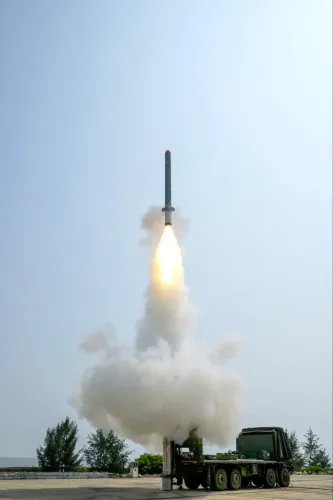
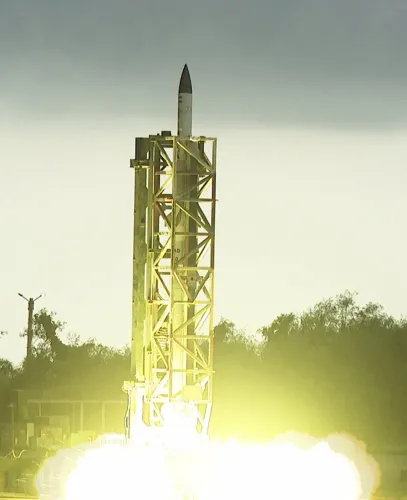
Pralay is a quasi-ballistic, surface-to-surface short-range missile developed by DRDO for tactical battlefield use.
The test is framed as a milestone of Atmanirbhar Bharat , PM Modi's 2020 initiative to indigenise defence production.
Pralay traces its lineage to the Integrated Guided Missile Development Programme (IGMDP) launched in 1983 , which produced the Prithvi and Agni families.
Next steps include formal induction timelines and user trials for Indian Army or Indian Air Force units.
India's defence self-reliance story gained another chapter on Friday, 6 November 2026, as Rajasthan Chief Minister Bhajan Lal Sharma congratulated the nation's scientific community on the successful test of the 'Pralay' missile — describing it as a proud proof of India's growing strategic strength and technological independence.
Posting on X in Hindi, CM Sharma wrote: 'Pralay missile ka safal parikshan Bharat ki badhti samrik shakti, takniki aatmanirbharta aur sudridh raksha sankalp ka gauravshali praman hai' — ('The successful test of the Pralay missile is a glorious proof of India's rising strategic power, technological self-reliance and firm defence resolve'). He extended warm congratulations to the entire team at DRDO, the dedicated scientists, the armed forces, and every individual connected to the mission.
What Pralay is — and why it matters
The Pralay is a quasi-ballistic, surface-to-surface short-range missile developed by the Defence Research and Development Organisation (DRDO) for tactical battlefield use. Unlike conventional ballistic missiles that follow a predictable arc, quasi-ballistic systems manoeuvre mid-flight — making interception significantly harder for adversaries. The missile is designed to strike targets at short-to-medium ranges with high precision, giving ground commanders a credible conventional strike option that does not carry the escalation risks of longer-range systems.
Pralay sits within a lineage stretching back to the Integrated Guided Missile Development Programme (IGMDP), launched in 1983, which gave India the Prithvi and Agni families. Four decades on, DRDO's scientists have moved well beyond those first-generation systems — building domestically designed seekers, propulsion, and guidance technology that the country once had to import.
Atmanirbhar Bharat's strategic dividend
Prime Minister Narendra Modi's Atmanirbhar Bharat initiative, announced in 2020, placed indigenous defence production at its centre. The policy imposed time-bound import embargoes on hundreds of weapons platforms and components, compelling the armed forces and industry to accelerate domestic alternatives. Each successful DRDO test since then has represented not just engineering achievement, but a measurable reduction in India's strategic import bill and foreign-supply vulnerability.
CM Sharma framed the latest test squarely in that arc, crediting PM Modi's leadership as the guiding force behind a defence ecosystem that now generates 'new milestones continuously' through domestic technology, scientific talent, and innovation.
DRDO scientists at the centre of the salute
Unusually for a political post, Sharma's statement placed the scientists and armed forces personnel — the 'karmayogi' (dedicated workers) of the mission — at the heart of the tribute. 'Your dedication and contribution towards strengthening national security and strategic capability is commendable,' he wrote. It is a signal of the political weight now attached to defence R&D success: DRDO breakthroughs have become moments of national pride that cut across electoral geography.
With successful tests completed, attention now turns to induction: Pralay's formal entry into Indian Army or Indian Air Force units, and the user trials that must follow before the system becomes fully operational.
Point of View
A state chief minister — traditionally concerned with domestic governance — signals that defence self-reliance now carries pan-party electoral resonance well beyond New Delhi. The quasi-ballistic category is particularly significant: it fills a tactical gap between artillery and longer-range strategic missiles, suggesting India is building a layered conventional deterrence architecture rather than relying solely on nuclear signalling. If Pralay moves quickly toward operational induction, it will mark one of the faster journeys from development to deployment in Indian missile history.
NationPress
6 Nov 2026
Frequently Asked Questions
What is the Pralay missile?
Pralay is a quasi-ballistic surface-to-surface short-range missile developed by India's Defence Research and Development Organisation (DRDO) for tactical battlefield use. It manoeuvres mid-flight, making it harder to intercept than conventional ballistic missiles.
Who developed the Pralay missile?
The Pralay missile was developed by DRDO, India's Defence Research and Development Organisation, as part of the country's ongoing effort to indigenise its missile and weapons systems.
What is Atmanirbhar Bharat in defence?
Atmanirbhar Bharat (Self-Reliant India) is an initiative announced by PM Narendra Modi in 2020 that prioritises domestic design and manufacture of defence equipment, including imposing import embargoes on hundreds of platforms to accelerate indigenous alternatives.
Why did Rajasthan CM Bhajan Lal Sharma comment on a defence test?
CM Bhajan Lal Sharma, as a senior BJP leader and state chief minister, congratulated DRDO and the armed forces on the Pralay test to highlight India's growing strategic capabilities under PM Modi's leadership — a theme of broad political and national significance.
What is India's Integrated Guided Missile Development Programme?
The Integrated Guided Missile Development Programme (IGMDP) was launched in 1983 and produced India's foundational missile systems including the Prithvi and Agni families, laying the groundwork for all subsequent indigenous missile development including Pralay.