CM Dhami credits Modi's flagship schemes for India's new direction
Synopsis
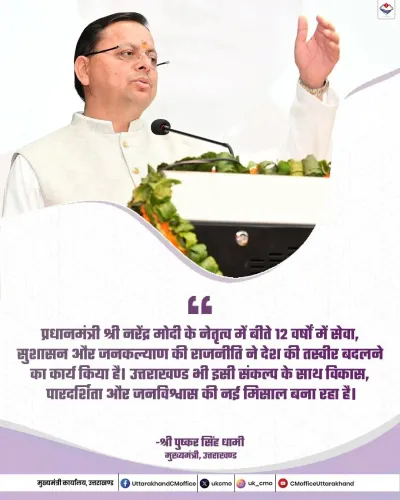
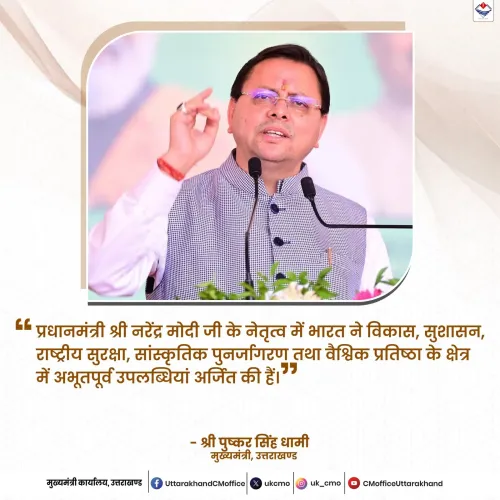
Uttarakhand Chief Minister Pushkar Singh Dhami, in a statement shared by the official CMO handle on 15 June 2026, credited PM Modi's leadership for transformative decisions including Atmanirbhar Bharat, Digital India, NEP 2020, GST and defence indigenisation, marking #12YearsOfGaribKalyan.
Key Takeaways
The Uttarakhand CMO official X account shared a statement by CM Pushkar Singh Dhami on 15 June 2026 under the #12YearsOfGaribKalyan hashtag.
CM Dhami credited PM Narendra Modi with five landmark decisions: Atmanirbhar Bharat Abhiyan , Digital India , National Education Policy 2020 , GST , and promotion of indigenous defence production.
Digital India was launched on 1 July 2015 ; GST came into force on 1 July 2017 ; NEP 2020 was approved by the Union Cabinet in July 2020 .
Atmanirbhar Bharat Abhiyan was announced in May 2020 with multi-tranche economic measures and a defence indigenisation push.
The statement is part of a broader coordinated messaging pattern among BJP-ruled states aligning with central government welfare-anniversary milestones.
Upcoming focus areas include Uttarakhand 's NEP implementation, defence corridor progress, and possible central welfare scheme extensions.
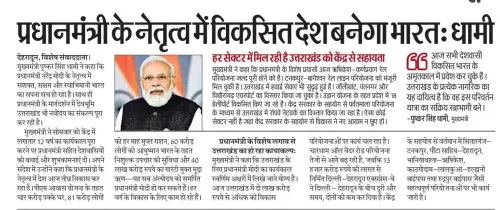
The Chief Minister's Office of Uttarakhand, on Monday, 15 June 2026, shared a statement by Chief Minister Pushkar Singh Dhami crediting Prime Minister Narendra Modi's leadership for reshaping India through a series of landmark policy decisions. The post, tagged under #12YearsOfGaribKalyan, cited schemes including Atmanirbhar Bharat Abhiyan, Digital India, National Education Policy 2020, GST, and domestic defence production as transformative milestones.
Context
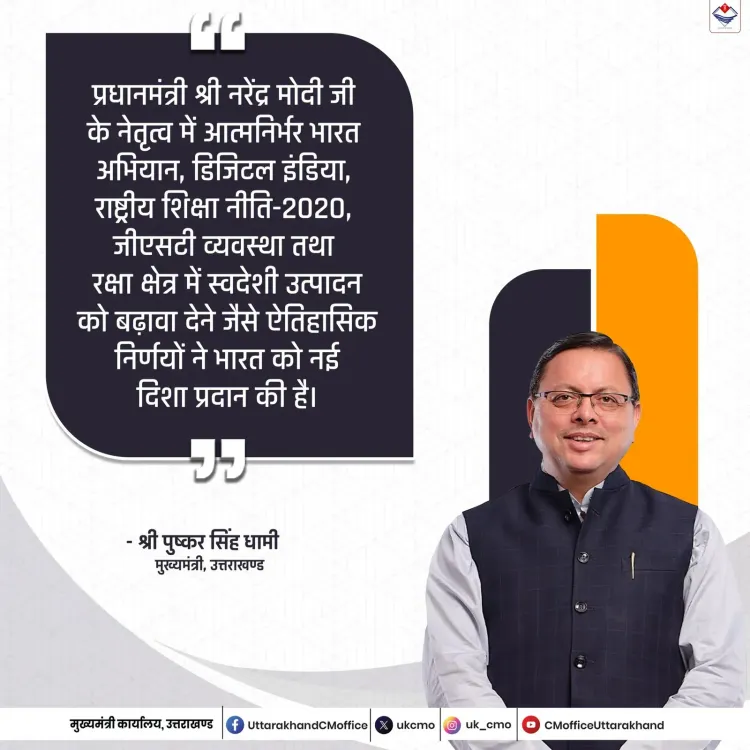
CM Dhami's statement, as quoted by the official CMO handle, reads: 'Pradhan Mantri Shri Narendra Modi ji ke netritva mein Atmanirbhar Bharat Abhiyan, Digital India, Rashtriya Shiksha Niti-2020, GST vyavastha tatha raksha kshetra mein swadeshi utpadan ko badhawa dene jaise aitihasik nirnyon ne Bharat ko nayi disha pradaan ki hai' — ('Under the leadership of Prime Minister Shri Narendra Modi, historic decisions such as the Atmanirbhar Bharat Abhiyan, Digital India, National Education Policy 2020, the GST system, and promotion of indigenous production in the defence sector have given India a new direction.')
The statement was issued as part of the #12YearsOfGaribKalyan communication cycle, which marks over a decade of welfare-oriented governance under the current central government. BJP-ruled states have periodically aligned their official messaging with such national milestones to reinforce a unified policy narrative.
Policy Backdrop
Digital India was formally launched on 1 July 2015 with nine pillars, including broadband highways and electronic service delivery. The Goods and Services Tax came into force on 1 July 2017 after a constitutional amendment, replacing a web of central and state levies with a single unified indirect tax structure.
The National Education Policy 2020 was approved by the Union Cabinet in July 2020, overhauling a framework that had remained unchanged since 1986, and introducing a new 5+3+3+4 curricular structure. The Atmanirbhar Bharat Abhiyan, announced in May 2020, combined a multi-tranche economic stimulus with a renewed push for domestic manufacturing and defence indigenisation lists.
Stakeholders and Impact
The schemes cited by CM Dhami span a wide cross-section of Indian society. GST directly affects businesses and consumers across all sectors, while Digital India has expanded e-governance access to rural and semi-urban populations. NEP 2020 is reshaping schooling and higher education for millions of students, and the defence indigenisation drive has created new opportunities for domestic manufacturers.
Uttarakhand itself has a stake in several of these initiatives, including planned defence corridor development and state-level NEP rollout. The CMO's statement positions the state government as an active partner in the central government's broader development agenda.
What's Next
Observers will watch for state-level implementation updates on NEP 2020 from Uttarakhand and progress reports on defence-sector investments in the state. At the national level, any extension announcements for the PM Garib Kalyan Anna Yojana ahead of the next Union Budget cycle are likely to generate a fresh round of coordinated messaging from BJP-governed states. The #12YearsOfGaribKalyan campaign signals that welfare-anniversary communication will remain a key tool in the ruling party's outreach strategy through the current political cycle.
Point of View
Where state governments in BJP-ruled states echo the Centre's narrative at key political anniversaries. The #12YearsOfGaribKalyan frame is a deliberate attempt to consolidate the welfare-governance brand ahead of potential electoral cycles. By invoking five distinct flagship schemes spanning economic reform, education, technology, and defence, the statement projects a comprehensive development arc rather than a single-issue tribute. The pattern suggests that anniversary-linked communications will intensify as the ruling party approaches the next round of state and national elections.
NationPress
14 Sept 2026
Frequently Asked Questions
What is #12YearsOfGaribKalyan?
#12YearsOfGaribKalyan is a hashtag campaign marking over twelve years of welfare-focused governance under PM Narendra Modi, used by BJP leaders and state governments to highlight central schemes on key anniversaries.
What did CM Dhami say about Modi's schemes?
CM Pushkar Singh Dhami stated that historic decisions under PM Modi's leadership — including Atmanirbhar Bharat, Digital India, NEP 2020, GST, and indigenous defence production — have given India a new direction.
What is Atmanirbhar Bharat Abhiyan?
Atmanirbhar Bharat Abhiyan is a self-reliant India campaign announced in May 2020, combining a multi-tranche economic stimulus with a push for domestic manufacturing and reduced import dependence.
When was the National Education Policy 2020 approved?
The National Education Policy 2020 was approved by the Union Cabinet in July 2020, replacing the 1986 policy and introducing a new 5+3+3+4 curricular structure.
When did GST come into effect in India?
The Goods and Services Tax came into effect across India on 1 July 2017, replacing multiple central and state levies with a unified indirect tax system after a constitutional amendment.