CM Pema Khandu forms four panels on APST, ILP, infiltration
Synopsis
Arunachal Pradesh Chief Minister Pema Khandu has agreed to form four High-Powered Committees — each led by a Cabinet Minister — to address ST Bachao Andolan demands on APST certificate verification, non-APST offspring, ILP reform and illegal infiltration. Official notification is due by Monday.
Key Takeaways
Four High-Powered Committees have been agreed upon by the Arunachal Pradesh government following talks with AITF, AAPSU, ST Bachao Andolan Committee, CBOs, officials and legal experts on 29 May 2026 .
The committees will examine re-verification of APST certificates , the non-APST offspring issue , strengthening the ILP framework and review of ILP guidelines, and illegal infiltration .
Each committee will be led by a Cabinet Minister-rank official and will include tribal body representatives, legal experts, research scholars and women representatives.
The official notification constituting the committees is expected to be issued by Monday, 1 June 2026 .
The Inner Line Permit system, in force since the colonial-era Bengal Eastern Frontier Regulation of 1873 , is central to Arunachal Pradesh's demographic protection framework.
Recommendations from the committees are expected to shape revisions to APST verification rules and ILP operational guidelines across the state.
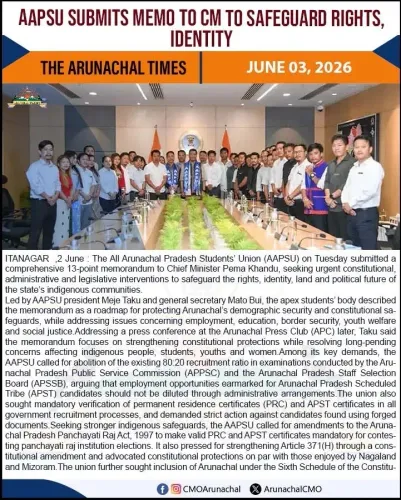
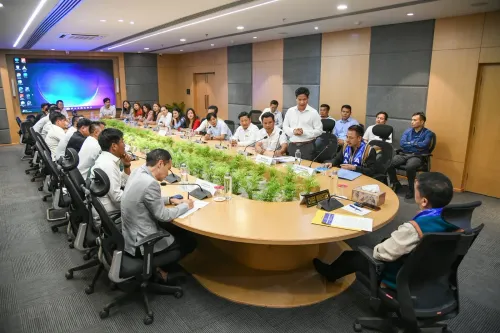
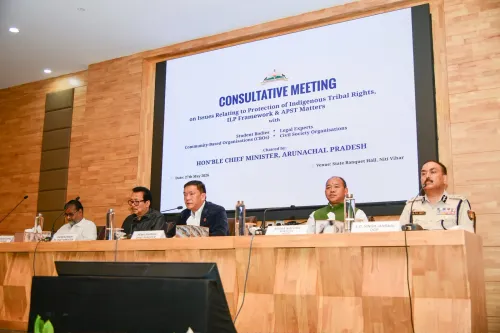
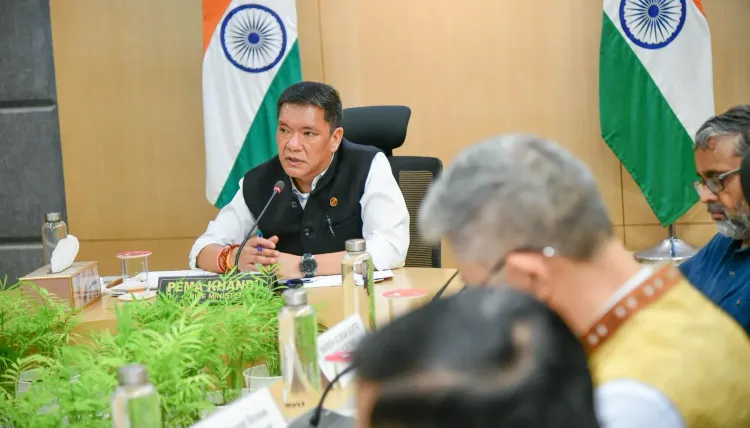
Arunachal Pradesh Chief Minister Pema Khandu announced on Friday, 29 May 2026 the formation of four High-Powered Committees to address key tribal protection demands raised by the ST Bachao Andolan, following discussions with indigenous tribal bodies, community-based organisations, student unions, government officials and legal experts.
Context
The decision came after a multi-stakeholder consultation that brought together the Arunachal Indigenous Tribes Forum (AITF), the All Arunachal Pradesh Students' Union (AAPSU), the ST Bachao Andolan Committee, community-based organisations (CBOs), government officials and legal experts. The four demands addressed centre on tribal identity, demographic integrity and border regulation — issues that have animated civil society in Arunachal Pradesh for decades. Chief Minister Khandu confirmed that an official notification constituting the committees will be issued by Monday.
Each of the four committees will be led by a Cabinet Minister-rank official and will include representatives from AITF, AAPSU, the ST Bachao Andolan Committee, legal experts, research scholars and women representatives, ensuring what the Chief Minister described as a 'balanced, inclusive and action-oriented process.'
Policy Backdrop
The four committees will examine and recommend measures on: (1) re-verification of Arunachal Pradesh Scheduled Tribe (APST) certificates; (2) the issue of non-APST offspring; (3) strengthening the Inner Line Permit (ILP) framework and review of ILP guidelines; and (4) illegal infiltration. The Inner Line Permit system, rooted in the colonial-era Bengal Eastern Frontier Regulation of 1873, requires non-residents to obtain permits before entering Arunachal Pradesh and has long served as a demographic safeguard for indigenous communities.
Periodic reviews of the ILP framework have been undertaken by successive state governments since the 2000s as demographic pressures and migration concerns have intensified. The question of APST certificate verification has similarly been a recurring flashpoint, with tribal organisations alleging that fraudulent or improperly issued certificates undermine the constitutional protections available to genuine Scheduled Tribe members.
Stakeholders and Impact
For AITF and AAPSU — the two most prominent civil society voices on indigenous rights in the state — the committee structure represents a formal seat at the table alongside government. Their inclusion as permanent members of each panel signals that the process is designed to be consultative rather than purely administrative. The inclusion of women representatives and research scholars further broadens the composition beyond traditional stakeholder groups.
APST certificate holders stand to be most directly affected by the re-verification exercise, which, if implemented rigorously, could alter access to reservations, land rights and government employment tied to Scheduled Tribe status. The non-APST offspring issue — concerning children born to mixed tribal and non-tribal parentage — is among the most legally complex and socially sensitive of the four mandates.
What's Next
The official notification constituting all four committees is expected by Monday, 1 June 2026. Once notified, the committees are expected to begin consultations and submit recommendations that could shape revisions to APST verification rules, ILP operational guidelines and anti-infiltration enforcement mechanisms. The outcome of this process will be closely watched by tribal communities, legal practitioners and policymakers across the Northeast, given its potential to set a precedent for how other states with ILP regimes handle similar identity and demographic pressures.
Point of View
AAPSU and the ST Bachao Andolan Committee directly into each panel, the government shares both ownership and accountability for outcomes, reducing the risk of rejection. This mirrors a broader Northeast governance pattern where student unions and tribal bodies are co-opted into policy mechanisms to defuse identity-linked agitations. The real test will be whether the committees produce actionable, time-bound recommendations or become procedural holding chambers that defer difficult decisions on APST verification and ILP reform indefinitely.
NationPress
13 Oct 2026
Frequently Asked Questions
What are the four High-Powered Committees formed by Arunachal Pradesh CM Pema Khandu?
The four committees will examine: re-verification of APST certificates, the non-APST offspring issue, strengthening the Inner Line Permit framework and review of ILP guidelines, and illegal infiltration. Each will be led by a Cabinet Minister-rank official.
What is the ST Bachao Andolan and what does it demand?
ST Bachao Andolan is a movement in Arunachal Pradesh pressing for stricter safeguards of Scheduled Tribe status, including rigorous verification of APST certificates and stronger measures against illegal immigration and demographic change.
What is the Inner Line Permit (ILP) in Arunachal Pradesh?
The Inner Line Permit is a regulatory system requiring non-residents to obtain a permit before entering Arunachal Pradesh. It is rooted in the colonial-era Bengal Eastern Frontier Regulation of 1873 and is designed to protect the demographic and cultural identity of indigenous tribes.
When will the official notification for the four committees be issued?
Chief Minister Pema Khandu stated that the official notification constituting the four High-Powered Committees will be issued by Monday, 1 June 2026.
Who will be part of the High-Powered Committees on APST and ILP in Arunachal Pradesh?
Each committee will include representatives from AITF, AAPSU, the ST Bachao Andolan Committee, legal experts, research scholars and women representatives, in addition to Cabinet Minister-rank leadership.