CM Majhi Champions Central Welfare Schemes for Odisha's Poor
Synopsis
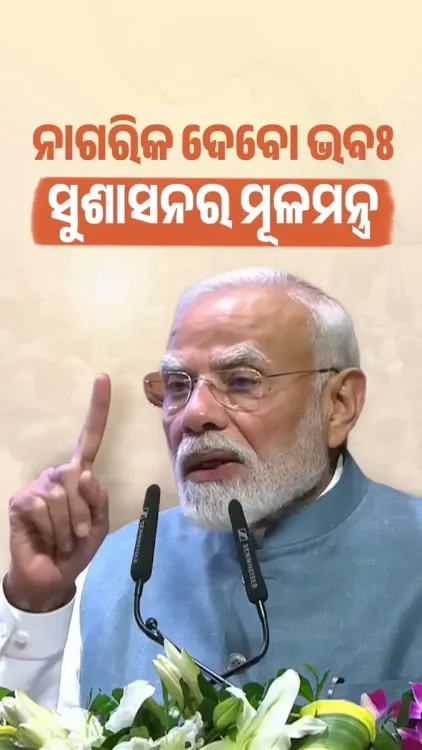
Odisha Chief Minister Mohan Charan Majhi invoked 'Nagarik Devo Bhava' as the guiding mantra of good governance while championing the Atal Pension Yojana and Pradhan Mantri Suraksha Bima Yojana as tools of financial security for ordinary citizens.
Key Takeaways
Odisha CM Mohan Charan Majhi publicly endorsed the Atal Pension Yojana and Pradhan Mantri Suraksha Bima Yojana on October 26, 2026 .
The Pradhan Mantri Suraksha Bima Yojana provides Rs 2 lakh accident insurance cover for just Rs 12 per year via bank accounts.
The Atal Pension Yojana targets unorganised-sector workers aged 18–40 with government co-contribution support.
Both schemes were launched in May 2015 under Prime Minister Narendra Modi as part of a broader financial inclusion drive.
Majhi coined 'Nagarik Devo Bhava' — the citizen is god — as his definition of good governance.
Majhi became Odisha's first BJP Chief Minister in June 2024 , with welfare delivery as a stated administrative priority.
Every ordinary citizen deserves a safety net — and Odisha Chief Minister Mohan Charan Majhi invoked that principle on Monday, October 26, 2026, holding up two landmark central schemes as proof that the promise is being kept. Posting in Odia and English, he anchored his message in a Sanskrit phrase that carries political weight: 'Nagarik Devo Bhava' — the citizen is god.
The Two Schemes at the Heart of Majhi's Message
The Chief Minister spotlighted the Atal Pension Yojana (APY) and the Pradhan Mantri Suraksha Bima Yojana (PMSBY) — twin pillars of the NDA government's financial inclusion push launched in May 2015 under Prime Minister Narendra Modi. Together, they target the vast informal workforce that traditional banking and insurance long ignored.
The Atal Pension Yojana offers old-age pension security to unorganised-sector workers aged 18 to 40, with a government co-contribution to sweeten enrolment. The Pradhan Mantri Suraksha Bima Yojana is even more accessible: a Rs 2 lakh accident insurance cover for a premium of just Rs 12 per year, delivered through bank accounts. The arithmetic alone is a policy argument.
Odisha's BJP Administration and the Continuity Signal
Majhi became Odisha's first BJP Chief Minister in June 2024, ending decades of BJD rule in the state. His administration has repeatedly signalled alignment with New Delhi's welfare architecture — and this post fits that pattern precisely. By naming central schemes in both Odia and English, he reaches local constituents while reinforcing ideological solidarity with the party's national governance record.
The mantra 'Nagarik Devo Bhava' — a deliberate riff on the classical Atithi Devo Bhava (the guest is god) — reframes the citizen as the supreme beneficiary of state action. It is the kind of phrase that travels from a social-media post into a rally slogan with ease.
Why the Informal Sector Remains the Defining Audience
India's unorganised sector accounts for the overwhelming majority of the country's workforce, yet historically lacked access to formal pensions or affordable accident insurance. The May 2015 Jan Suraksha package — which also included the Pradhan Mantri Jeevan Jyoti Bima Yojana — was designed as a direct answer to that gap, using the banking channel opened by the Jan Dhan account drive. For Odisha, a state with a large agrarian and tribal labour base, the relevance is acute.
Majhi's post does not cite enrolment numbers, and state-level figures for 2026 remain unconfirmed. But the framing is unmistakable: welfare delivery is not charity, it is governance — and governance, the CM insists, answers to the citizen first.
Point of View
Synchronising state and central messaging on welfare is also electoral strategy: the informal sector's votes are decisive in Odisha's assembly and Lok Sabha contests. Whether the mantra translates into measurable enrolment gains in the state will be the harder test.
NationPress
26 Oct 2026
Frequently Asked Questions
What is the Atal Pension Yojana and who can join?
The Atal Pension Yojana is a central government pension scheme launched in May 2015 for unorganised-sector workers aged 18 to 40, offering guaranteed monthly pensions with a government co-contribution for eligible subscribers.
What does Pradhan Mantri Suraksha Bima Yojana cover?
The Pradhan Mantri Suraksha Bima Yojana provides accident insurance of Rs 2 lakh for an annual premium of just Rs 12, accessible through bank accounts to low-income citizens.
What does 'Nagarik Devo Bhava' mean?
'Nagarik Devo Bhava' means 'the citizen is god' — a phrase used by Odisha CM Mohan Charan Majhi to describe his vision of citizen-centric good governance.
When did Mohan Charan Majhi become Odisha Chief Minister?
Mohan Charan Majhi became Odisha's Chief Minister in June 2024, making him the state's first BJP Chief Minister after the party won the Odisha assembly elections.
How do Atal Pension Yojana and PMSBY benefit Odisha's workers?
Both schemes target informal and low-income workers who lack access to formal pensions or insurance — a significant population in Odisha given its large agrarian and tribal labour workforce.