CM Mohan Yadav Pushes Jalabhishek 2.0 for MP Water Revival
Synopsis
MP Chief Minister Dr. Mohan Yadav has directed mission-mode execution of 'Jalabhishek 2.0', a two-year plan to revive ponds and stepwells, recharge groundwater at farm and village level, and launch a state water dashboard to counter deficient rainfall.
Key Takeaways
Jalabhishek 2.0 is a proposed two-year action plan for revival of ponds, stepwells, and water structures in Madhya Pradesh .
The plan is anchored in the principle that farm water must be retained on the farm and village water within the village for decentralised groundwater recharge.
A state-level water dashboard is to be created for real-time monitoring of water structures and recharge works.
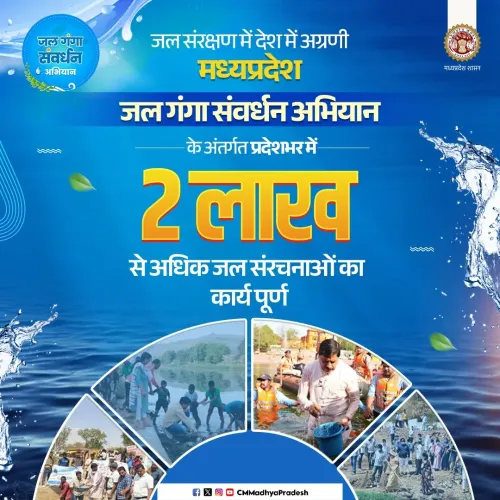
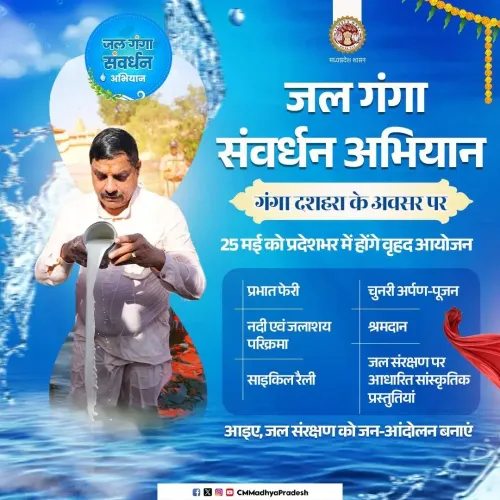
The 'Jal Ganga Sanvardhan Abhiyan' is cited as the model for a sustained, public-participation-based water conservation campaign to run alongside the structural works.
The directive responds to the threat of deficient rainfall and aims to build drought resilience ahead of future monsoon cycles.
The initiative builds on Madhya Pradesh 's earlier Mukhya Mantri Jal Swavalamban Abhiyan (launched 2016 ) for watershed development.
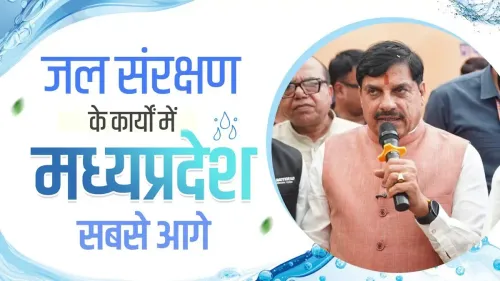
Madhya Pradesh Chief Minister Dr. Mohan Yadav on Thursday, 2 July 2026 directed that 'Jalabhishek 2.0' — a two-year action plan for revival of ponds, stepwells, and other water structures — be executed in mission mode to counter the threat of deficient rainfall across the state. The directive also calls for groundwater recharge works anchored in the principle 'khet ka paani khet mein, gaon ka paani gaon mein' ('farm water stays on the farm, village water stays in the village'), alongside a state-level water dashboard and a sustained public-participation conservation campaign.
Context
Responding to a post by @karansingh_158 on X, Chief Minister Dr. Mohan Yadav outlined a multi-pronged water security framework for Madhya Pradesh. He called for the revival of traditional water bodies — ponds and bawdis (stepwells) — through 'Jalabhishek 2.0', while simultaneously pushing for decentralised groundwater recharge at the farm and village level. The CM also directed that a public-participation campaign modelled on the existing 'Jal Ganga Sanvardhan Abhiyan' be scaled up into a sustained, long-term conservation drive.
The post signals that the state government is treating anticipated below-normal rainfall as an immediate planning challenge, not a reactive crisis. The two-year horizon of the action plan suggests a structured, pre-emptive approach to drought resilience ahead of future monsoon cycles.
Policy Backdrop
Madhya Pradesh has a track record of decentralised water harvesting initiatives. The Mukhya Mantri Jal Swavalamban Abhiyan, launched in 2016, focused on watershed development and the construction of water harvesting structures across rain-fed districts. 'Jalabhishek 2.0' appears to build on that lineage, extending it with a digital monitoring layer — the proposed state-level water dashboard — to track progress in real time.
The 'Jal Ganga Sanvardhan Abhiyan', cited by the CM as a model, is an existing Madhya Pradesh campaign that mobilises community participation for river and water body conservation. Elevating its approach into a mission-mode statewide programme reflects an effort to institutionalise what have so far been periodic drives into a continuous governance mechanism. This mirrors the architecture of national programmes such as the Jal Shakti Abhiyan, which combines community mobilisation with measurable district-level targets.
Stakeholders and Impact
Farmers and rural communities across Madhya Pradesh — particularly in rain-fed agricultural belts — stand as the primary beneficiaries of the proposed interventions. Groundwater recharge at the field level directly addresses irrigation stress during years of deficient monsoon, reducing dependence on erratic rainfall for crop cycles.
The proposed state water dashboard, if operationalised, would give district administrators and policymakers real-time visibility into the status of water structures and recharge works, enabling faster course corrections. Community-led conservation campaigns, meanwhile, aim to build local ownership of water assets — a factor that has historically determined the long-term sustainability of such infrastructure.
What's Next
Attention will now turn to the formal rollout of Jalabhishek 2.0, including its budget allocation, district-wise targets, and implementation timelines — none of which have been detailed in the directive so far. The design and integration of the state water dashboard with existing district-level reporting systems will be a key operational test.
The scaling of the public-participation campaign along the lines of the 'Jal Ganga Sanvardhan Abhiyan' will depend on how quickly the state can mobilise local bodies, gram panchayats, and civil society networks. How the government translates this mission-mode mandate into measurable, time-bound deliverables will determine whether Madhya Pradesh can meaningfully improve its drought preparedness ahead of the next agricultural season.
Point of View
Mission-mode response to climate variability rather than a reactive drought measure — a shift in framing that carries political weight in a state with a large agrarian constituency. By invoking the 'Jal Ganga Sanvardhan Abhiyan' as a template, the CM signals continuity with proven community-mobilisation models while layering in a digital accountability mechanism through the proposed water dashboard. The two-year horizon and mission-mode language suggest an intent to lock in institutional momentum beyond a single monsoon cycle. Whether this translates into funded, time-bound targets or remains an aspirational framework will be the defining test of its policy seriousness.
NationPress
2 Jul 2026
Frequently Asked Questions
What is Jalabhishek 2.0 in Madhya Pradesh?
Jalabhishek 2.0 is a two-year action plan announced by Madhya Pradesh Chief Minister Dr. Mohan Yadav for the revival of ponds, stepwells, and other water structures, combined with groundwater recharge works, to address the risk of deficient rainfall in the state.
What does 'khet ka paani khet mein, gaon ka paani gaon mein' mean?
The phrase means 'farm water stays on the farm, village water stays in the village' — a guiding principle for decentralised water retention and groundwater recharge at the local level rather than allowing runoff to drain away.
What is the Jal Ganga Sanvardhan Abhiyan?
The Jal Ganga Sanvardhan Abhiyan is an existing Madhya Pradesh public-participation campaign for river and water body conservation. CM Dr. Mohan Yadav has cited it as the model for a new sustained, community-led water conservation drive under the Jalabhishek 2.0 framework.
What is the state water dashboard proposed by CM Mohan Yadav?
The state-level water dashboard is a proposed digital monitoring tool for Madhya Pradesh that would provide real-time visibility into the status of water structures and groundwater recharge works, enabling better oversight by district administrators and policymakers.
How does Jalabhishek 2.0 relate to earlier MP water schemes?
Jalabhishek 2.0 builds on the Mukhya Mantri Jal Swavalamban Abhiyan launched in 2016, which focused on watershed development and water harvesting structures. The new plan extends that foundation with a two-year mission-mode mandate and a digital dashboard for monitoring progress.