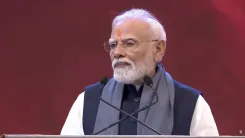
CM Sai, President Murmu Grace Bastar Dussehra 2026
Synopsis
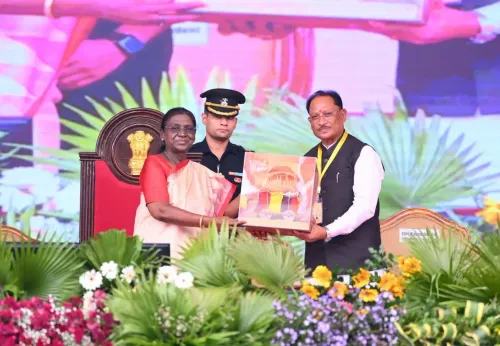
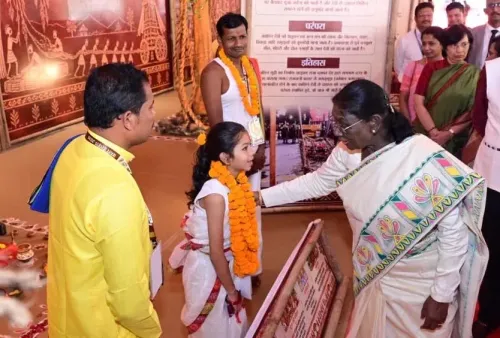
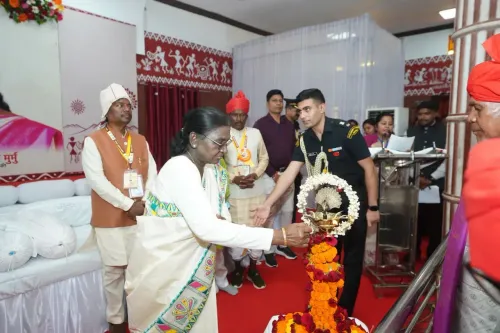
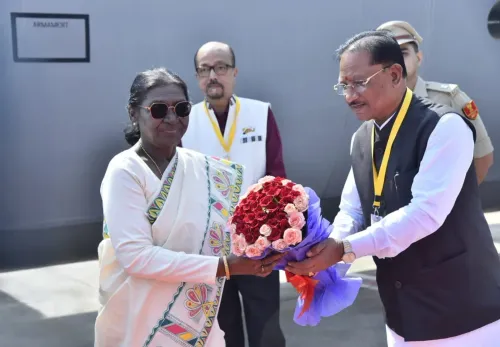
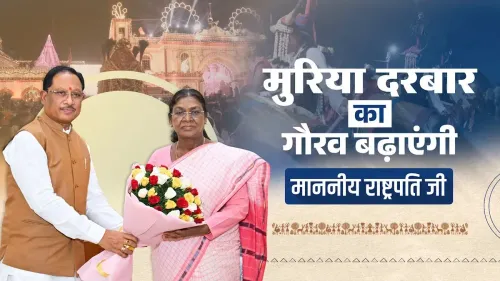
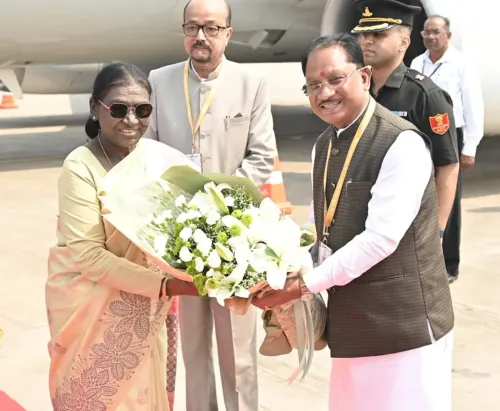
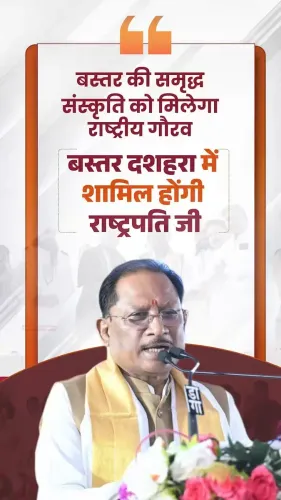
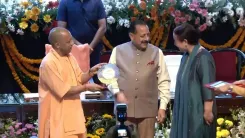
President Draupadi Murmu graced the Bastar Dussehra 2026 celebrations at Lalbag Maidan, Jagdalpur, alongside Chief Minister Vishnu Dev Sai — a historic presidential visit to the ancient 75-day tribal festival that the CMO linked to the transformed, post-Maoist security landscape in the region.
Key Takeaways
President Draupadi Murmu attended Bastar Dussehra 2026 at Lalbag Maidan, Jagdalpur on October 23, 2026 .
Chief Minister Vishnu Dev Sai hosted the event, with the Chief Minister's Office of Chhattisgarh officially announcing the occasion.
Bastar Dussehra is a distinct 75-day tribal festival centred on local deities, separate from mainstream Dussehra traditions.
The CMO framed the presidential visit as a milestone enabled by the decline of Maoist violence in the Bastar region following intensified security operations after 2019 .
President Murmu , India's first tribal-community President since 2022 , has consistently highlighted indigenous heritage at the national level.
State governments in Chhattisgarh have paired cultural promotion with counter-insurgency strategy in Bastar since the early 2000s.
A festival older than modern India itself got a historic upgrade on Friday, October 23, 2026 — when President Draupadi Murmu arrived at Lalbag Maidan, Jagdalpur to be part of the Bastar Dussehra celebrations, marking the first presidential presence at this ancient tribal event in living memory. The Chief Minister's Office of Chhattisgarh announced the occasion alongside Chief Minister Vishnu Dev Sai, framing it as proof that a transformed Bastar is ready to show itself to the nation.
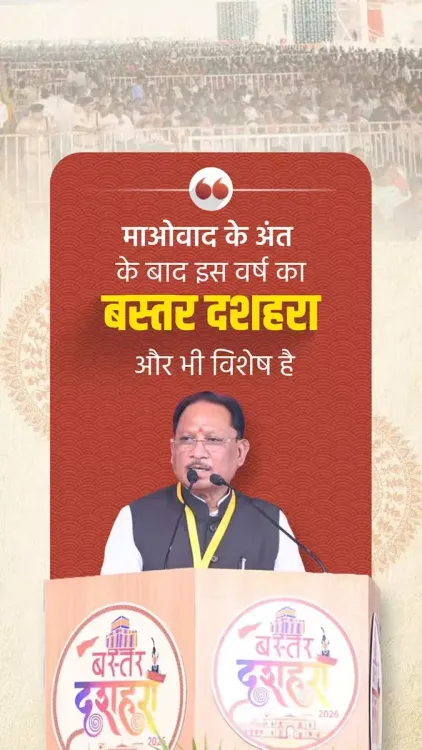
The CMO's post declared, 'Bastar Dussehra, Bastar ki samridh lokasanskriti aur gauravshali paramparaon ka aaina hai' — 'Bastar Dussehra is a mirror of Bastar's rich folk culture and glorious traditions.' It went further, linking President Murmu's dignified presence to the changed security landscape after the decline of Maoist violence, calling it a convergence that made this edition of the festival uniquely historic.
The 75-Day Festival That Defies Convention
Bastar Dussehra is unlike any other Dussehra in India. While the rest of the country burns an effigy of Ravana, Bastar's version — running for roughly 75 days — is centred entirely on local tribal deities, ancient processions, and community rituals that predate the Mughal era. The festival is governed by a council of priests and community representatives, not the state machinery, giving it a living, autonomous cultural heartbeat.
The region's tribal communities — who form the overwhelming majority of Bastar district in southern Chhattisgarh — treat this as their most sacred annual gathering. State governments have participated in an official capacity since the early 2000s, but a presidential visit of this kind elevates the festival's national profile to an entirely new register.
Why Murmu's Presence Carries Extra Weight
President Murmu, who assumed office in 2022 as India's first President from a tribal community, has consistently used her platform to spotlight indigenous heritage. Her visit to Jagdalpur is consistent with that arc — but its significance in the context of Bastar is sharper. For decades, this region was synonymous with Maoist insurgency; large-scale public events were frequently impossible or dangerous.
Security operations against Maoist groups in Bastar intensified significantly after 2019, with state and central forces reporting a progressive reduction in violence-affected areas. The ability to host a presidential visit at an open public ground in Jagdalpur is, by itself, a statement on how much the ground reality has shifted.
Sai's Tribal-First Political Agenda on Display
Chief Minister Vishnu Dev Sai, who took charge in December 2023, has centred his administration's identity around tribal development and the assertion of Chhattisgarh's indigenous cultural identity. His presence alongside the President at Lalbag Maidan was a visible alignment of that political agenda with institutional prestige.
State governments in Chhattisgarh have long understood that pairing counter-insurgency operations with cultural promotion is a necessary strategy for reasserting administrative presence in former Maoist strongholds. Bastar Dussehra, in that sense, is not merely a festival — it is a barometer. When it is celebrated freely, loudly, and at the highest level, it signals something the security briefings alone cannot.
Bastar is finding its voice again — and this year, the President of India came to listen.
Point of View
Hosting the President in Jagdalpur is a dual dividend: it burnishes the state's counter-insurgency credentials while reinforcing CM Sai's tribal-identity politics ahead of future electoral cycles. The move fits a broader national pattern of using symbolic gestures around indigenous culture to consolidate support in Scheduled Tribe constituencies, where Murmu's identity as India's first tribal President carries real emotional resonance. Whether this translates into sustained development investment in Bastar, or remains primarily a political-optics moment, will be the more telling story in the months ahead.
NationPress
23 Oct 2026
Frequently Asked Questions
What is Bastar Dussehra and how is it different from regular Dussehra?
Bastar Dussehra is a unique 75-day tribal festival in the Bastar region of Chhattisgarh centred on local tribal deities, ancient processions, and community rituals. Unlike mainstream Dussehra, which marks the victory of Ram over Ravana, Bastar's version has no effigy-burning — it is rooted entirely in the indigenous traditions of the region's tribal communities.
Why did President Draupadi Murmu attend Bastar Dussehra 2026?
President Murmu attended the Bastar Dussehra 2026 celebrations at Lalbag Maidan, Jagdalpur on October 23, 2026. As India's first President from a tribal community, she has consistently used her platform to highlight indigenous heritage, and the CMO framed her visit as making this edition of the festival historically significant.
What is the significance of Bastar Dussehra being held freely in 2026?
For decades, the Bastar region was affected by Maoist insurgency, which made large public events difficult or dangerous. Security operations after 2019 progressively reduced violence in the area, and the ability to host a presidential visit at an open public ground in Jagdalpur signals a meaningful shift in the security situation.
Who is Chief Minister Vishnu Dev Sai?
Vishnu Dev Sai is the Chief Minister of Chhattisgarh since December 2023, representing the BJP. His administration has focused on tribal development and cultural promotion alongside counter-insurgency efforts in the Bastar region.
Where is Bastar Dussehra held?
Bastar Dussehra's main celebrations are held in Jagdalpur, the principal city of Bastar district in southern Chhattisgarh. The 2026 event took place at Lalbag Maidan, Jagdalpur.