Dr. Jitendra Singh calls AI essential for governance at Jaipur e-Gov meet
Synopsis
At the National Conference on e-Governance in Jaipur, Union Minister Dr. Jitendra Singh declared AI an essential governance tool while urging a 'Human-led AI' model that keeps citizens central, marks 11 years of Digital India, and anchors technology in ethics and public trust.
Key Takeaways
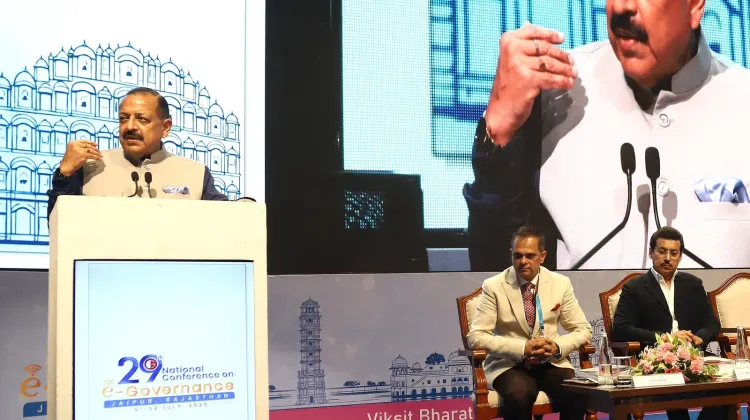
Jitendra Singh addressed the National Conference on e-Governance in Jaipur on 2 July 2026 .
The conference theme was 'AI-enabled, Data-driven, Secure, Digital Governance' .
The minister declared AI 'an essential component of governance,' not a matter of choice.
He called for a 'Human-led AI' philosophy where technology amplifies human capability rather than replacing human decision-making.
The address marked 11 years of the Digital India programme launched by PM Narendra Modi in 2015 .
Ethics, transparency and public trust were cited as the non-negotiable anchors for any AI deployment in public administration.
Union Minister of State (Independent Charge) for Science and Technology Dr. Jitendra Singh addressed the National Conference on e-Governance in Jaipur on 2 July 2026, declaring that artificial intelligence has moved beyond being optional and is now an essential pillar of modern governance. Speaking on the theme 'AI-enabled, Data-driven, Secure, Digital Governance', the minister laid out a human-centred philosophy for deploying AI in public administration.
Context
Dr. Singh stated that 'Artificial Intelligence has ceased to be a matter of choice and has become an essential component of governance.' He was careful to frame the challenge not as a technical one but as one of institutional readiness, saying the real test is 'whether governments possess the vision and maturity to deploy it responsibly with citizens remaining at the centre of every technological intervention.'
The minister invoked the completion of 11 years of Digital India, the flagship programme launched by Prime Minister Narendra Modi in 2015, to anchor his argument. He stressed that India's digital transformation was never intended to replace human decision-making with machines, but to empower public institutions with tools that improve transparency, accountability, efficiency and service delivery.
Policy Backdrop
The Digital India programme, launched in 2015, set the foundation for data-driven governance by expanding digital infrastructure, online public services and digital literacy across the country. It built on the earlier National e-Governance Plan approved in 2006, which computerised public services at central and state levels.
The current push to layer AI onto this infrastructure reflects a natural progression of that policy lineage. Successive administrations have emphasised citizen-centric design and institutional accountability as non-negotiable anchors, and Dr. Singh's remarks reinforce that continuity. His call for a 'Human-led AI' governance philosophy signals that the government intends to resist autonomous machine decision-making in public administration.
Stakeholders and Impact
Citizens, public institutions and government administrators are the three stakeholder groups most directly implicated by the minister's address. For citizens, the promise is improved service delivery and a governance experience built on trust. For institutions, it means adopting AI tools while maintaining human accountability at every decision node.
Dr. Singh called for a governance model where 'technology amplifies human capability, strengthens institutional credibility and improves citizens' experience while remaining firmly anchored in ethics, transparency and public trust.' This framing places ethical guardrails at the centre of any future AI procurement or deployment policy, with implications for both central ministries and state governments piloting digital services.
What's Next
The minister's emphasis on ethics, transparency and public trust points toward the possible articulation of formal AI governance guidelines by the relevant central ministries. State governments that have been running digital-service pilots will be watching for procurement standards and accountability frameworks that align with the 'Human-led AI' philosophy outlined at Jaipur.
As India's e-governance architecture matures into its second decade, the direction signalled at this conference suggests that the next phase will be defined not by the speed of AI adoption, but by the rigour of the ethical and institutional frameworks built around it.
Point of View
Not replacement' camp at a moment when many democracies are debating exactly how far to let algorithms penetrate public decision-making. By tethering the AI conversation to the 11-year Digital India legacy, he signals policy continuity rather than disruption, reinforcing the BJP government's narrative of incremental, institution-led modernisation. The explicit call for a 'Human-led AI' governance model could be a precursor to formal ethical guidelines or procurement standards, giving the ministry a normative stake in how state governments roll out AI-driven services. Politically, it allows the government to champion technological ambition while insulating itself from criticism over automation displacing human accountability in welfare delivery.
NationPress
2 Jul 2026
Frequently Asked Questions
What did Dr. Jitendra Singh say about AI and governance at Jaipur?
Dr. Jitendra Singh said that AI has become an essential component of governance and is no longer a matter of choice. He called for a 'Human-led AI' model where technology improves transparency and service delivery while citizens remain at the centre of every intervention.
What is the National Conference on e-Governance?
The National Conference on e-Governance is an annual government forum that reviews progress on electronic service delivery and digital administration across India. The 2026 edition was held in Jaipur with the theme 'AI-enabled, Data-driven, Secure, Digital Governance'.
How many years has Digital India been running?
As of 2026, the Digital India programme has completed 11 years. It was launched by Prime Minister Narendra Modi in 2015 to expand digital infrastructure, e-services and digital literacy across India.
What does 'Human-led AI' mean in Indian governance?
As articulated by Dr. Jitendra Singh, 'Human-led AI' means using artificial intelligence to amplify human capability and strengthen institutional credibility rather than replacing human decision-making. It requires AI deployment to remain anchored in ethics, transparency and public trust.
What could follow from Dr. Jitendra Singh's e-governance speech?
The minister's emphasis on ethics and accountability suggests possible issuance of AI governance or procurement guidelines by central ministries, as well as state-level adoption pilots that align with the 'Human-led AI' philosophy he outlined.