Emergency 51st anniversary: BJP CMs call 1975 imposition assault on Constitution
Synopsis
Fifty-one years after Indira Gandhi imposed the Emergency, BJP Chief Ministers from five states used the anniversary to mount a coordinated constitutional indictment — invoking 'Samvidhan Hatya Diwas' and saluting 'Democracy Warriors.' The chorus signals the BJP's sustained effort to cement 25 June as a permanent fixture in India's political memory.
Key Takeaways
BJP Chief Ministers from Uttar Pradesh , Delhi , Uttarakhand , Rajasthan , and Madhya Pradesh marked the 51st Emergency anniversary on 25 June 2025 .
CM Yogi Adityanath called the Emergency an attempt to 'crush the constitutional soul of the nation,' posting on social media platform X .
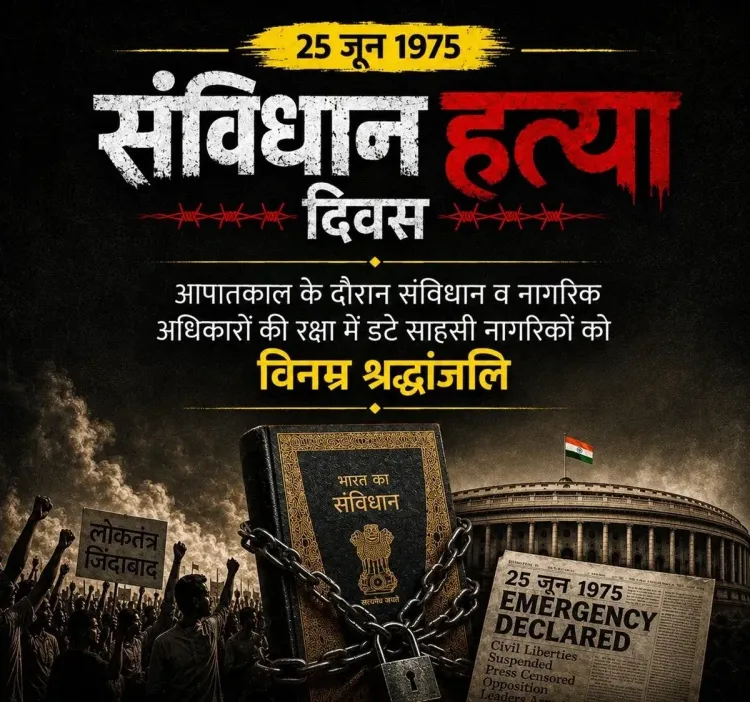
Delhi CM Rekha Gupta noted that 25 June is now observed as 'Samvidhan Hatya Diwas' — Day of the Murder of the Constitution.
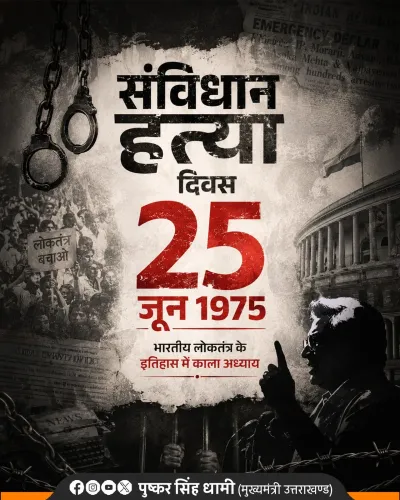
Uttarakhand CM Pushkar Singh Dhami said lakhs of citizens and political activists were imprisoned without trial during the Emergency.
All five CMs attributed the Emergency to the Congress government's 'arrogance of power' under then PM Indira Gandhi .
The Emergency lasted from 25 June 1975 to 21 March 1977 , suspending fundamental rights and imposing press censorship.
On the 51st anniversary of the Emergency, several Bharatiya Janata Party (BJP) Chief Ministers on Thursday, 25 June condemned the imposition of the Emergency on 25 June 1975 as a deliberate assault on India's constitutional framework, civil liberties, and democratic institutions — squarely attributing the decision to the then Indian National Congress government led by Prime Minister Indira Gandhi.
Yogi Adityanath: 'Crushing the Constitutional Soul'
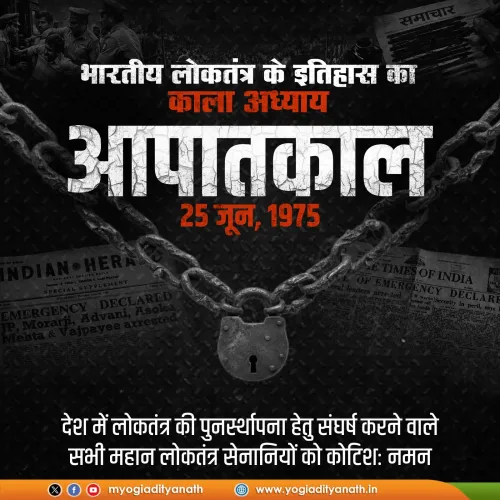
Uttar Pradesh Chief Minister Yogi Adityanath posted a tribute on social media platform X, writing in Hindi that 25 June 1975 marked 'a dark chapter in the history of Indian democracy — a time when an attempt was made to crush the constitutional soul of the nation by imposing the Emergency.' He described the Emergency as born of 'the arrogance of power' and said it 'dealt a severe blow to freedom of expression and civil liberties.' Adityanath extended 'a million salutations' to what he called 'Democracy Warriors' who resisted the crackdown 'while enduring brutal torture.'
Delhi CM Rekha Gupta Invokes 'Samvidhan Hatya Diwas'
Delhi Chief Minister Rekha Gupta termed 25 June 1975 one of the darkest days in India's democratic history, noting that the date is now observed as 'Samvidhan Hatya Diwas' — literally, the Day of the Murder of the Constitution. She said the Emergency was 'the most severe blow ever dealt to India's democracy and Constitution,' adding that the Congress-led decision 'inflicted deep wounds on democratic institutions.' According to Gupta, civil rights were violated, press freedom was shackled, and freedom of expression was stifled during that period.
Dhami, Sharma, Yadav Add Their Voices
Uttarakhand Chief Minister Pushkar Singh Dhami, also posting on X, said the Congress government of 1975 was 'intoxicated by the arrogance of power' when it imposed the Emergency, during which 'lakhs of citizens and political activists were imprisoned without trial' and 'fundamental rights guaranteed by the Constitution were severely curtailed.' Dhami characterised the Emergency as 'not merely a political decision' but 'a severe assault on democratic values and constitutional propriety,' crediting those who resisted with keeping India 'a vibrant democracy today.'
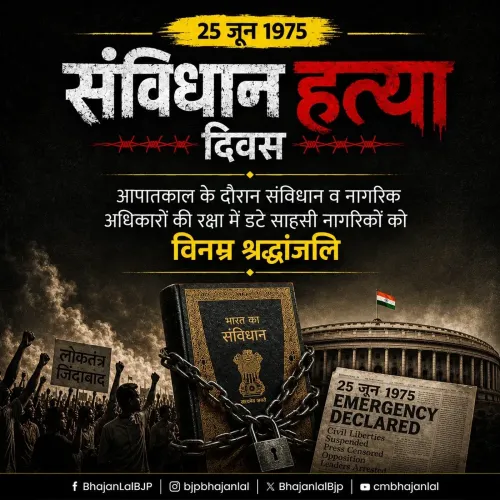
Rajasthan Chief Minister Bhajanlal Sharma echoed that framing, saying the Emergency was marked by 'blatant suppression of freedom of expression, civil rights, and constitutional values, alongside attempts to weaken democratic institutions.' He paid tribute to 'Democracy Warriors and patriots who, despite enduring immense suffering, repression, and persecution during that dark era, fought to protect and restore democracy.'
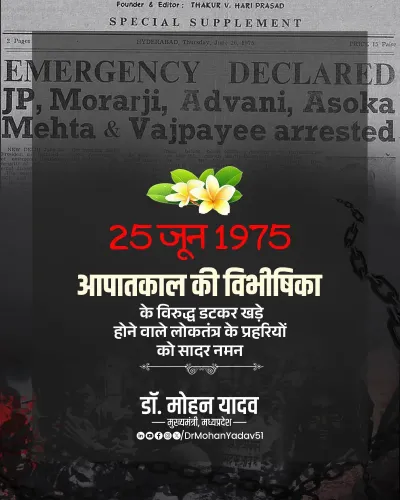
Madhya Pradesh Chief Minister Mohan Yadav called 25 June 1975 'the darkest day in the history of Indian democracy,' attributing the Emergency to 'the arrogance of the Indira government.' He called on citizens to 'pledge to continue serving the nation with unwavering dedication to the cause of protecting democracy.'
Political Context and the 'Samvidhan Hatya Diwas' Framing
The coordinated statements from BJP Chief Ministers across Uttar Pradesh, Delhi, Uttarakhand, Rajasthan, and Madhya Pradesh reflect a broader BJP effort to institutionalise the Emergency anniversary as a political counter-narrative against the Congress. The designation of 25 June as Samvidhan Hatya Diwas — a term now in active use by BJP leaders — signals an attempt to embed the Emergency into public memory as a constitutional, not merely political, transgression. This comes amid continued BJP-Congress rivalry over constitutional legacy and democratic credentials.
What the Emergency Was
The Emergency, declared by then Prime Minister Indira Gandhi on 25 June 1975 and lasting until 21 March 1977, suspended fundamental rights, imposed press censorship, and enabled mass detention of political opponents under preventive detention laws. It remains one of the most contested episodes in post-Independence Indian history. The 51st anniversary marks a continued effort by BJP-ruled governments to keep the episode in national political discourse as a cautionary symbol.
Point of View
All on the same day, using near-identical framing — is less spontaneous commemoration and more structured political messaging. The adoption of 'Samvidhan Hatya Diwas' as a shared vocabulary is notable: it attempts to shift the Emergency debate from a political-historical argument to a constitutional-moral one, making it harder for Congress to contest on purely electoral grounds. What mainstream coverage underplays is that this annual ritual has grown more institutionalised with each passing year, suggesting the BJP intends the Emergency to remain a live political liability for Congress well into the 2029 election cycle. The risk for the BJP is that repeated invocation without fresh policy substance can eventually feel like a substitute for accountability on present-day democratic concerns.
NationPress
25 Jun 2026
Frequently Asked Questions
What is the Emergency that BJP CMs are commemorating on 25 June?
The Emergency refers to a 21-month period from 25 June 1975 to 21 March 1977, during which then Prime Minister Indira Gandhi suspended fundamental rights, imposed press censorship, and enabled mass detention of political opponents. It is widely regarded as the most severe curtailment of civil liberties in post-Independence India.
What is 'Samvidhan Hatya Diwas' and why is it significant?
'Samvidhan Hatya Diwas,' meaning Day of the Murder of the Constitution, is the designation given to 25 June by BJP leaders to mark the Emergency's imposition. Delhi CM Rekha Gupta noted the day is now formally observed under this name, reflecting the BJP's effort to frame the Emergency as a constitutional transgression rather than a mere political event.
Which BJP Chief Ministers spoke on the Emergency anniversary?
Chief Ministers Yogi Adityanath (Uttar Pradesh), Rekha Gupta (Delhi), Pushkar Singh Dhami (Uttarakhand), Bhajanlal Sharma (Rajasthan), and Mohan Yadav (Madhya Pradesh) all issued statements on 25 June condemning the 1975 Emergency.
Why do BJP leaders hold the Congress responsible for the Emergency?
The Emergency was declared by the Congress government under Prime Minister Indira Gandhi on 25 June 1975. BJP leaders argue it was an act of political self-preservation — imposed after the Allahabad High Court invalidated Gandhi's 1971 election — and represent it as evidence of Congress's willingness to subvert constitutional norms when in power.
How long did the Emergency last and what were its key impacts?
The Emergency lasted approximately 21 months, from 25 June 1975 to 21 March 1977. During this period, fundamental rights were suspended, the press was censored, and lakhs of citizens and political activists were reportedly detained without trial under preventive detention laws.