Giriraj Singh: 170 Firms Join Textiles PLI Scheme
Synopsis
Union Textiles Minister Giriraj Singh announced that 170 companies — including a significant number of MSMEs — have joined the PLI scheme for MMF Apparel, MMF Fabric, and Technical Textiles, citing positive prospects for investment, production, and employment following recent scheme modifications.
Key Takeaways
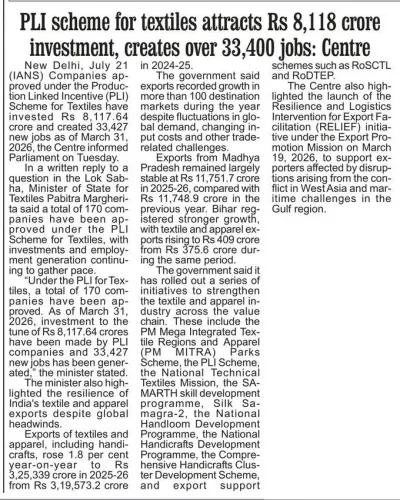
170 companies have enrolled under India's PLI scheme for textiles as of July 2026, with a large share being MSMEs .
The scheme targets MMF Apparel, MMF Fabric, and Technical Textiles — segments where India has historically lagged global competitors.
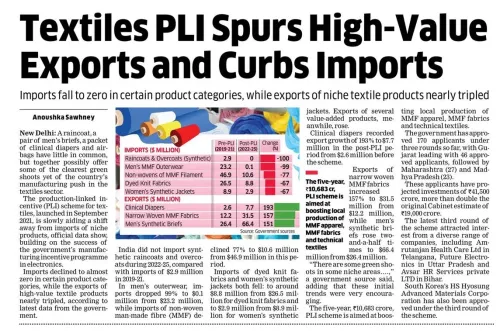
The Union Cabinet approved the PLI textiles scheme in September 2021 with an outlay of Rs 10,683 crore over five years .
Recent modifications to the scheme are credited with attracting broader industry participation beyond large corporates.
Actual economic impact depends on the disbursement and monitoring phase — incentives are paid only on verified incremental production.
The textiles PLI is part of India's wider sector-specific PLI rollout launched since 2020 to boost domestic manufacturing and cut import dependence.
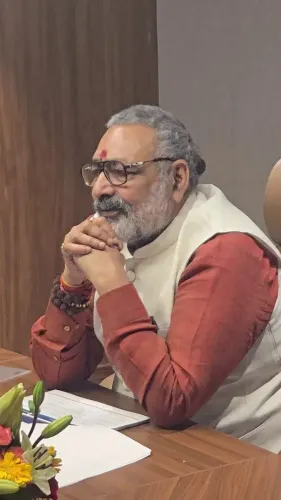
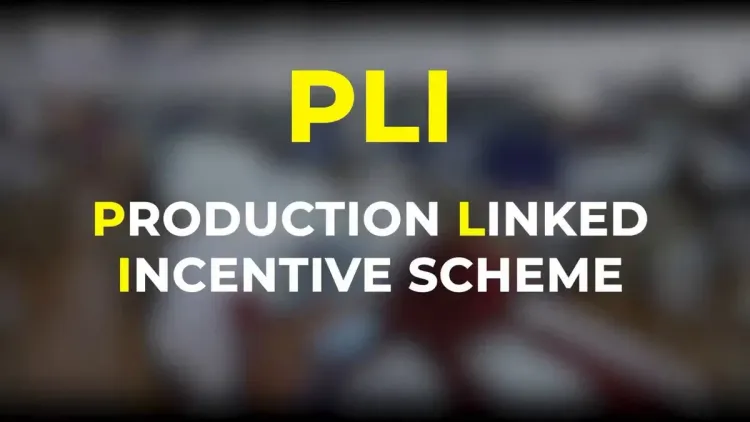
India's textiles manufacturing push is pulling in companies at scale. Union Textiles Minister Giriraj Singh announced on Thursday, July 30, 2026 that 170 companies have now enrolled under the Production Linked Incentive (PLI) scheme for textiles — with a significant share of MSMEs among them — signalling that recent tweaks to the programme are opening doors beyond large industrial players.
Posting on X, the Minister stated: 'PLI yojana ke tahat haal ke badlaavon ke baad adhik kampaniyon ki bhaagidaari dekhne ko mili hai' ('After recent changes to the PLI scheme, greater participation from more companies has been seen'). He highlighted positive momentum in investment, production, and job creation across MMF Apparel, MMF Fabric, and Technical Textiles — the three segments the scheme was designed to turbocharge.
What the PLI Scheme for Textiles Was Built to Do
The Union Cabinet approved the PLI scheme for textiles in September 2021 with an outlay of Rs 10,683 crore over five years. The target was clear: pull India into man-made fibre and technical textiles — segments where China and other Asian competitors had long outpaced Indian manufacturers. Cotton dominates India's textile exports, but MMF and technical textiles command higher global value and growing demand. The scheme offered incentives pegged to incremental production, rewarding companies that actually manufactured rather than simply planned to.
The inclusion of MSMEs in large numbers is the detail worth watching. Earlier rounds of PLI schemes across sectors drew criticism for favouring large corporates with the capital and compliance capacity to qualify. If the textiles scheme is now reaching smaller manufacturers, it broadens both the industrial base and the employment potential — textiles being among India's most labour-intensive sectors.
170 Companies In — and What Comes Next
Reaching 170 enrolled companies marks a participation milestone, but the harder test is disbursement. PLI incentives are paid out only after companies demonstrate actual incremental production against verified baselines — meaning the real economic impact will show in the monitoring and payout phases ahead. Investment commitments, factory ramp-ups, and jobs created on the ground are the numbers that will determine whether the scheme delivers on its promise.
India's broader PLI architecture — rolled out across more than a dozen sectors since 2020 — rests on the logic that demand-linked incentives can compress the time it takes domestic industry to reach global competitiveness. Textiles, with its direct link to rural employment and export earnings, is one of the higher-stakes bets in that portfolio.
With 170 companies now in the tent and MSMEs part of the story, the scheme's next chapter is less about sign-ups and more about output — and whether the factories actually hum.
Point of View
But the scheme's real test lies in the disbursement pipeline — PLI payouts are production-linked, not registration-linked. The notable MSME inclusion is politically and economically significant: it responds to earlier criticism that PLI schemes concentrated benefits among large industry, and it aligns with the government's broader narrative of inclusive industrial growth. For Giriraj Singh, who took charge of the Textiles Ministry, amplifying this data point ahead of any budget or policy review cycle is also a way of building a performance record in a ministry that carries heavy electoral weight in states like Gujarat, Tamil Nadu, and Maharashtra.
NationPress
30 Jul 2026
Frequently Asked Questions
What is the PLI scheme for textiles in India?
The Production Linked Incentive (PLI) scheme for textiles was approved by the Union Cabinet in September 2021 with an outlay of Rs 10,683 crore over five years . It offers incentives to companies that achieve incremental production in MMF Apparel, MMF Fabric, and Technical Textiles segments.
How many companies have joined the textiles PLI scheme?
As of July 2026 , 170 companies have enrolled under the PLI scheme for textiles, including a significant number of MSMEs, according to Union Textiles Minister Giriraj Singh.
What are MMF textiles and why do they matter for India?
MMF stands for Man-Made Fibre. MMF Apparel and MMF Fabric are high-value textile segments where India has historically had a smaller global share compared to cotton textiles. Expanding MMF manufacturing is seen as key to boosting India's textile export earnings and reducing import dependence.
What role do MSMEs play in India's textiles PLI scheme?
MSMEs — Micro, Small and Medium Enterprises — are participating in the textiles PLI scheme in large numbers, according to the Minister. Their inclusion is significant because it broadens the industrial base and the scheme's potential for employment generation in a labour-intensive sector.
When will companies start receiving PLI incentives for textiles?
PLI incentives are disbursed only after companies demonstrate verified incremental production against set baselines. The scheme is now moving into its disbursement and monitoring phase, where actual investment, output, and employment numbers will be tracked.