Giriraj Singh: Arunachal Weaver's Income Doubles with Govt Aid
Synopsis
Union Textiles Minister Giriraj Singh spotlighted Arunachal artisan Rinchin Dema Lama, whose monthly income rose from ₹12,000 to ₹25,000 through government support, market-access linkages and skill-development — citing it as proof of the 'empowered weavers, prosperous India' agenda.
Key Takeaways
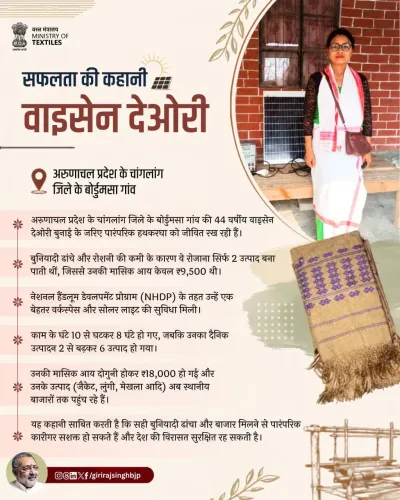
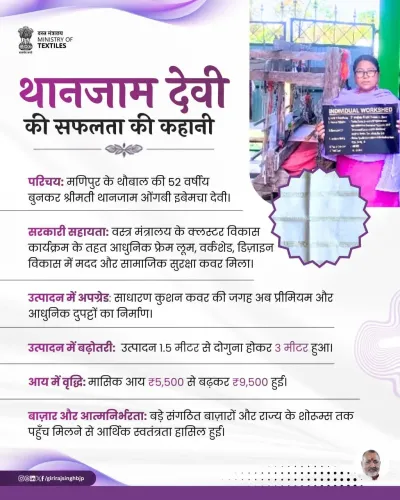
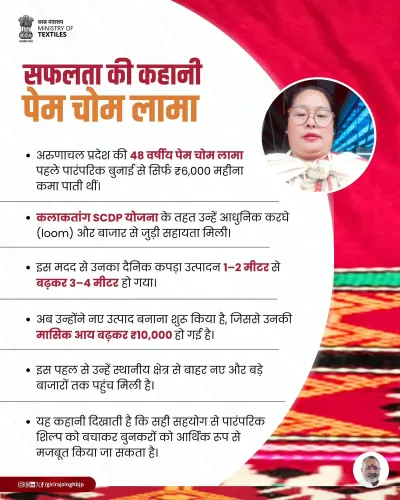
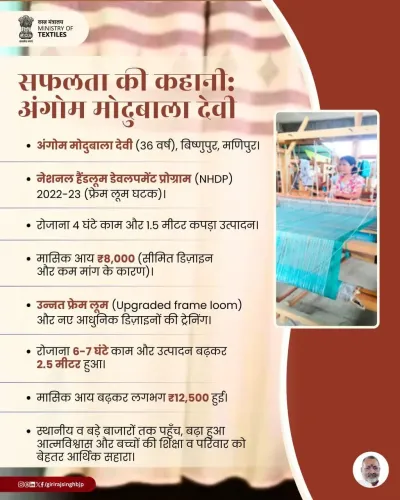
Rinchin Dema Lama , a handloom artisan from Arunachal Pradesh , saw her monthly income rise from ₹12,000 to ₹25,000 — more than doubling.
The growth is attributed to three central interventions: government subsidies , improved market access , and skill-development training .
Union Textiles Minister Giriraj Singh shared the case on 27 October 2026 as an outcome showcase for artisan welfare schemes.
Northeast India , including Arunachal Pradesh, has been a targeted geography for handloom and handicraft welfare programmes under central schemes.
The Ministry's tagline — 'Sashakt bunkar, samridh Bharat' ('Empowered weavers, prosperous India') — signals the political framing of artisan income growth as a national prosperity indicator.
A single number tells the story: a monthly income of ₹12,000 climbing to ₹25,000. Union Textiles Minister Giriraj Singh on Tuesday, 27 October 2026, shared the journey of Smt. Rinchin Dema Lama, a handloom artisan from Arunachal Pradesh, as evidence that government-backed welfare programmes are translating into real household gains in India's Northeast.
Posting in Hindi, the Minister wrote: 'Sarkari sahayata, behtar baazar tak pahunch aur kaushal vikas ke avsar' — 'Government support, better market access and skill-development opportunities' — had given Rinchin Dema Lama's productivity 'new momentum,' more than doubling her monthly earnings. He closed with the tagline: 'Sashakt bunkar, samridh Bharat' — 'Empowered weavers, prosperous India.'
Rinchin Dema Lama's income leap: what changed
The three levers the Minister named — government subsidies, market-access linkages, and skill-upgradation training — are the core pillars of India's handloom development architecture, which has been refined across successive Five Year Plan cycles. For Northeast artisans, who produce culturally distinctive textiles with limited formal distribution networks, the market-access piece has historically been the weakest link. Bridging that gap is precisely what central schemes targeting handloom clusters in states like Arunachal Pradesh aim to do.
Rinchin Dema Lama's case, as cited by the Minister, illustrates the compounding effect: once a weaver can sell more of what she produces at better prices, the same loom hours yield proportionally higher returns. That is how a ₹12,000 floor becomes a ₹25,000 ceiling — without a capital-intensive change in the production model itself.
Northeast handlooms in India's textiles welfare push
Arunachal Pradesh sits within a broader Northeast textile belt that the central government has increasingly spotlighted for targeted intervention. The region's handloom tradition is both an economic asset and a cultural heritage marker, making artisan-welfare schemes here politically and symbolically significant for a ministry keen to showcase inclusive growth.
Central ministries have routinely publicised individual beneficiary stories to put a human face on aggregate scheme outcomes — and the Textiles Ministry under Giriraj Singh has continued that practice, using social media to bridge the distance between policy announcements in Delhi and ground-level results in states like Arunachal. The Minister's post carries the weight of that communication strategy: one artisan, one income figure, one clean headline.
The next test will be whether the upcoming textiles budget and scheme evaluation reports show that Rinchin Dema Lama's trajectory is a pattern — not an exception.
Point of View
Amplifying Northeast success stories serves a dual purpose: demonstrating scheme efficacy ahead of budget cycles and reinforcing the BJP government's inclusive-growth narrative in a strategically sensitive border region. The ₹25,000 figure, if representative of a broader trend, would signal meaningful progress in raising the income floor for India's estimated 35 lakh handloom weavers. The critical question policymakers and evaluators will ask is whether individual showcases reflect systemic scale — or whether market-access gains remain concentrated among a select cohort of linked artisans.
NationPress
27 Oct 2026
Frequently Asked Questions
Who is Rinchin Dema Lama and why is she in the news?
Rinchin Dema Lama is a handloom artisan from Arunachal Pradesh whose monthly income reportedly rose from ₹12,000 to ₹25,000 after receiving government support, better market access and skill-development training. Union Textiles Minister Giriraj Singh cited her case on 27 October 2026 to illustrate the impact of artisan welfare schemes.
What government schemes help handloom weavers in Arunachal Pradesh?
The central government runs handloom development schemes providing subsidies, skill-upgradation training and marketing support to weavers. Northeast states, including Arunachal Pradesh, receive targeted assistance under textiles and handicraft programmes aimed at raising rural household incomes.
What did Textiles Minister Giriraj Singh post about weavers?
On 27 October 2026, Minister Giriraj Singh posted that government assistance, improved market access and skill-development opportunities had more than doubled Arunachal artisan Rinchin Dema Lama's monthly income — from ₹12,000 to ₹25,000 — under the banner 'Empowered weavers, prosperous India.'
How many handloom weavers are there in India?
India has an estimated 35 lakh (3.5 million) handloom weavers, making the sector one of the largest rural employment generators after agriculture. Northeast states account for a significant share of this workforce.
What is the significance of Northeast India in the handloom sector?
Northeastern states like Arunachal Pradesh have a strong tradition of handloom weaving, producing culturally distinctive textiles. The region has received targeted central government attention through textile and handicraft schemes designed to improve rural incomes and preserve heritage crafts.