Giriraj Singh flags crochet and hand knitting as jobs, green growth lever
Synopsis
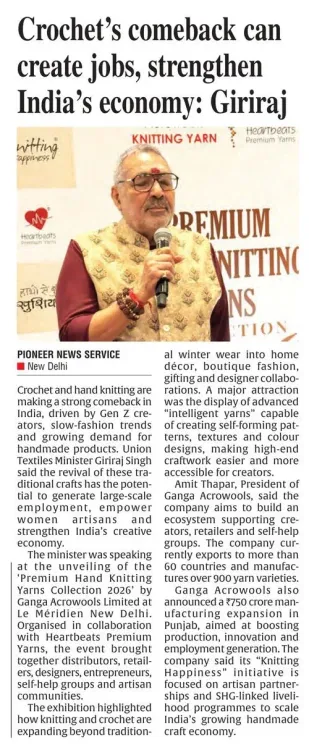
Union Textiles Minister Giriraj Singh has spotlighted the revival of crochet and hand knitting as an eco-friendly engine for mass employment and women's empowerment, tying the growth of innovative 'intelligent yarns' to the Atmanirbhar Bharat agenda and India's expanding creative economy.
Key Takeaways
Giriraj Singh , Union Textiles Minister, flagged the revival of crochet and hand knitting as eco-friendly drivers of large-scale employment on 23 May 2026 .
The minister linked 'innovative and intelligent yarns' to strengthening India's creative economy and the Atmanirbhar Bharat vision.
The Ministry of Textiles oversees key schemes including the PLI Scheme for Textiles (approved September 2021 ) and the National Handloom Development Programme .
Primary beneficiaries identified are women artisans , handloom weavers , and textile MSMEs , especially in rural clusters.
The minister's emphasis on slow fashion and eco-friendly techniques aligns with global circular-economy trends increasingly reflected in Indian policy.
Upcoming Union Budget allocations and parliamentary sessions will be watched for concrete policy or funding announcements on sustainable textiles.
Union Textiles Minister Giriraj Singh on Saturday, 23 May 2026, highlighted the revival of crochet and hand knitting as a convergence of environmental sustainability, large-scale employment generation, and women's empowerment, framing it as a pillar of India's broader self-reliance agenda. The minister, posting on X, also pointed to the development of innovative 'intelligent yarns' as a catalyst for strengthening India's creative economy.
Context
In his post, Singh wrote — translated from Hindi — that 'Crochet' aur 'Hand Knitting' ka punruththan [the revival of crochet and hand knitting] is opening new doors for large-scale employment and women's empowerment alongside being eco-friendly. He specifically credited the growth of 'innovative and intelligent yarns' with reinforcing India's creative economy and giving fresh momentum to the Atmanirbhar Bharat vision. The post was accompanied by an image and carried hashtags including #SlowFashion, #WomenEmpowerment, and #AtmanirbharBharat.
Policy Backdrop
The Ministry of Textiles, which Singh heads, is the nodal body for handloom development, handicraft promotion, and textile export strategy across India's vast value chain. The Atmanirbhar Bharat Abhiyan, launched in May 2020, identified textiles as a key employment-intensive sector and has since shaped policy priorities ranging from import substitution to craft revival. The Production Linked Incentive (PLI) Scheme for Textiles, approved in September 2021, further extended these goals by incentivising investment in apparel and technical textiles to generate jobs at scale.
Longer-standing instruments such as the National Handloom Development Programme have supported traditional crafts and women weavers since the early 2010s, providing an institutional foundation on which newer yarn-innovation initiatives can build. The minister's emphasis on eco-friendly techniques and slow fashion also mirrors the global circular-economy discourse that Indian policymakers have increasingly adopted in recent years.
Stakeholders and Impact
The communities most directly addressed by Singh's remarks are women artisans, handloom weavers, and textile micro, small and medium enterprises (MSMEs) — segments that have historically borne the brunt of competition from cheaper synthetic imports. A renewed policy focus on hand-crafted, eco-friendly textiles could expand market access and income opportunities for these groups, particularly in rural clusters where crochet and knitting are already practiced as cottage industries.
The reference to 'intelligent yarns' — a term covering technologically enhanced fibres with properties such as moisture management, thermal regulation, or biodegradability — signals the ministry's intent to blend traditional craft with material innovation. This dual approach could help Indian products command premium positioning in both domestic and export markets aligned with slow-fashion values.
What's Next
Observers will watch upcoming Union Budget allocations and any revised guidelines under the PLI Scheme or handloom programmes for concrete financial commitments behind the minister's stated priorities. Parliamentary sessions may also see new technical-textile or sustainable-yarn policy announcements that translate this vision into enforceable targets and funding. If the government formalises support mechanisms — whether through procurement mandates, export incentives, or skilling programmes — the revival of crochet and hand knitting could move from ministerial aspiration to a measurable economic outcome for India's artisan workforce.
Point of View
Giving the government's self-reliance agenda a grassroots, women-centric face ahead of potential budget or policy announcements. By coupling eco-friendly slow fashion with the more technical concept of 'intelligent yarns,' the minister is straddling two distinct constituencies — rural artisans and modern textile innovators — signalling that the ministry sees no contradiction between heritage and high-tech. The framing around women's empowerment is politically significant: it positions the BJP-led government's textile policy as a social equity instrument, not merely an industrial one. Whether this translates into new scheme allocations or remains aspirational rhetoric will be the real test of intent.
NationPress
7 Oct 2026
Frequently Asked Questions
What did Giriraj Singh say about crochet and hand knitting?
Union Textiles Minister Giriraj Singh said the revival of crochet and hand knitting is eco-friendly and is opening new avenues for large-scale employment and women's empowerment in India, while also strengthening the country's creative economy through innovative 'intelligent yarns.'
What are 'intelligent yarns' in the context of Indian textiles?
'Intelligent yarns' is a term for technologically enhanced fibres with advanced properties such as moisture management, thermal regulation, or biodegradability. Singh referenced their development as a driver of India's creative economy under the Atmanirbhar Bharat framework.
How does crochet and hand knitting revival relate to Atmanirbhar Bharat?
Atmanirbhar Bharat, launched in May 2020, identified textiles as a key employment-intensive sector. The revival of labour-intensive crafts like crochet and hand knitting supports the initiative's goals of domestic manufacturing, import substitution, and job creation.
Which government schemes support handloom and craft revival in India?
Key schemes include the National Handloom Development Programme, which has supported traditional crafts and women weavers since the early 2010s, and the Production Linked Incentive (PLI) Scheme for Textiles, approved in September 2021 to boost investment and employment in the sector.
How does slow fashion connect to India's textile policy?
Slow fashion emphasises eco-friendly, durable, and handcrafted goods over mass-produced synthetics. Indian policymakers have aligned this approach with circular-economy goals and the Atmanirbhar Bharat strategy, which seeks to reduce dependence on imported fabrics while expanding artisan livelihoods.