Giriraj Singh backs tribal-language books for Bastar children under NEP 2020
Synopsis
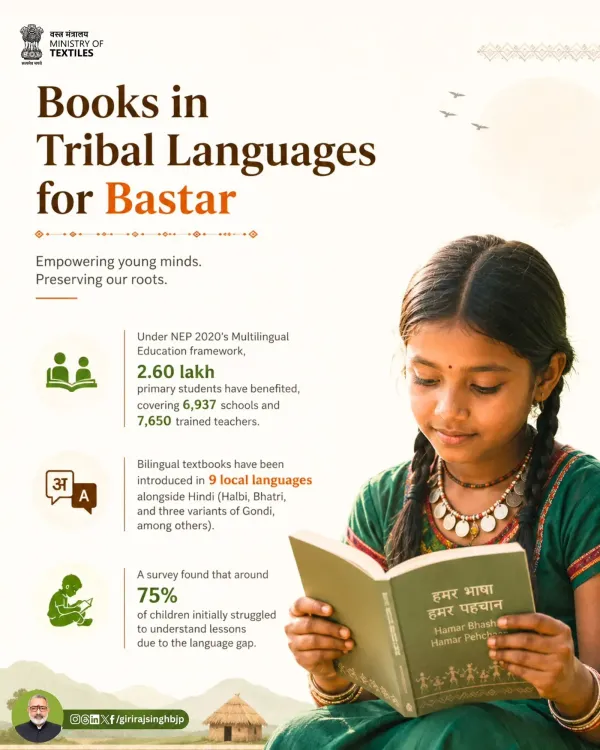
Union Textiles Minister Giriraj Singh has backed an initiative to supply tribal-language textbooks to lakhs of children in Bastar under NEP 2020, saying mother-tongue education helps children learn better, build confidence, and stay rooted in their cultural identity.
Key Takeaways
Giriraj Singh on 21 July 2026 highlighted a push to deliver books in tribal languages to lakhs of children in Bastar, Chhattisgarh .
The initiative is framed under NEP 2020 , which mandates mother-tongue instruction up to at least Grade 5 .
Bastar is home to multiple tribal language communities including Gondi, Halbi, Bhatri, and Dorli speakers.
The minister said the effort helps children understand lessons better, grow with confidence, and preserve their cultural identity.
The drive aligns with the broader Viksit Bharat 2047 goal of inclusive, culturally grounded education.
Success in Bastar could provide a replicable model for tribal-language education in states like Jharkhand, Odisha, and Madhya Pradesh .
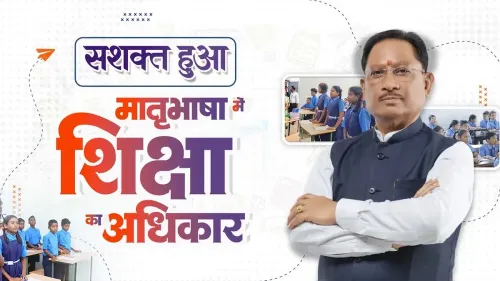
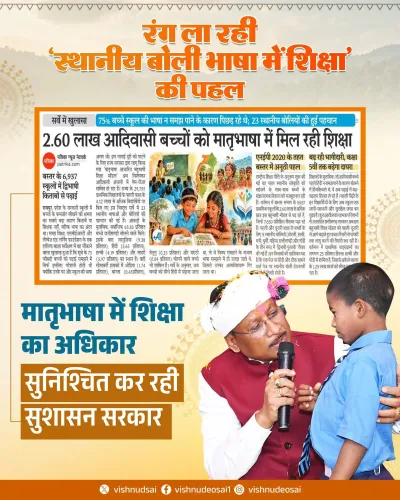
Union Textiles Minister Giriraj Singh on Tuesday, 21 July 2026 highlighted an initiative to deliver books in tribal languages to lakhs of children in Bastar, Chhattisgarh, calling it a step toward promoting mother-tongue education under the National Education Policy (NEP) 2020.
In a post on X, the senior BJP leader wrote: 'स्थानीय भाषाओं में पढ़ाई बच्चों के लिए सीखना आसान बनाती है' ('Studying in local languages makes learning easier for children'). He added that the effort helps children stay connected to their language, culture, and traditions while building confidence and preserving cultural identity.
Context
Bastar is a predominantly tribal division in southern Chhattisgarh, home to several indigenous communities including the Gondi, Halbi, Bhatri, and Dorli language speakers. Generations of children in the region have faced learning barriers because classroom instruction was delivered in languages unfamiliar at home, contributing to high dropout rates in early grades.
The initiative described by Giriraj Singh seeks to bridge that gap by making curriculum materials available in the languages children actually speak, a recognised best practice in foundational literacy research globally.
Policy Backdrop
NEP 2020, approved by the Union Cabinet in July 2020, explicitly recommends that the medium of instruction up to at least Grade 5 — and preferably up to Grade 8 — be the home language, mother tongue, or regional language. It also calls for the development of high-quality textbooks and teaching-learning materials in Indian languages, including tribal and scheduled languages.
The policy is a cornerstone of the government's Viksit Bharat 2047 vision, which aims to build an educated, skilled, and culturally rooted population by the centenary of India's independence. Tribal education has been identified as a priority area under Eklavya Model Residential Schools and other centrally sponsored schemes.
Stakeholders and Impact
Bastar's tribal belt spans districts including Bastar, Kondagaon, Narayanpur, Bijapur, Sukma, Dantewada, and Kanker. Collectively, these districts are home to a substantial scheduled tribe population for whom access to mother-tongue educational materials can meaningfully improve foundational literacy outcomes.
Educationists and tribal rights advocates have long argued that children learn to read and reason faster when initial instruction is in their first language, and that such an approach also reduces the stigma sometimes associated with indigenous languages. By framing the delivery of tribal-language books as a cultural-identity initiative — not merely a pedagogical one — the government is signalling a broader commitment to linguistic diversity under #ViksitBharat2047.
What's Next
The scale of the effort — described as reaching lakhs of children across Bastar — will depend on sustained production and distribution pipelines for books in multiple tribal languages, along with teacher training in multilingual pedagogy. If the Bastar model proves effective, it could serve as a template for similar tribal-language education drives in other states with large indigenous populations, such as Jharkhand, Odisha, Madhya Pradesh, and Maharashtra.
With NEP 2020 implementation still uneven across states, political advocacy from Union ministers like Giriraj Singh keeps the spotlight on under-resourced communities and may accelerate resource allocation for tribal-language curriculum development in the months ahead.
Point of View
A combination that broadens the BJP's appeal among scheduled tribe communities ahead of state and national electoral cycles. It also reflects a pattern of senior cabinet ministers amplifying education and social-sector deliverables on social media to demonstrate whole-of-government ownership of NEP 2020. The real test will be whether book distribution translates into trained multilingual teachers and measurable learning outcomes on the ground.
NationPress
21 Jul 2026
Frequently Asked Questions
What did Giriraj Singh say about tribal language education in Bastar?
Giriraj Singh said that studying in local languages makes learning easier for children and that delivering books in tribal languages to lakhs of children in Bastar under NEP 2020 promotes mother-tongue education, helping children understand lessons better, grow with confidence, and preserve their cultural identity.
What is NEP 2020 and what does it say about mother-tongue education?
The National Education Policy 2020, approved by the Union Cabinet in July 2020, recommends that the medium of instruction up to at least Grade 5 — and preferably Grade 8 — be the child's home language or mother tongue, and calls for textbooks in Indian languages including tribal languages.
Which tribal languages are spoken in Bastar, Chhattisgarh?
Bastar is home to several indigenous language communities, with Gondi, Halbi, Bhatri, and Dorli being among the prominent tribal languages spoken across the division's seven districts.
How does mother-tongue education help tribal children?
Research and policy frameworks consistently show that children learn foundational literacy and numeracy faster when taught initially in their first language; it also reduces school dropout rates, builds confidence, and helps preserve indigenous cultural identity.
What is Viksit Bharat 2047 and how does tribal education fit into it?
Viksit Bharat 2047 is the government's vision to make India a developed nation by the centenary of independence in 2047; inclusive, quality education for all communities — including tribal populations — is a stated pillar of that goal, making initiatives like the Bastar tribal-language book drive directly relevant to the broader national agenda.