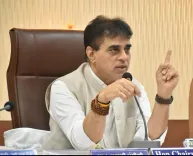
Giriraj Singh Flags Positive Outlook for India's Power Sector
Synopsis
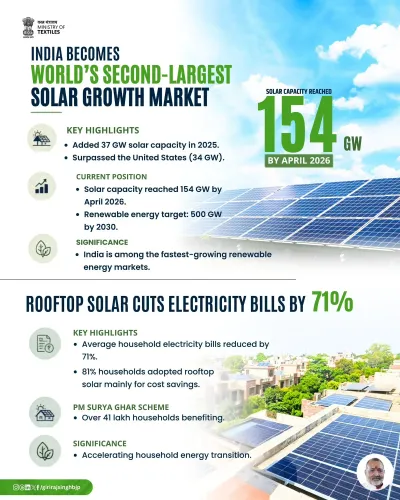
Union Textiles Minister Giriraj Singh amplified a report on 24 June 2026 projecting a positive outlook for India's power sector, pointing to robust demand growth and sustained policy support including the 500 GW non-fossil fuel target and the Saubhagya electrification scheme.
Key Takeaways
Giriraj Singh , Union Textiles Minister, shared a report on 24 June 2026 citing a positive outlook for India's power sector.
The report attributes the optimism to strong demand and continued policy support from the government.
India has committed to 500 GW of non-fossil fuel capacity by 2030 , announced at COP26 in 2021 .
The Saubhagya scheme (2017) achieved near-universal household electrification, creating a large new consumer base.
The PLI scheme for solar modules (2020) supports domestic manufacturing of renewable energy equipment.
State discom financial health and upcoming renewable tender outcomes remain key variables to watch.
Union Textiles Minister Giriraj Singh on Wednesday, 24 June 2026 shared a report highlighting a positive outlook for India's power sector, citing strong demand and sustained policy support as the key drivers of growth. The minister amplified the report via the NaMo App, underscoring the ruling dispensation's emphasis on governance momentum across infrastructure sectors.
Context
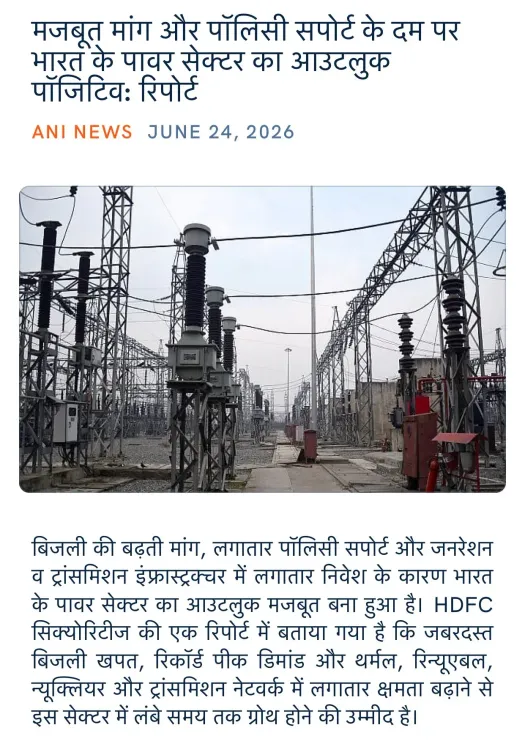
The post, shared in Hindi, reads: 'मजबूत मांग और पॉलिसी सपोर्ट के दम पर भारत के पावर सेक्टर का आउटलुक पॉजिटिव' — ('India's power sector outlook is positive on the strength of strong demand and policy support'). While Giriraj Singh holds the Textiles portfolio, cross-ministerial amplification of economy-wide sector reports has become a common social media practice among senior BJP leaders to project broad governance momentum.
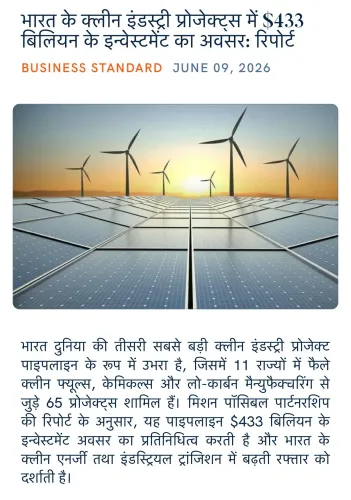
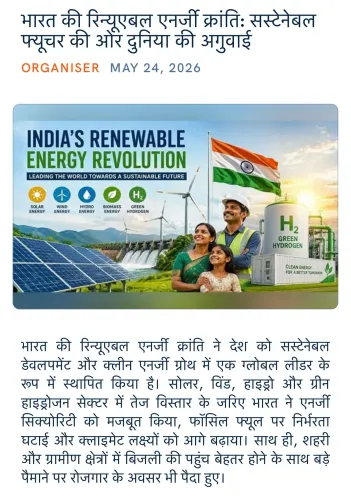
The report arrives at a time when India is aggressively pursuing capacity expansion across both conventional and renewable energy streams, with industrial demand and rural electrification acting as twin engines of consumption growth.
Policy Backdrop
India's power sector reform has a long legislative lineage, anchored by the Electricity Act, 2003, which consolidated generation, transmission, and distribution rules to restructure the sector and invite private participation. Since 2014, the government has pursued rapid capacity additions, backed by schemes such as Saubhagya — launched in 2017 — which drove near-universal household electrification across the country.
At COP26 in 2021, India committed to a target of 500 GW of non-fossil fuel energy capacity by 2030. The 2020 Production Linked Incentive (PLI) scheme for solar modules further reinforced the manufacturing push to support domestic renewable deployment at scale.
Stakeholders and Impact
The positive sectoral outlook directly affects power utilities, renewable energy developers, and large industrial consumers, who have all been navigating a rapidly evolving demand-supply landscape. For utilities, sustained demand growth translates into improved revenue visibility, while developers benefit from continued policy signals on tariff and tender frameworks.
Rural and semi-urban consumers, brought into the grid through programmes like Saubhagya, represent a growing base of new electricity users whose consumption is expected to rise alongside income levels and appliance penetration. Their inclusion reinforces the structural demand argument underpinning the report's positive assessment.
What's Next
Observers will watch the pace of state electricity distribution company (discom) reforms closely, as financial health of discoms remains a critical bottleneck that could temper the otherwise optimistic sectoral trajectory. Fresh renewable energy tender outcomes in the coming quarters will also serve as a real-time indicator of investor confidence.
With the next Union Budget cycle approaching, policy continuity signals — including ministerial social media amplification of positive sector reports — are likely to intensify as the government seeks to maintain momentum on its energy and infrastructure agenda.
Point of View
Particularly as the budget cycle nears. The move fits a broader pattern where senior ministers use the NaMo App ecosystem to signal policy continuity and attract investor sentiment. The positive framing of the power sector is politically useful ahead of state elections, where reliable electricity supply remains a key voter concern. However, the credibility of the outlook will ultimately hinge on discom reforms, which have repeatedly stalled at the state level despite central policy ambition.
NationPress
24 Jun 2026
Frequently Asked Questions
Why did Textiles Minister Giriraj Singh post about the power sector?
Senior ministers frequently amplify economy-wide sector reports on social media to project overall governance momentum, even outside their direct portfolio. Giriraj Singh shared the power sector report via the NaMo App on 24 June 2026 as part of this broader communication pattern.
What is India's power sector outlook for 2026?
A report shared by Union Minister Giriraj Singh on 24 June 2026 describes India's power sector outlook as positive, driven by strong electricity demand and sustained government policy support including renewable energy targets and electrification schemes.
What is India's 500 GW renewable energy target?
India announced a target of 500 GW of non-fossil fuel energy capacity by 2030 at the COP26 climate summit in 2021. This target is a central pillar of India's energy transition policy.
What is the Saubhagya scheme?
Saubhagya is a government scheme launched in 2017 aimed at last-mile household electrification across India. It contributed to near-universal electricity access and significantly expanded the country's base of electricity consumers.
What challenges remain for India's power sector despite the positive outlook?
The financial health of state electricity distribution companies, known as discoms, remains a key structural challenge. Slow discom reforms and the pace of renewable energy tender awards are the main factors that could affect the sector's otherwise optimistic trajectory.