Giriraj Singh Hails Record 10% EV Share in Two-Wheeler Sales
Synopsis
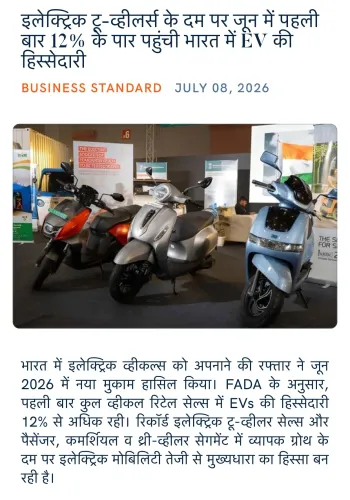
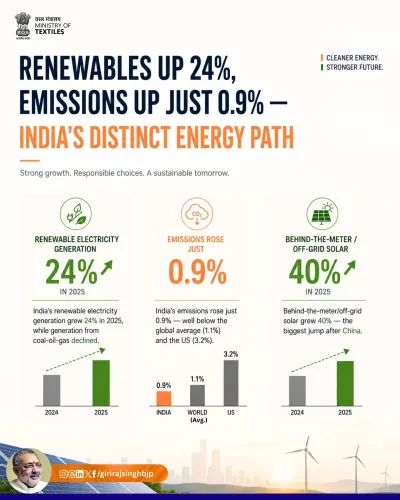
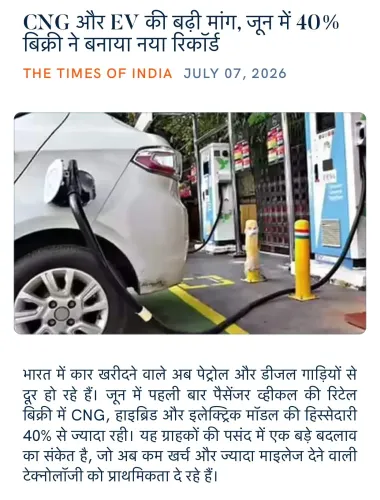
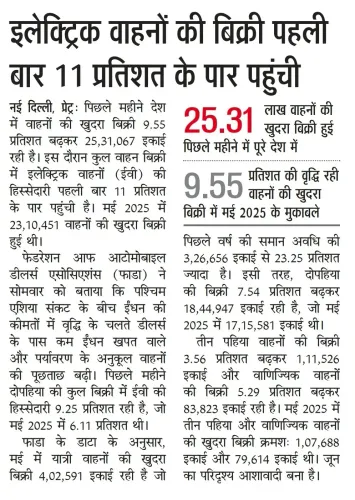
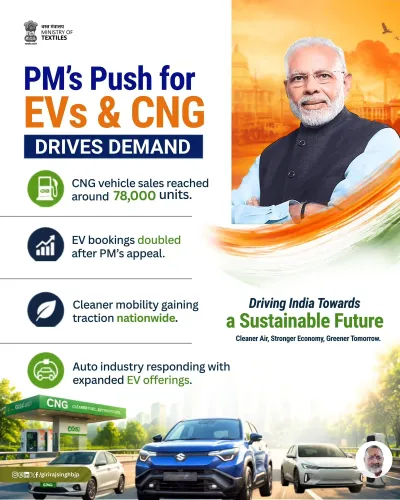
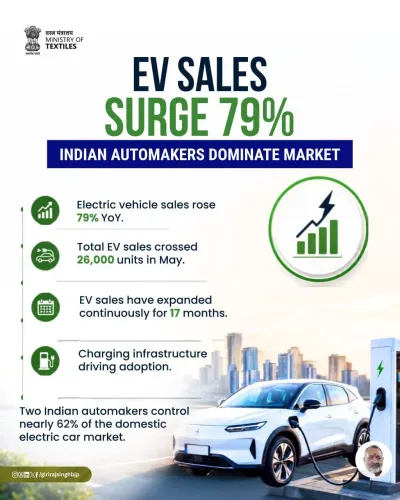
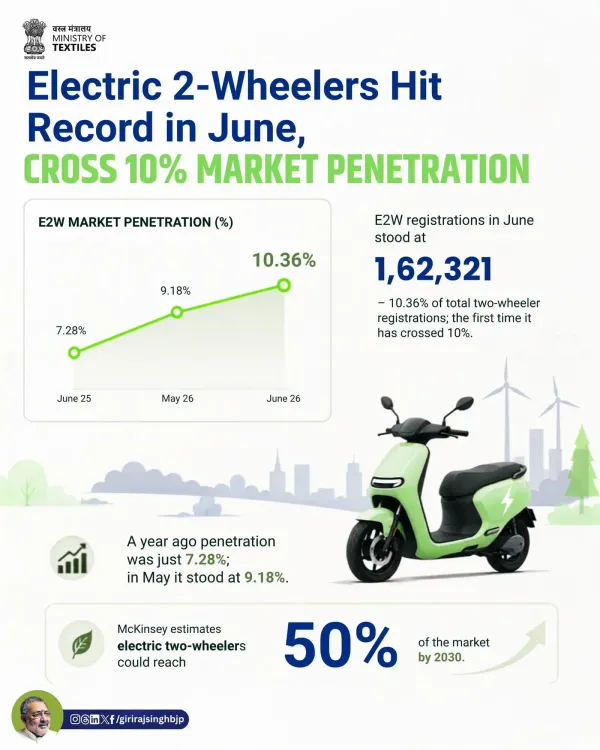
Electric two-wheelers crossed 10 per cent of India's total two-wheeler sales in June 2026 for the first time, Union Textiles Minister Giriraj Singh announced on X, attributing the milestone to PM Modi's clean-transport policies, FAME subsidies, and the Aatmanirbhar Bharat manufacturing push.
Key Takeaways
Electric two-wheelers surpassed 10 per cent of total two-wheeler sales in India for the first time in June 2026 .
Union Textiles Minister Giriraj Singh credited PM Narendra Modi 's push for clean, affordable and environment-friendly transport.
The FAME-II scheme , approved in 2019 with a Rs 10,000 crore outlay, provided purchase subsidies that helped drive adoption.
The PLI scheme for automobiles (2021) incentivised domestic EV component manufacturing under the Aatmanirbhar Bharat framework.
The milestone aligns with India's Viksit Bharat 2047 vision and the country's 2070 net-zero emissions commitment.
Next key data point: SIAM quarterly sales figures for July–September 2026 .
Union Textiles Minister Giriraj Singh on Friday, 10 July 2026, credited Prime Minister Narendra Modi's push for clean and affordable transport after electric two-wheelers crossed a landmark threshold in India, with their share of total two-wheeler sales surpassing 10 per cent for the first time in June 2026.
Posting on X, Singh wrote: 'पहली बार कुल दोपहिया वाहनों की बिक्री में इनकी हिस्सेदारी 10% के पार पहुंची है' — 'For the first time, their share in total two-wheeler sales has crossed 10 per cent' — calling it a clear signal of the country's growing confidence in green transport. He linked the milestone to the goals of Aatmanirbhar Bharat and Viksit Bharat 2047.
Context
The 10 per cent penetration mark is widely regarded in the auto industry as a tipping point that signals mainstream consumer acceptance rather than niche adoption. India's two-wheeler segment is among the largest in the world by volume, making even a fractional shift in the sales mix a significant absolute gain for electric mobility. Singh described the achievement as a product of 'continuous efforts' under Modi's leadership to promote clean, affordable and environment-friendly transport.
Policy Backdrop
The milestone sits on a foundation of successive central schemes. The FAME India (Faster Adoption and Manufacturing of Electric Vehicles) scheme, launched in 2015 and expanded in Phase II in 2019 with an outlay of Rs 10,000 crore, provided direct purchase subsidies that helped bring down the upfront cost of electric two-wheelers. The Production Linked Incentive (PLI) scheme for automobiles and auto components, notified in 2021, complemented demand-side support by incentivising domestic manufacturing of EV components, reducing import dependence.
Both schemes sit under the broader Aatmanirbhar Bharat framework announced in 2020, which aims to build self-reliant supply chains in strategic sectors. India's commitment to reaching net-zero emissions by 2070 and its desire to reduce crude oil import bills have given the EV push a dual economic and environmental rationale.
Stakeholders and Impact
Domestic two-wheeler manufacturers stand to benefit most immediately, as higher EV volumes justify fresh investment in battery assembly, motor production and charging infrastructure. Urban commuters — the core buyers of entry-level electric scooters — gain from lower running costs compared with petrol-powered alternatives. State governments that have layered their own EV subsidies on top of central incentives may also see this data as vindication of their policies.
The shift also carries implications for fuel retailers and the downstream petroleum sector, as sustained EV adoption gradually trims petrol consumption in the segment. Component suppliers transitioning from internal combustion engine parts to electric drivetrains face both opportunity and disruption.
What's Next
Industry observers will watch quarterly sales data from SIAM (Society of Indian Automobile Manufacturers) for July–September 2026 to determine whether June's record share holds and deepens, or whether it reflects seasonal or subsidy-driven factors. Any fresh state-level EV policy announcements — particularly on charging infrastructure rollout — could sustain the momentum. The government's own Viksit Bharat 2047 roadmap treats electric mobility as a pillar of sustainable development, suggesting that policy support is unlikely to be withdrawn in the near term.
Point of View
Or risk being seen as laggards on a popular green-economy issue. Sustained penetration above 10 per cent will, however, depend on whether FAME-era subsidies are renewed or replaced with a successor scheme.
NationPress
10 Jul 2026
Frequently Asked Questions
What share of two-wheeler sales in India are now electric?
Electric two-wheelers crossed 10 per cent of total two-wheeler sales in India for the first time in June 2026, according to a post by Union Textiles Minister Giriraj Singh on X.
What is the FAME India scheme and how does it help EV buyers?
FAME India (Faster Adoption and Manufacturing of Electric Vehicles) is a central government scheme launched in 2015 and expanded in Phase II in 2019 with a Rs 10,000 crore outlay. It provides direct purchase subsidies on electric two-wheelers, three-wheelers and buses, reducing their upfront cost for buyers.
What is Aatmanirbhar Bharat's role in India's EV growth?
Aatmanirbhar Bharat, announced in 2020, includes incentives for domestic production of EV components through the PLI scheme for automobiles (2021), reducing India's dependence on imported parts and lowering manufacturing costs over time.
What is Viksit Bharat 2047 and how does it relate to electric vehicles?
Viksit Bharat 2047 is the Indian government's vision for a fully developed economy by the centenary of independence. Sustainable and electric mobility is identified as one of the pillars of this vision, with EV adoption linked to cutting oil imports and meeting India's 2070 net-zero target.
Who is Giriraj Singh and why is he commenting on EV sales?
Giriraj Singh is the Union Minister of Textiles and a senior BJP leader and Lok Sabha MP from Begusarai, Bihar. His post on EV sales reflects a broader BJP government communications effort to highlight green-economy milestones under PM Modi's leadership, beyond his specific ministerial portfolio.