Giriraj Singh Highlights PMAY-U Progress Toward 1.25 Cr Homes
Synopsis
Union Textiles Minister Giriraj Singh on 24 June 2026 highlighted that PMAY-U is closing in on its 1.25 crore homes target, sharing state-wise completion rankings via the NaMo App. The post underscores the government's push to publicise welfare delivery milestones under the flagship urban housing programme.
Key Takeaways
PMAY-U is approaching a target of 1.25 crore homes , according to content shared by Union Textiles Minister Giriraj Singh on 24 June 2026 .
Certain states have been identified as leaders in completing housing construction under the scheme, though specific state names were not listed in the post itself.
PMAY-Urban was launched in June 2015 under the Housing for All by 2022 mission with four implementation verticals.
The scheme relies on state-level execution backed by central funding, with competitive state rankings used to drive accountability.
The post was shared via the NaMo App , reflecting routine cross-ministerial amplification of flagship scheme progress.
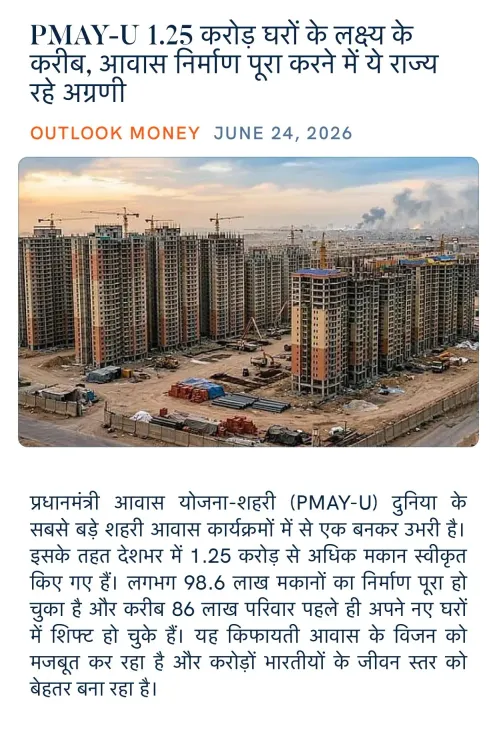
Union Textiles Minister Giriraj Singh on Wednesday, 24 June 2026 shared an update on the Pradhan Mantri Awas Yojana-Urban (PMAY-U), noting that the scheme is approaching its target of 1.25 crore homes and highlighting the states that have led in completing construction under the programme.
Context
Singh shared an article via the NaMo App reporting that PMAY-U is nearing its 1.25 crore homes target, with certain states emerging as top performers in completion rates. The post, in Hindi, translates roughly to: 'PMAY-U 1.25 करोड़ घरों के लक्ष्य के करीब, आवास निर्माण पूरा करने में ये राज्य रहे अग्रणी' ('PMAY-U nears 1.25 crore homes target; these states led in completing housing construction'). The minister's amplification of scheme-level data reflects the ruling party's broader effort to publicise welfare delivery milestones ahead of political cycles.
Policy Backdrop
PMAY-Urban was launched in June 2015 under the Housing for All by 2022 mission, anchored on four verticals: in-situ slum redevelopment, a credit-linked subsidy scheme, affordable housing in partnership, and beneficiary-led construction. The programme is centrally sponsored, with the Ministry of Housing and Urban Affairs overseeing sanctions and fund releases while state governments and urban local bodies manage on-ground execution. Periodic publication of state-wise rankings has become a tool of competitive federalism, nudging laggard states to accelerate delivery.
Although the original Housing for All deadline was set for 2022, implementation timelines were extended to allow states to complete sanctioned units. Progress on physical completion — as distinct from mere sanction — has been a consistent point of scrutiny in parliamentary debates and budget discussions.
Stakeholders and Impact
The primary beneficiaries of PMAY-U are economically weaker sections and low-income urban households who were previously housed in informal settlements or kutcha structures. State governments bear significant responsibility for beneficiary identification, land allocation, and construction oversight, making their execution capacity a direct determinant of outcomes. States that have recorded high completion rates demonstrate stronger administrative machinery and, in many cases, closer coordination between urban local bodies and central nodal agencies.
For the urban poor, a completed pucca house translates into improved sanitation access, structural safety, and legal tenure — outcomes that compound across health, education, and economic participation. The competitive state ranking mechanism is designed to sustain political and bureaucratic attention on these last-mile delivery gaps.
What's Next
The Ministry of Housing and Urban Affairs is expected to release subsequent quarterly progress reports detailing updated sanction and completion figures across states. Any revision to PMAY-U funding allocations or a potential extension of the programme's scope may feature in forthcoming budget announcements or parliamentary sessions. Singh's post signals continued cross-ministerial amplification of flagship scheme milestones, a pattern likely to intensify as the government approaches the end of its current term.
Point of View
Rewarding high-performing states with visibility while implicitly pressuring others. With the scheme's original 2022 deadline long past, highlighting proximity to the 1.25 crore target serves to reframe extended timelines as delivery momentum rather than delay. This pattern of milestone-driven social media communication is likely to accelerate as the government seeks to consolidate its welfare narrative ahead of future electoral cycles.
NationPress
24 Jun 2026
Frequently Asked Questions
What is PMAY-U and what is its target?
PMAY-U, or Pradhan Mantri Awas Yojana-Urban, is a central government scheme launched in June 2015 to provide pucca houses to eligible urban households. The scheme has been working toward a target of 1.25 crore homes under the Housing for All mission.
Which states are leading in PMAY-U completion rates?
Union Minister Giriraj Singh shared a report on 24 June 2026 identifying certain states as top performers in PMAY-U housing completion, though the specific states were detailed in the linked article rather than the post itself.
Why is Textiles Minister Giriraj Singh posting about a housing scheme?
Senior government ministers frequently amplify progress on flagship welfare schemes across portfolios as part of routine government communication, regardless of their specific ministerial responsibility.
Has PMAY-U met its Housing for All 2022 deadline?
The original Housing for All by 2022 deadline was not fully met, and implementation timelines were extended to allow states to complete sanctioned units. As of June 2026, the scheme is reported to be nearing its 1.25 crore homes target.
How does PMAY-U work?
PMAY-U operates through four verticals: in-situ slum redevelopment, a credit-linked subsidy scheme, affordable housing in partnership, and beneficiary-led construction. The central government provides funding and oversight while state governments and urban local bodies manage on-ground execution.