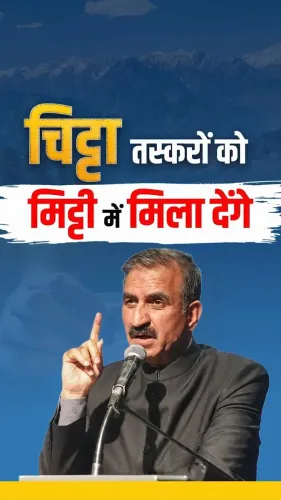
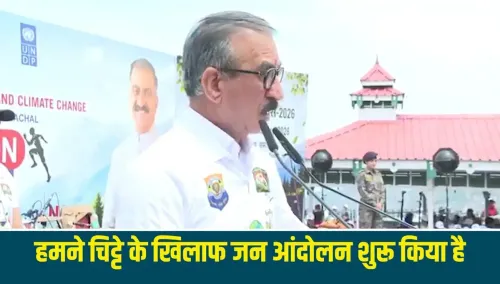
HP CM Office Calls on Panchayat Reps to Fight Chitta Menace

Synopsis
The Chief Minister's Office of Himachal Pradesh has urged newly elected panchayat representatives to combine development work with firm action against chitta, the synthetic opioid devastating rural communities, signalling a push for grassroots-led anti-narcotics governance across the state.
Key Takeaways
The Chief Minister's Office of Himachal Pradesh posted the appeal on 15 June 2026 , targeting newly elected panchayat representatives.
The message calls for 'full resolve and commitment' against chitta , a synthetic opioid widely used in Himachal Pradesh and Punjab.
Panchayat representatives are being asked to integrate anti-drug work with their existing local development mandate .
The appeal aligns with the National Action Plan for Drug Demand Reduction and the devolution framework of the 73rd Constitutional Amendment .
Himachal Pradesh borders Punjab and sits in a corridor where synthetic opioid use has risen sharply among rural youth.
Analysts will watch for formal panchayat-level anti-narcotics committees and state budget allocations for de-addiction infrastructure.
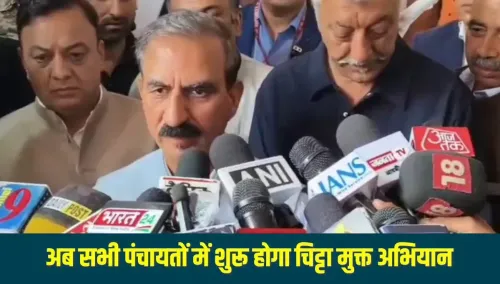
The Chief Minister's Office of Himachal Pradesh on Monday, 15 June 2026 called upon newly elected panchayat representatives across the state to stand firmly against the synthetic drug chitta — a street name for heroin or synthetic opioids — while simultaneously driving local development work. The appeal, posted on the official CMO account, underscores the state government's intent to enlist grassroots elected bodies as frontline partners in its anti-narcotics campaign.
Context
The post, addressed as a reply from @CMOFFICEHP, states: 'is abhiyan ko safal banane mein hamare nav-nirvachit panchayat pratinidhiyon ki bhumika atyant mahatvapurna hai' — 'the role of our newly elected panchayat representatives is extremely important in making this campaign a success.' It goes on to express hope that the representatives will stand with 'full resolve and commitment' against the deadly drug chitta, even as they carry out development work in their respective areas.
Chitta is a colloquial term widely used in Himachal Pradesh and neighbouring Punjab for white-powder synthetic opioids, including heroin and pharmaceutical-grade diacetylmorphine diverted from illicit channels. Its spread among rural youth has been a growing concern for state authorities over the past decade.
Policy Backdrop
The appeal draws on a well-established constitutional framework. The 73rd Constitutional Amendment of 1992 devolved powers to Panchayati Raj Institutions (PRIs), enabling them to take up social welfare functions — including health awareness and community surveillance — at the village level. Northern states have leveraged this framework to involve gram panchayats in anti-narcotics drives since the mid-2000s under the National Action Plan for Drug Demand Reduction.
Himachal Pradesh, which shares a border with Punjab, has recorded rising incidents of synthetic drug use in districts adjoining the plains. The state sits within the Punjab-Haryana-Himachal corridor where synthetic opioids have migrated from traditional cultivation zones into rural hinterlands, making community-level intervention particularly urgent.
Stakeholders and Impact
The primary audience of the CMO's message is the cohort of newly elected panchayat representatives — sarpanchs, ward members, and panchayat samiti members — who have recently assumed office following local body elections. These officials are uniquely positioned to identify at-risk youth, facilitate awareness camps, and coordinate with district police and health departments at the village level.
Rural youth in Himachal Pradesh represent the most vulnerable demographic. By tasking elected local representatives with anti-drug messaging alongside their development mandate, the state government signals a shift toward community-led implementation rather than relying solely on police enforcement or centralised de-addiction programmes.
What's Next
Observers will watch for the formation of panchayat-level anti-narcotics committees, a model that some northern states have piloted to give local bodies a formal role in surveillance and referral. Any accompanying state budget provisions for de-addiction facilities in rural districts would indicate how deep the government's commitment runs beyond the rhetorical appeal.
If the CMO's call translates into a structured programme, it could position Himachal Pradesh as a model for community-driven narcotics control in the hill-state belt — a template other states in the corridor may look to replicate as synthetic drug use continues to challenge traditional enforcement approaches.
Point of View
The Himachal Pradesh government is embedding anti-narcotics responsibility within the elected local governance structure. This mirrors a broader national pattern where state governments, finding centralised enforcement insufficient, are pushing the 73rd Amendment's devolution logic into social-welfare domains it was always meant to cover. For newly elected panchayat members, the message is politically significant — it ties their legitimacy as development agents to their role as community guardians. Whether the appeal is backed by resources and formal mandates will determine if it becomes policy or remains symbolic outreach.
NationPress
14 Sept 2026
Frequently Asked Questions
What is chitta and why is it a problem in Himachal Pradesh?
Chitta is a street name for white-powder synthetic opioids, including heroin, that has spread rapidly in Himachal Pradesh, particularly in districts bordering Punjab. Its low cost and high addictiveness have made it a serious public health crisis among rural youth in the state.
What did the Himachal Pradesh CMO say about panchayat representatives and drugs?
The Chief Minister's Office of Himachal Pradesh said on 15 June 2026 that newly elected panchayat representatives have an 'extremely important role' in making the anti-drug campaign a success, urging them to stand against chitta with 'full resolve and commitment' alongside their development work.
What powers do panchayats have in fighting drug abuse in India?
Under the 73rd Constitutional Amendment of 1992, Panchayati Raj Institutions can take up social welfare and community health functions, which states have used to involve gram panchayats in anti-narcotics awareness, surveillance, and referral to de-addiction services.
Which states in India face the biggest chitta or synthetic drug problem?
Punjab, Himachal Pradesh, and Haryana form a corridor where synthetic opioid use is most acute. Himachal Pradesh's proximity to Punjab has made it particularly vulnerable, with rising incidents reported in districts adjoining the plains.
What is the National Action Plan for Drug Demand Reduction?
The National Action Plan for Drug Demand Reduction is a central government framework under which states run community-based anti-narcotics programmes, including those involving gram panchayats, to reduce demand for illicit drugs at the grassroots level.