Kishan Reddy Hails India's First Indigenous H5N1 Poultry Vaccine
Synopsis
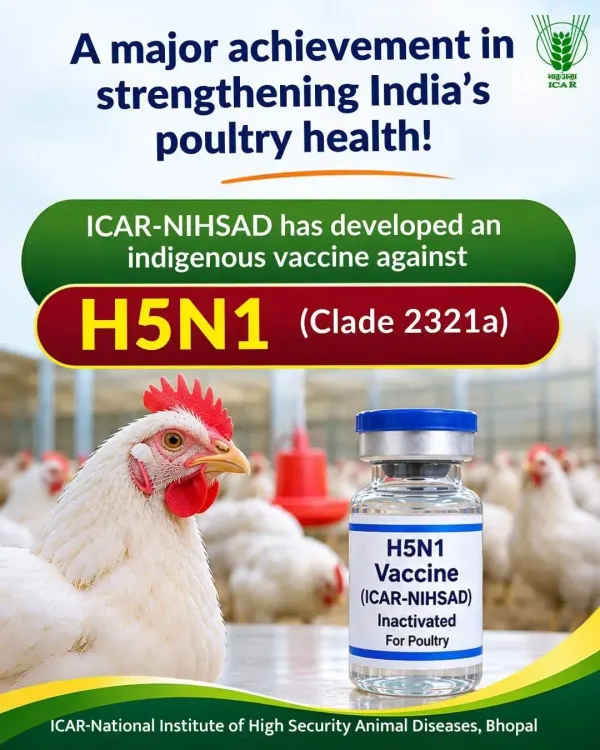
Union Minister G. Kishan Reddy on 20 November 2026 celebrated ICAR-NIHSAD Bhopal's development of India's first indigenous H5N1 (Clade 2.3.2.1a) avian influenza vaccine, calling it a major step under Aatmanirbhar Bharat to protect poultry farmers from outbreak-driven economic losses.
Key Takeaways
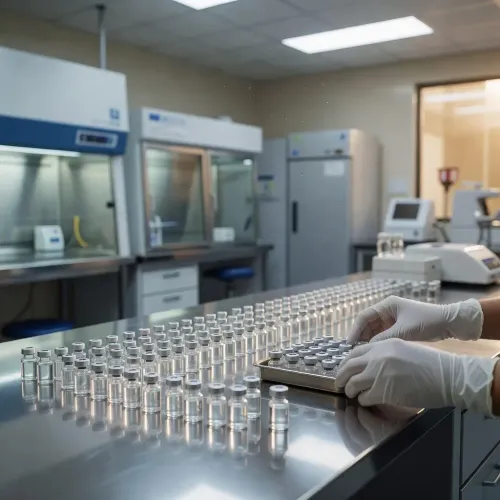
ICAR-National Institute of High Security Animal Diseases (NIHSAD), Bhopal has developed India's first indigenous H5N1 (Clade 2.3.2.1a) Avian Influenza vaccine .
The vaccine is targeted at a specific viral clade responsible for poultry outbreaks across Asia, making it directly relevant to Indian farm conditions.
The achievement is framed as part of Prime Minister Narendra Modi 's Aatmanirbhar Bharat self-reliance initiative launched in May 2020 .
Union Agriculture Minister Shivraj Singh Chouhan 's department guided the poultry and agriculture sector push under which the research was supported.
Regulatory approval, field trials, and commercial rollout timelines have not yet been officially announced.
India's poultry sector — home to millions of small-scale farmers — currently relies on mass culling as the primary outbreak response, a practice this vaccine could reduce or replace.
India's poultry farmers — a community that has watched culling drives and economic ruin follow every avian influenza outbreak — have a new reason for hope. On Friday, 20 November 2026, Union Coal and Mines Minister G. Kishan Reddy celebrated a landmark in Indian veterinary science: the development of the country's first indigenous H5N1 (Clade 2.3.2.1a) Avian Influenza vaccine, crediting the scientific team at ICAR-National Institute of High Security Animal Diseases (NIHSAD), Bhopal.
What NIHSAD's Bhopal lab built — and why the clade detail matters
Not all H5N1 is the same. The specific clade designation — 2.3.2.1a — identifies the genetic lineage of the virus strain the vaccine is designed to target, a lineage that has been responsible for outbreaks across Asian poultry populations. By developing a vaccine calibrated to this clade, ICAR-NIHSAD's researchers have produced a tool with direct, field-relevant application for Indian farms rather than a generic formulation borrowed from abroad.
Until now, India's avian influenza response has relied heavily on stamping-out — mass culling of birds in affected zones — a blunt instrument that devastates livelihoods before a single compensation cheque arrives. An indigenous vaccine changes the calculus: prevention instead of destruction, biosecurity instead of bulldozers.
Aatmanirbhar Bharat reaches the poultry shed
Kishan Reddy's post frames the achievement squarely within Prime Minister Narendra Modi's Aatmanirbhar Bharat self-reliance drive, launched in May 2020, which extended beyond manufacturing and pharmaceuticals to cover animal health infrastructure. Union Agriculture and Farmers Welfare Minister Shivraj Singh Chouhan, under whose ministry the Department of Agriculture and Farmers Welfare operates, is cited as guiding the sector-specific push.
The strategic logic is straightforward. India is one of the world's top poultry producers, and recurring H5N1 scares have repeatedly triggered import bans by trading partners and sharp price crashes domestically. A domestically produced, domestically approved vaccine cuts the dependence on foreign supply chains that could snap precisely when demand peaks — during an outbreak.
What still needs to happen before it reaches farmers
Scientific development and regulatory clearance are two different finish lines. The vaccine's path to commercial rollout will run through the Department of Animal Husbandry and Dairying, which oversees veterinary biologicals approval in India. Field trials, efficacy data across diverse agro-climatic zones, and manufacturing scale-up are all steps that lie ahead. Those timelines have not been officially disclosed.
Kishan Reddy's congratulations to the 'entire scientific team' reflect the collegial significance of the moment — a cross-ministerial salute from a Cabinet colleague to researchers operating under the agriculture and animal sciences umbrella. It also signals that the political establishment is invested in this vaccine's success story well before the regulatory clock starts.
India's poultry sector supports millions of farmers, many of them small-scale operators with no financial buffer when a culling order arrives. If NIHSAD's vaccine clears every regulatory hurdle, those farmers will not just gain a biological shield — they will gain the kind of insurance that decades of outbreak response never offered them.
Point of View
If still early-stage, inflection point in India's animal health sovereignty. For years, the country's only outbreak tool was mass culling — a reactive, economically punishing measure — so a domestically produced preventive option fits neatly into the Aatmanirbhar Bharat arc of reducing import dependency across strategic sectors. The political signalling here is also deliberate: a minister from Coal and Mines publicly congratulating an agriculture-linked research institute signals whole-of-government ownership of the self-reliance narrative. The critical test, however, will be the speed and rigour of regulatory clearance and whether scale-up can match the geographic spread of India's poultry industry before the next outbreak cycle arrives.
NationPress
20 Nov 2026
Frequently Asked Questions
What is India's first indigenous H5N1 avian influenza vaccine?
It is a vaccine developed by ICAR-NIHSAD in Bhopal targeting the H5N1 Clade 2.3.2.1a strain of avian influenza, making it the first domestically produced H5N1 vaccine for poultry in India.
Which institute developed the H5N1 vaccine in India?
The ICAR-National Institute of High Security Animal Diseases (NIHSAD) , located in Bhopal , developed the vaccine.
Is the H5N1 poultry vaccine approved for use in India?
As of November 2026, the vaccine has been announced as developed but its regulatory approval status, field trial results, and commercial rollout timeline have not been officially disclosed.
How does the H5N1 vaccine help Indian poultry farmers?
By providing a preventive option against avian influenza, the vaccine aims to reduce dependence on mass culling during outbreaks, which currently causes severe economic losses for poultry farmers.
What is the connection between this vaccine and Aatmanirbhar Bharat?
Aatmanirbhar Bharat , launched in May 2020 , promotes indigenous development across sectors including animal health. This H5N1 vaccine is cited as an example of that self-reliance push reducing India's dependence on foreign veterinary biologicals.