Vaishnaw: Cover Glass for Mobile Displays Now Made in India
Synopsis
Union Minister Ashwini Vaishnaw announced on 28 May 2026 that India is now manufacturing cover glass for mobile phone displays, tagging Corning and calling it PM Modi's Make in India vision in action. The development marks a key step in India's push to localise electronics component production.
Key Takeaways
Union Minister Ashwini Vaishnaw announced on 28 May 2026 that cover glass for mobile phone displays is now being made in India.
The post tagged Corning , the US specialty glass manufacturer behind Gorilla Glass, indicating its involvement in domestic production.
Make in India , launched in September 2014 , and the PLI scheme for mobile phones (2020) form the policy foundation for this development.
Cover glass localisation reduces India's import dependence for a critical smartphone component, particularly from China .
India is already the world's second-largest mobile phone producer; component-level manufacturing such as display glass represents the next stage of value-chain integration.
Further PLI extensions for displays and semiconductors are expected as India targets a fully integrated electronics manufacturing ecosystem.
Union Minister Ashwini Vaishnaw on Thursday, 28 May 2026 highlighted a significant milestone in India's electronics manufacturing journey, announcing that cover glass used in mobile phone displays is now being produced domestically — citing it as a concrete realisation of Prime Minister Narendra Modi's Make in India vision. The post tagged Corning, the US-based specialty glass manufacturer widely known for its Gorilla Glass technology used in smartphone screens worldwide.
Context
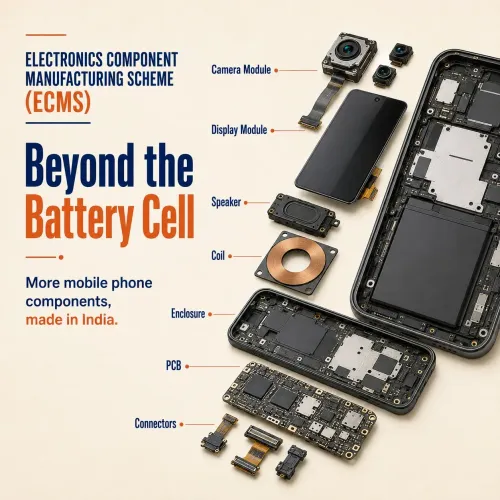
Cover glass — the thin, hardened glass layer protecting smartphone touchscreens — has historically been imported, making it one of the last major components in the mobile phone supply chain that India had not manufactured at scale. Vaishnaw's post marks the crossing of that threshold, positioning the development as a direct outcome of sustained industrial policy under the Make in India programme. The tagging of Corning points to the US firm's involvement in establishing or partnering for domestic production capacity.
Corning is the dominant global supplier of specialty cover glass for consumer electronics, supplying major smartphone brands across the world. The company had previously signalled interest in deepening its India footprint in line with the country's growing role as a mobile phone assembly hub.
Policy Backdrop
The Make in India initiative was launched in September 2014 with the goal of raising manufacturing's share of GDP and attracting foreign direct investment into industrial production. Mobile phones became one of its most visible success stories, with India emerging as the world's second-largest mobile phone producer through a combination of policy incentives and global supply-chain realignment.
The Production Linked Incentive (PLI) scheme for mobile phones and electronics, announced in 2020, accelerated local assembly and pushed manufacturers to progressively deepen component sourcing within India. Display components and cover glass have been identified as priority targets for the next phase of electronics localisation, reducing dependence on imports — particularly from China — and generating higher-value domestic employment.
Vaishnaw, who holds the Electronics and Information Technology portfolio alongside Railways and Information and Broadcasting, has been a central figure in driving the component-manufacturing agenda, including ongoing work on semiconductor fabrication and display ecosystems.
Stakeholders and Impact
Domestic mobile phone manufacturers, global original equipment manufacturers (OEMs) assembling handsets in India, and downstream electronics exporters stand to benefit directly from a reliable local supply of cover glass. Reduced import costs could improve margins for manufacturers and support India's ambition to move up the electronics value chain from assembly to components.
For Corning, establishing or expanding production in India aligns with the broader 'China-plus-one' supply-chain strategy being pursued by global technology companies. India's large and growing smartphone market also provides a substantial captive customer base for locally produced display glass.
What's Next
Analysts and industry observers will watch for formal announcements detailing the scale, location, and investment figures associated with the cover-glass manufacturing facility. Further extensions of the PLI scheme to cover display modules and semiconductors are expected to be the next frontier, as India seeks to build a fully integrated electronics manufacturing ecosystem. Any additional FDI disclosures or Corning capacity announcements will be closely tracked as indicators of the programme's depth and durability.
Point of View
Higher-value segment dominated by East Asian suppliers. By tagging Corning directly, the minister is publicly anchoring a global brand to the Make in India narrative, lending credibility to what has often been a target rather than a reality. The development, if substantiated at scale, would represent a meaningful inflection in the PLI programme's impact, shifting the conversation from handset output numbers to supply-chain depth. It also fits a pattern of the government using social media announcements to build investor and industry confidence ahead of formal policy or FDI disclosures.
NationPress
11 Oct 2026
Frequently Asked Questions
Is cover glass for mobile phones now made in India?
Yes, according to Union Minister Ashwini Vaishnaw's post on 28 May 2026, cover glass used in mobile phone displays is now being manufactured in India, with Corning tagged in the announcement.
What is Corning's role in India's mobile display glass production?
Corning, the US-based maker of Gorilla Glass used in smartphone screens, was tagged by Vaishnaw in the announcement, indicating the company's involvement in establishing domestic cover-glass production capacity in India.
What is the Make in India scheme?
Make in India is a national initiative launched by Prime Minister Narendra Modi in September 2014 to boost domestic manufacturing, attract foreign direct investment, and increase manufacturing's share of India's GDP.
How does the PLI scheme support mobile phone manufacturing in India?
The Production Linked Incentive (PLI) scheme for mobile phones, announced in 2020, provides financial incentives to manufacturers who produce in India, encouraging both assembly and deeper component sourcing within the country.
Why is domestic cover glass production significant for India?
Cover glass has been one of the last major smartphone components still imported by India. Local production reduces import dependence, lowers costs for manufacturers, and moves India up the electronics value chain from assembly toward higher-value component manufacturing.