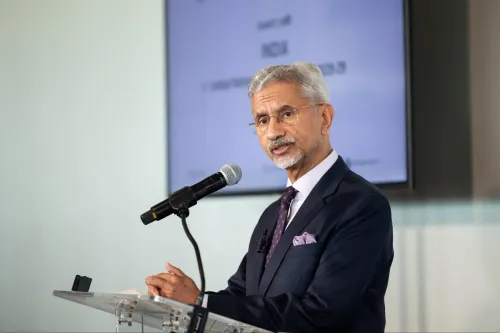
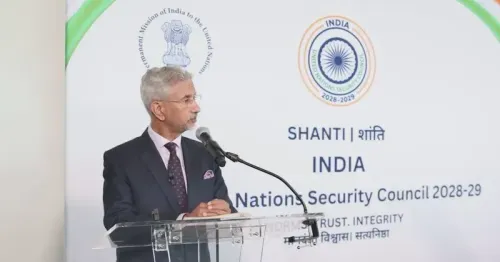
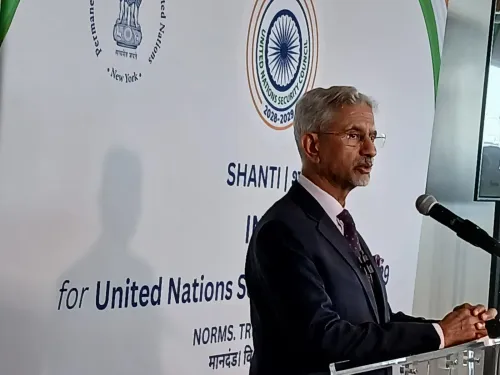
Jaishankar Launches India's UNSC 2028-29 Campaign in New York

Synopsis
External Affairs Minister Dr. S. Jaishankar concluded a visit to New York on 15 July 2026 to formally launch India's bid for a UN Security Council non-permanent seat for the 2028-29 term, opening a sustained diplomatic campaign ahead of the expected 2027 General Assembly vote.
Key Takeaways
Jaishankar visited New York on 15 July 2026 to formally launch India's UNSC campaign.
India is seeking a non-permanent seat on the UN Security Council for the 2028-29 term.
The UN General Assembly vote for the Asia-Pacific seat is expected in 2027 .
India last served on the UNSC as a non-permanent member during the 2021-22 term.
India is a member of the G4 grouping with Brazil , Germany , and Japan , collectively pressing for permanent UNSC expansion since 2004 .
Diplomatic outreach is expected to target swing-vote blocs in Africa , the Caribbean , Latin America , and Pacific Island states .
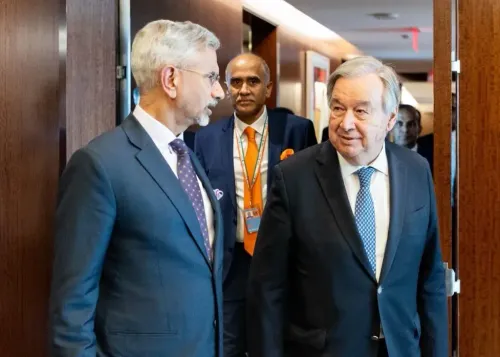
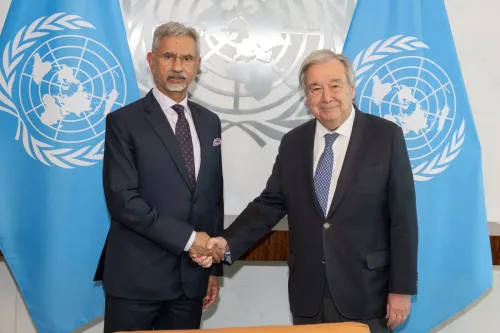
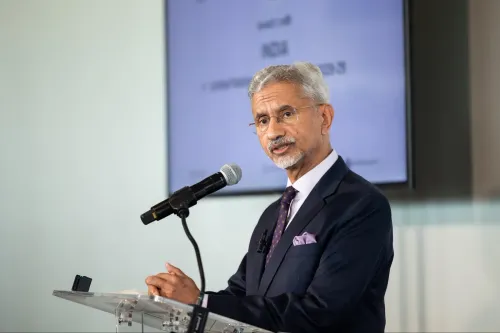
Union External Affairs Minister Dr. S. Jaishankar concluded a visit to New York on Wednesday, 15 July 2026, formally launching India's campaign for a non-permanent seat on the United Nations Security Council for the 2028-29 term. The visit marks the opening of what is expected to be a sustained diplomatic push by New Delhi to secure the Asian seat at the world's most powerful multilateral body.
Context
Posting on X, Dr. Jaishankar wrote: 'Concluded my visit to New York to launch India's campaign for United Nations Security Council 2028-29.' The statement is terse but deliberate — a formal signal to UN member states and international partners that India's candidacy is now active. Campaigns for non-permanent seats are typically launched well ahead of the General Assembly vote, which for the 2028-29 term is expected in 2027.
India most recently served on the UNSC as a non-permanent member during the 2021-22 term, having been elected unopposed in June 2020. That stint was widely regarded in New Delhi as a platform to demonstrate India's readiness for a larger, permanent role in global governance.
Policy Backdrop
India has been a member of the G4 grouping — alongside Brazil, Germany, and Japan — since 2004, collectively advocating for expansion of the UNSC's permanent membership to better reflect contemporary geopolitical realities. Successive non-permanent candidatures are part of a calibrated strategy: each term builds diplomatic capital, deepens relationships with swing-vote nations, and reinforces India's argument that the current five-permanent-member structure is an anachronism.
The Ministry of External Affairs has historically coordinated these campaigns through bilateral engagements, regional groupings, and high-level visits timed to coincide with the UN General Assembly calendar in New York. The July 2026 launch — more than a year before the anticipated vote — signals an early and high-priority push.
Stakeholders and Impact
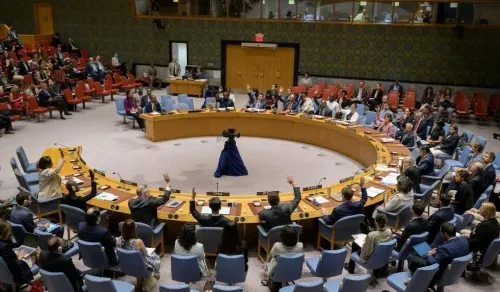
The immediate audience is the 193-member UN General Assembly, which elects non-permanent members by a two-thirds majority. Within the Asia-Pacific regional group, India will need to either run unopposed or outpoll any competing candidate. Diplomatic missions across Africa, the Caribbean, Latin America, and the Pacific Island states — blocs that collectively hold decisive votes — are expected to be central targets of outreach in the months ahead.
For Indian diplomats and the broader foreign-policy establishment, a 2028-29 seat would provide a formal platform to shape decisions on global security, counter-terrorism, and multilateral reform at a moment when India is simultaneously pressing its case for permanent membership. Civil society groups and think tanks focused on UN reform will also watch the campaign's framing for signals about New Delhi's evolving multilateral posture.
What's Next
The UN General Assembly election for the Asia-Pacific non-permanent seat for the 2028-29 term is anticipated in 2027. Between now and then, India is likely to intensify bilateral engagements, leverage its G4 partnerships, and use upcoming multilateral forums — including future UN General Assembly high-level weeks — to consolidate support. Possible joint statements or coordinated visits by G4 foreign ministers could follow as the vote draws closer. Dr. Jaishankar's New York visit sets the diplomatic clock ticking on what will be one of India's most consequential multilateral campaigns of the decade.
Point of View
A lesson drawn from previous multilateral contests. By deploying the External Affairs Minister himself for the opening salvo in New York, New Delhi signals that this candidacy sits at the apex of its foreign-policy priorities, not as a routine exercise. The move also fits a broader arc: India is simultaneously pursuing permanent membership reform through the G4 while using non-permanent terms to demonstrate operational credibility on the Council. How India frames its campaign — whether around reform, Global South leadership, or counter-terrorism credentials — will be closely read by both allies and rivals as a proxy for its evolving grand strategy.
NationPress
15 Jul 2026
Frequently Asked Questions
What is India's UNSC 2028-29 campaign?
India is seeking election as a non-permanent member of the UN Security Council for the 2028-29 term. External Affairs Minister Dr. S. Jaishankar formally launched the campaign in New York on 15 July 2026, with the General Assembly vote expected in 2027.
When did India last serve on the UN Security Council?
India most recently served as a non-permanent member of the UNSC during the 2021-22 term, having been elected unopposed in June 2020.
How are non-permanent UNSC members elected?
Non-permanent members are elected by the 193-member UN General Assembly by a two-thirds majority, with seats distributed across regional groups. India competes within the Asia-Pacific group.
What is the G4 grouping and how does it relate to India's UNSC bid?
The G4 is a grouping of Brazil, Germany, India, and Japan formed in 2004 to collectively advocate for expansion of the UNSC's permanent membership. India uses both G4 diplomacy and non-permanent candidatures as complementary tracks toward greater influence at the UN.
Why is Jaishankar's New York visit significant?
A ministerial-level visit to launch the campaign signals that India treats the 2028-29 UNSC bid as a top foreign-policy priority. Launching more than a year before the vote gives India time to build consensus across key blocs in Africa, Latin America, the Caribbean, and the Pacific.