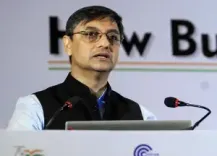
Kishan Reddy highlights e-Shram milestones in Telangana
Synopsis
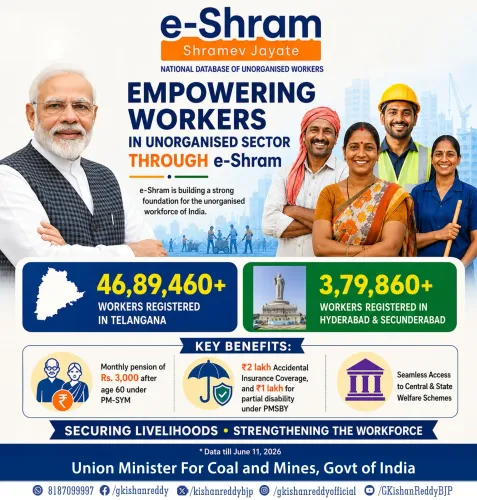
Union Minister G. Kishan Reddy on 4 November 2026 shared data showing over 47 lakh unorganized workers in Telangana registered on the e-Shram portal, with PMSBY insurance cover of up to ₹2 lakh per worker.
Key Takeaways
47,21,780 unorganized sector workers in Telangana are registered on the e-Shram portal as of 14 August 2026 .
3,84,770 workers from the Hyderabad-Secunderabad region are among those enrolled.
Registered workers receive ₹2 lakh accidental death cover and ₹1 lakh partial disability cover under PMSBY .
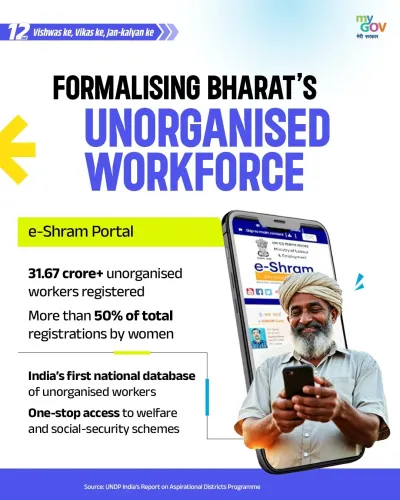
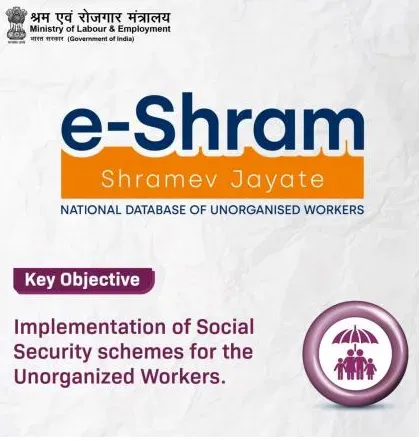
The e-Shram portal was launched on 26 August 2021 to build a national database linking informal workers to social security benefits.
Kishan Reddy , also BJP Telangana president, posted the update tagging the Ministry of Labour and Employment .
Over 47 lakh unorganized workers in Telangana now carry a safety net in their pocket — and Union Coal and Mines Minister G. Kishan Reddy wants every one of them to know it. On Wednesday, 4 November 2026, Reddy took to X to spotlight the state-level reach of the e-Shram portal, framing the numbers as proof of Prime Minister Narendra Modi's pledge to bring full social security to India's vast informal workforce.
Posting in Telugu, Reddy wrote that it is PM Modi's 'primary resolve to fill light into the lives of unorganized sector workers by providing them complete social security.' He pointed to the e-Shram registration data as evidence that resolve is translating into reality — with 47,21,780 workers enrolled across Telangana and 3,84,770 in the Hyderabad-Secunderabad twin-city zone alone, as of 14 August 2026.
What an e-Shram card actually delivers
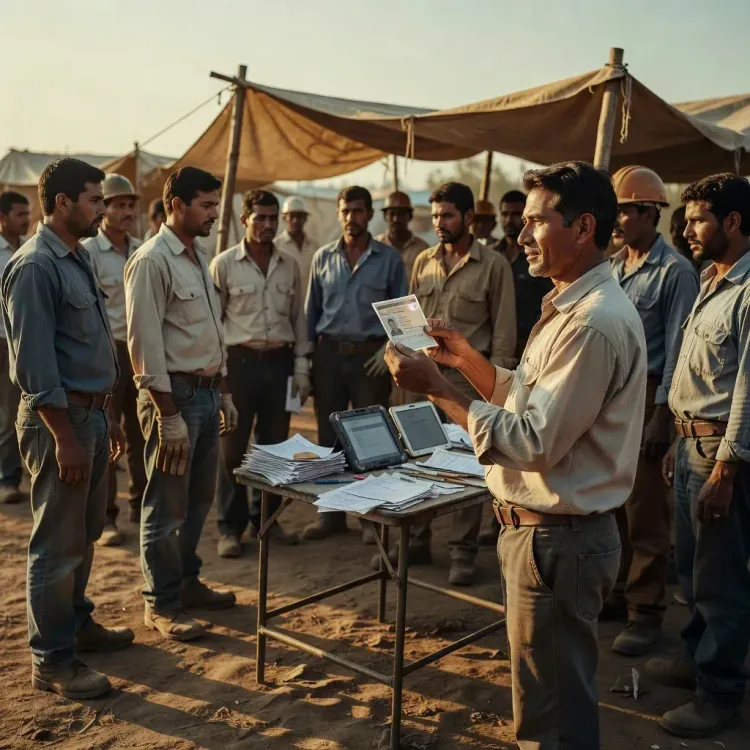
The numbers matter less without the benefit attached to them. Each registered worker is automatically covered under the Pradhan Mantri Suraksha Bima Yojana (PMSBY) — a central accident insurance scheme first launched in May 2015. The coverage is blunt and clear: ₹2 lakh for accidental death, ₹1 lakh for partial disability. For a daily-wage construction worker or a street vendor with no employer-backed cover, that is the difference between a family surviving a tragedy or not.
Reddy described the e-Shram cards as giving workers 'financial assurance' and the courage to 'live with self-respect and self-reliance' — ఆత్మగౌరవంతో స్వయంశక్తితో జీవించేలా (to live with dignity through self-strength).
e-Shram's roots and the road to 47 lakh in Telangana
The e-Shram portal was launched on 26 August 2021 by the Ministry of Labour and Employment to build a national database of unorganized workers — a population that makes up roughly 90% of India's total workforce yet historically fell outside any formal social-protection architecture. The 2020 Code on Social Security had already consolidated scattered labour laws, but the portal gave the ambition a digital spine: a single registration that links a worker's Aadhaar to a universal account number and to downstream scheme benefits.
Telangana's figure of over 47 lakh registrations reflects years of on-ground enrolment drives coordinated between the central Labour Ministry — tagged by Reddy in his post as @LabourMinistry — and state-level implementation machinery. The Hyderabad-Secunderabad corridor alone crossing 3.84 lakh registrations underscores how heavily urban informal labour concentrates in the twin cities, from construction sites to home-based piece workers.
Reddy's dual role in the message
The post carries a layered political context. As BJP Telangana state president, Reddy has an obvious interest in showcasing central-scheme performance in a state governed by a rival party. By anchoring his post to concrete, verifiable registration counts and insurance amounts rather than broad claims, he grounds the communication in data — leaving the numbers to make the argument.
The Ministry of Labour and Employment is expected to continue integrating e-Shram with state-specific welfare schemes, with national registration targets likely to feature in upcoming labour policy updates. For Telangana's informal workers, however, the scorecard is already written in a card they carry.
Point of View
Using bundled schemes like PMSBY as an accessible entry point. Telangana's 47-lakh figure signals strong ground-level enrolment but also points to the continuing challenge: registration is step one; ensuring workers actually claim benefits when needed remains the harder governance problem. With labour ministry integration of state schemes still evolving, the portal's real impact will be measured at the claims counter, not just the registration dashboard.
NationPress
4 Nov 2026
Frequently Asked Questions
What is the e-Shram portal and who can register?
The e-Shram portal, launched on 26 August 2021 by the Ministry of Labour and Employment, is a national database for unorganized sector workers such as construction labourers, street vendors, domestic workers, and agricultural workers. Any unorganized worker aged 16-59 who is not a member of EPFO or ESIC can register.
What insurance benefits does an e-Shram card provide?
An e-Shram card holder is automatically covered under the Pradhan Mantri Suraksha Bima Yojana (PMSBY), which provides ₹2 lakh for accidental death and ₹1 lakh for partial disability.
How many workers have registered on e-Shram in Telangana?
According to data cited by Minister G. Kishan Reddy, over 47,21,780 unorganized workers in Telangana had registered on the e-Shram portal as of 14 August 2026, with over 3,84,770 from the Hyderabad-Secunderabad region alone.
What is PMSBY and how does it link to e-Shram?
The Pradhan Mantri Suraksha Bima Yojana (PMSBY) is a government accident insurance scheme launched in May 2015. It is integrated with e-Shram registrations so that workers who enrol on the portal automatically receive the scheme's accident insurance coverage.
Why is G. Kishan Reddy highlighting e-Shram numbers in Telangana?
G. Kishan Reddy is the Union Minister of Coal and Mines and also the BJP's Telangana state president, giving him both a ministerial and a political stake in publicising the central government's welfare delivery in the state.