Kishan Reddy Highlights PDS Reach in Hyderabad-Secunderabad
Synopsis
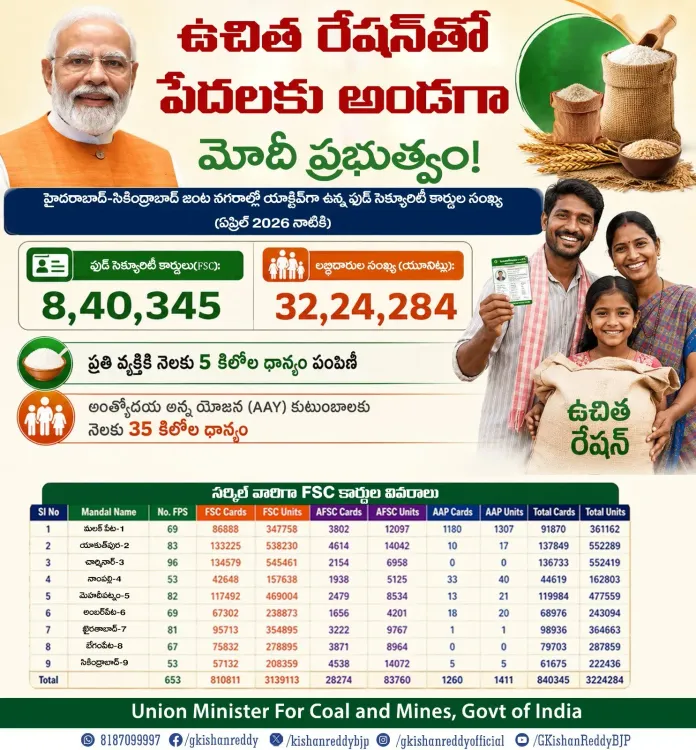
Union Minister and BJP Telangana president G. Kishan Reddy cited official data showing 8,40,345 active Food Security Cards covering over 32 lakh beneficiaries in Hyderabad-Secunderabad as of April 2026, framing central food welfare schemes as PM Modi's 'Sabka Saath, Sabka Vikas' vision in action.
Key Takeaways
8,40,345 Food Security Cards (FSC) are active in the Hyderabad-Secunderabad twin cities as of April 2026 .
32,24,284 beneficiary units are covered under these active cards in the twin cities.
Each eligible individual receives 5 kg of grain per month under the National Food Security Act .
Antyodaya Anna Yojana (AAY) households receive 35 kg of grain per month , targeting the poorest families.
The post was shared by G.
Kishan Reddy in his dual role as Union Coal and Mines Minister and BJP Telangana state president .
Central food entitlements under the NFSA continue to operate in Telangana through the state's distribution machinery irrespective of the ruling state government.
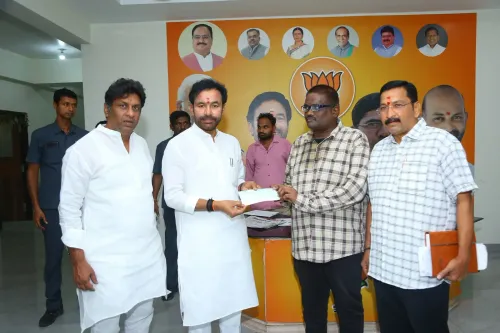
Union Coal and Mines Minister G. Kishan Reddy on Wednesday, 8 July 2026, shared data on the reach of central food security schemes in the Hyderabad-Secunderabad twin cities, citing over 32 lakh beneficiaries covered under the National Food Security Act (NFSA) as of April 2026. The minister, who also serves as BJP Telangana state president, framed the figures as a ground-level realisation of Prime Minister Narendra Modi's vision of ensuring food for every citizen.
Context
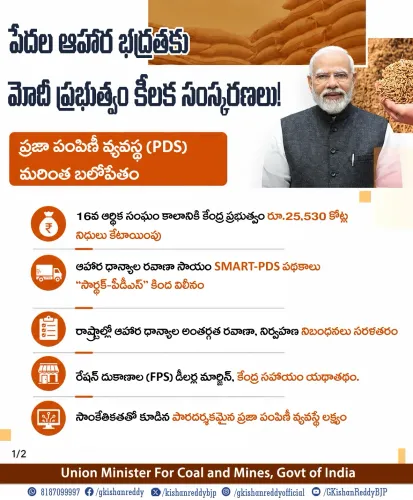
In his post in Telugu, Reddy wrote that the resolve to feed every person — 'ప్రతి ఒక్కరికీ అన్నం పెట్టాలనే సంకల్పం' ('the determination to provide food to every individual') — is becoming a ground reality under PM Modi's visionary leadership. He described the central government's ongoing food distribution effort as an 'ఆహార యజ్ఞం' ('food mission') guided by the 'Sabka Saath, Sabka Vikas' principle, standing as a pillar for crores of poor families.
Reddy specifically cited data for the twin cities, stating that as of April 2026, 8,40,345 Food Security Cards (FSC) are active, covering 32,24,284 beneficiary units. He noted that each individual receives 5 kg of grain per month, while families under the Antyodaya Anna Yojana (AAY) receive 35 kg per month.
Policy Backdrop
The National Food Security Act, 2013 mandates subsidised grain entitlements to up to 67 per cent of India's population — 5 kg per person per month for priority households. The Antyodaya Anna Yojana, a central scheme targeting the poorest of the poor, provides a higher allocation of 35 kg per household per month at heavily subsidised rates.
The Pradhan Mantri Garib Kalyan Anna Yojana (PMGKAY), launched in 2020 during the pandemic, extended additional free grain allocations and was renewed in successive phases, deepening the reach of the public distribution system. These schemes together form the backbone of the central government's food welfare architecture.
Stakeholders and Impact
Hyderabad and Secunderabad, as a major urban agglomeration, present a unique implementation context — urban poor households, migrant workers, and low-income families are among the primary beneficiaries of the Public Distribution System (PDS) in the twin cities. The figures cited by Reddy suggest that more than 32 lakh individuals in this urban pocket alone are covered under active food security entitlements.
Telangana was governed by the Bharat Rashtra Samithi (BRS) until late 2023, after which the Indian National Congress came to power in the state. The central NFSA entitlements continue to operate through the state's Food and Civil Supplies machinery regardless of which party holds state power, making the data a reflection of central scheme delivery rather than state-level policy.
What's Next
The Telangana government's Food and Civil Supplies Department periodically undertakes card renewal and digitisation drives that can affect active beneficiary counts. Any revision in the state's ration card database or changes in central allocation norms under the NFSA could alter the figures cited for the twin cities.
As BJP Telangana state president, Reddy's highlighting of central welfare delivery in Hyderabad signals the party's intent to build political capital around food security outcomes in the state ahead of future electoral cycles. The broader rollout of welfare data communication by Union ministers at the constituency level is expected to intensify as the party seeks to consolidate its presence in Telangana.
Point of View
Timed for an audience in a state where the BJP is the principal opposition. By anchoring the message in the twin cities — Telangana's most populous and politically consequential urban cluster — the party signals that it is tracking welfare delivery at a granular level and intends to own credit for central schemes even where state administration is in rival hands. The invocation of 'Sabka Saath, Sabka Vikas' alongside food distribution figures is consistent with the BJP's broader strategy of positioning PM Modi's welfare architecture as a non-partisan, inclusive enterprise. This approach is likely to become more frequent as the party builds toward the next Telangana assembly election cycle.
NationPress
8 Jul 2026
Frequently Asked Questions
How many people benefit from food security schemes in Hyderabad and Secunderabad?
As of April 2026, 32,24,284 beneficiary units are covered under 8,40,345 active Food Security Cards in the Hyderabad-Secunderabad twin cities, according to data shared by Union Minister G. Kishan Reddy.
How much grain does each person get under the National Food Security Act?
Under the National Food Security Act (NFSA) , each eligible individual receives 5 kg of subsidised grain per month . Families covered under the Antyodaya Anna Yojana (AAY) receive a higher allocation of 35 kg per household per month .
What is the Antyodaya Anna Yojana?
Antyodaya Anna Yojana (AAY) is a central government scheme that provides 35 kg of subsidised food grain per month to the poorest identified households in India, targeting those at the very bottom of the economic ladder.
Who is G. Kishan Reddy and why is he talking about food schemes in Hyderabad?
G. Kishan Reddy is the Union Minister of Coal and Mines and the BJP Telangana state president . His post on food security data in Hyderabad reflects his role in the party's outreach in Telangana, highlighting central government welfare delivery in the state.
What is the 'Sabka Saath, Sabka Vikas' slogan?
'Sabka Saath, Sabka Vikas' — meaning 'Together with all, development for all' — is the governing motto of the BJP-led central government under PM Narendra Modi , used to describe its inclusive welfare and development agenda.