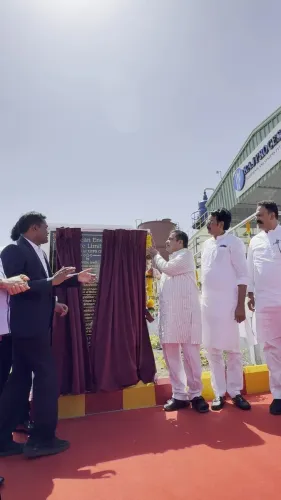
Modi to lay foundation stone for ₹160-crore CBG plant in Bengaluru on Nov 13
Synopsis
A ₹160-crore Compressed Bio-Gas plant — entirely Central-funded and operated by GAIL — is set to end three decades of waste misery in Bengaluru's Bommanahalli, with PM Modi laying the foundation stone on 13 November. The facility will supply cooking gas to 25,000 households and save 3.2 lakh LPG cylinders a year, making it South India's first CBG project of this scale by a central PSU.
Key Takeaways
PM Narendra Modi will lay the foundation stone for a ₹160-crore Compressed Bio-Gas plant in Bengaluru on 13 November 2026 .
The plant, to be built by GAIL , will be the first of its kind in Karnataka and South India run by a central PSU.
Initial capacity: 300 tonnes of wet waste per day, expandable to 500 tonnes ; completion targeted in 15 months .
Around 25,000 households in Bengaluru will receive cooking gas; savings of 3.2 lakh LPG cylinders and ₹27 crore in foreign exchange annually are projected.
The plant will generate about 22 tonnes of organic manure daily for farmers in and around Bengaluru.
Bengaluru South MP Tejasvi Surya urged the Karnataka government to replicate the model at 10 more locations across the city.
Prime Minister Narendra Modi will lay the foundation stone for a ₹160-crore Compressed Bio-Gas (CBG) plant in Bengaluru on 13 November 2026, in a move that is expected to offer a lasting solution to the city's long-standing solid waste management crisis. Bengaluru South MP Tejasvi Surya made the announcement on Wednesday at an awareness programme held at the Karnataka Compost Development Corporation (KCDC) plant in Bommanahalli constituency.
India's First GAIL-Led CBG Plant in South India
The proposed facility, to be built and operated by state-owned gas major GAIL — a central public sector undertaking — will be the first of its kind in Karnataka and across South India to be established by a central PSU under this model. The project is entirely funded by the Central government under the Swachh Bharat Mission-Urban and the SATAT scheme.
Surya said he and Bommanahalli MLA Satish Reddy had worked over three to four years to secure the project as a sustainable alternative to the existing, troubled compost plant at the same location.
Decades of Waste Mismanagement Behind the Push
The KCDC facility at Bommanahalli currently receives around 500 tonnes of wet waste every day, and residents in the area have reportedly endured foul odour spreading across three to four kilometres for the last 25 to 30 years. According to Surya, leachate from the plant has contaminated groundwater and caused air, water, and other forms of environmental pollution.
The Karnataka government had banned and shut down the plant's operations in 2008, Surya alleged, but it was restarted in 2013 due to the absence of a viable alternative. The new CBG plant is designed to end that cycle of compromise.
Scale, Capacity and Circular Economy Benefits
The proposed CBG plant will initially process 300 tonnes of wet waste per day, with capacity expandable to 500 tonnes. It is expected to be completed within 15 months and will process close to one lakh tonnes of wet waste annually, addressing nearly 40 per cent of the wet waste generated in Bengaluru South.
Under the circular economy model, wet waste will be converted into biogas and supplied to households through pipelines. Nearly 25,000 households in Bengaluru will receive cooking gas from the plant, saving an estimated 900 LPG cylinders per day — approximately 3.2 lakh cylinders annually. This translates into foreign exchange savings of around ₹27 crore per year for the country, Surya said. The plant is also projected to generate around 22 tonnes of organic manure daily, which can be supplied to farmers in and around Bengaluru.
Surya urged the Karnataka government to coordinate with GAIL to replicate the model across at least 10 more locations in Bengaluru.
Surya's Attack on Karnataka Home Minister Kharge
Separately, Surya launched a sharp political broadside against Karnataka Home Minister Priyank Kharge, accusing him of neglecting law and order while fixating on the Rashtriya Swayamsevak Sangh (RSS). He alleged that drug mafias and infiltration were worsening in Bengaluru, with college students increasingly falling prey to drugs, and that cybercrime complaints were mounting among residents.
'What is the Home Minister doing? He is obsessed with the RSS. We need a serious Home Minister whose job should be to focus on law and order in the city and the security of the state,' Surya said.
He also accused Kharge of spreading unverified claims on social media and questioned the rationale behind the minister's proposal to establish a fact-checking unit. 'If the Chief Minister can grant one wish of mine, I would request him to give Karnataka a serious Home Minister who likes to do his job,' he added. Responding to Kharge's demand that the RSS register itself as an organisation, Surya said, 'Let him get it done. Let him use all the powers at his disposal. Let that be his legacy.'
What Comes Next
With Prime Minister Modi set to lay the foundation stone on 13 November, construction of the plant is expected to follow immediately, with completion targeted within 15 months. The project's success could serve as a template for CBG expansion across other Indian metros grappling with wet waste management.
Point of View
Clean energy policy, and Central funding converge into one project — but the fact that Bommanahalli has endured 25-30 years of environmental harm before this intervention raises urgent questions about accountability. The SATAT scheme has been on the books since 2018; the glacial pace of delivery in one of India's most civic-conscious cities is itself a story. Surya's political attack on Home Minister Kharge, delivered at the same press conference, risks overshadowing a genuinely consequential infrastructure announcement, turning a development milestone into a partisan moment. If Bengaluru's waste crisis is to be solved at scale, the real ask — replicating this across 10 more sites — will require the state and Centre to cooperate rather than spar.
NationPress
11 Nov 2026
Frequently Asked Questions
What is the ₹160-crore CBG plant being set up in Bengaluru?
It is a Compressed Bio-Gas plant to be built by state-owned GAIL at Bommanahalli in Bengaluru, funded entirely by the Central government under the Swachh Bharat Mission-Urban and the SATAT scheme. The plant will process up to 300 tonnes of wet waste daily, supply cooking gas to 25,000 households, and generate organic manure for farmers.
When will PM Modi lay the foundation stone for the Bengaluru CBG plant?
Prime Minister Narendra Modi is scheduled to lay the foundation stone on 13 November 2026. Construction is expected to be completed within 15 months of groundbreaking.
Why is this CBG plant significant for South India?
It will be the first Compressed Bio-Gas plant in Karnataka and South India to be established and operated by a central PSU — GAIL. The project addresses around 40 per cent of wet waste generated in Bengaluru South and offers a circular economy model linking waste processing, clean cooking fuel, and agricultural manure.
How will the plant benefit Bengaluru's residents?
Nearly 25,000 households will receive piped cooking gas from the plant, saving roughly 900 LPG cylinders per day and about 3.2 lakh cylinders annually. This is projected to generate foreign exchange savings of around ₹27 crore per year. Residents of Bommanahalli, who have suffered from odour and groundwater contamination for 25-30 years, are expected to see direct environmental relief.
What is the SATAT scheme under which this plant is being developed?
SATAT — Sustainable Alternative Towards Affordable Transportation — is a Central government initiative launched in 2018 to promote the production and use of Compressed Bio-Gas as an alternative, cleaner fuel. It encourages investment in CBG plants through offtake agreements with government entities like GAIL and Indian Oil.