Nadda Flags Shift to Preventive Healthcare Since 2017 Policy
Synopsis
Union Health Minister J. P. Nadda on 24 June 2026 reaffirmed that the National Health Policy 2017 transformed India's healthcare approach from purely curative treatment to a holistic model covering prevention, promotion, geriatric, palliative, and rehabilitative care, linking citizen health directly to national economic growth.
Key Takeaways
Union Health Minister J.
Nadda stated on 24 June 2026 that health is the foundation of national economic growth and social well-being.
The National Health Policy 2017 shifted India's healthcare focus from post-illness treatment to preventive, promotive, curative, palliative, geriatric, and rehabilitative care.
Before 2017 , Indian health policy was predominantly curative and hospital-centric, modelled on the National Health Policy 2002 .
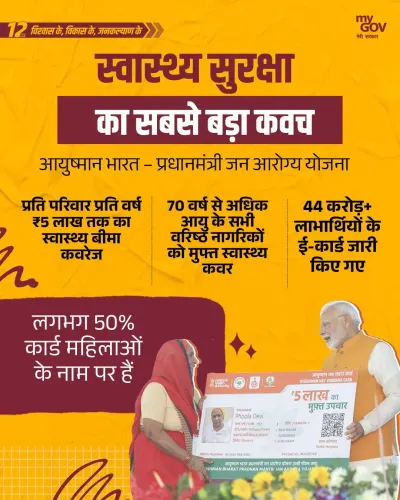
The Ayushman Bharat programme, launched in 2018 , was built to operationalise the 2017 policy's vision of holistic and financially protective healthcare.
Geriatric and palliative care inclusion in the national framework addresses India's ageing population and historically underserved patient groups.
State-level rollout of these care packages and the next Union Budget health outlay are the key near-term markers to watch.
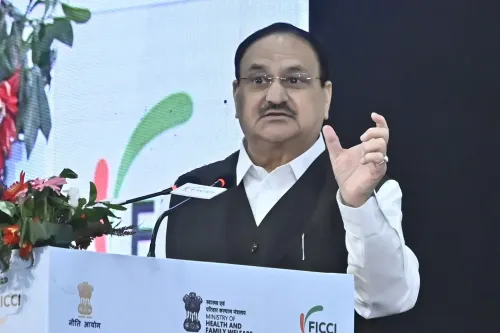
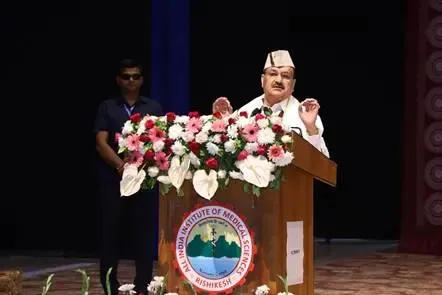
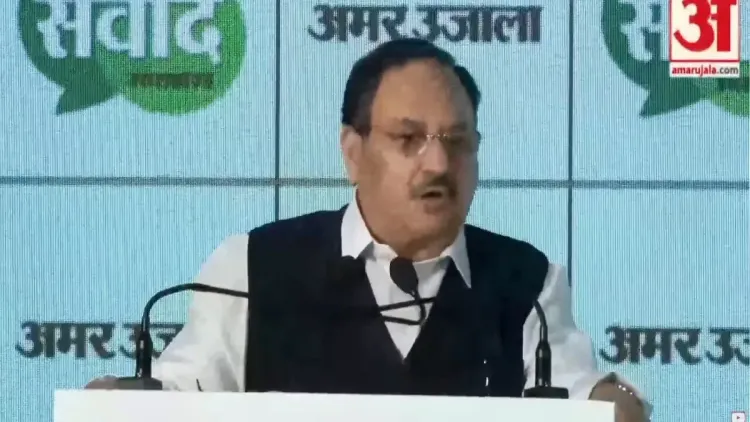
Union Health Minister J. P. Nadda on Wednesday, 24 June 2026 underscored that health is the foundation of a prosperous nation, asserting that the National Health Policy 2017 marked a decisive shift from treating illness to preventing it — a pivot he described as essential for accelerating India's economic growth and social well-being.
Writing in Hindi on X, Nadda stated: 'स्वास्थ्य एक स्वस्थ राष्ट्र की नींव है' ('Health is the foundation of a healthy nation'). He argued that when citizens are healthy, the country's economic development accelerates, productivity rises, and society's outlook turns positive.
Context
Nadda drew a sharp contrast between India's earlier approach to healthcare and the framework introduced in 2017. Before the policy revision, he noted, health was understood narrowly as treatment after illness. The National Health Policy 2017 broadened that definition to encompass preventive, promotive, curative, palliative, geriatric, and rehabilitative care — a holistic and inclusive mandate that replaced the predominantly hospital-centric model of its predecessor, the National Health Policy 2002.
The minister described the new policy as a 'holistic and inclusive health policy' that integrates the full spectrum of care, from disease prevention to end-of-life support and rehabilitation for the elderly and differently-abled.
Policy Backdrop
India's health policy architecture has evolved across three landmark documents. The National Health Policy 1983 established the first comprehensive post-independence framework. The 2002 policy set time-bound targets for infrastructure expansion and priority disease control. The 2017 policy then repositioned the state's role from provider of last resort to an active steward of population health across the life cycle.
The Ayushman Bharat programme, launched in 2018, was designed to operationalise the 2017 vision through two pillars: health and wellness centres at the primary-care level, and the Pradhan Mantri Jan Arogya Yojana providing financial protection to economically vulnerable families. Successive Union Budgets have added wellness infrastructure, digital health records, and expanded insurance coverage to support this expanded mandate.
Stakeholders and Impact
The shift to preventive and promotive healthcare directly benefits India's rural population, the elderly, and communities with limited access to tertiary hospitals. By addressing health before hospitalisation becomes necessary, the policy aims to reduce catastrophic out-of-pocket expenditure — one of the leading causes of household poverty in India.
The inclusion of geriatric and palliative care within the national policy framework is particularly significant given India's ageing demographic. Integrating rehabilitation into the mainstream health mandate also addresses the needs of persons recovering from chronic illness or disability, populations historically underserved by a curative-only system.
What's Next
Attention will turn to state-level implementation of geriatric and palliative care packages under Ayushman Bharat, as well as health outlay announcements in the forthcoming Union Budget. The minister's restatement of the 2017 policy's philosophy signals continued federal emphasis on primary and preventive care as the backbone of India's public health strategy, even as demands on the curative system remain high.
Whether the ambitions of the 2017 framework translate into measurable outcomes at the grassroots level will depend on coordinated funding, trained health workers, and sustained political will at both the Centre and the states.
Point of View
The minister is making a political argument that public health investment is fiscal prudence. The enumeration of six care dimensions — preventive, promotive, curative, palliative, geriatric, rehabilitative — signals that the government wants the 2017 framework seen as comprehensive rather than incremental. With budget discussions approaching, this messaging could be a prelude to defending or expanding health allocations in the next Union Budget.
NationPress
24 Jun 2026
Frequently Asked Questions
What is the National Health Policy 2017 India?
The National Health Policy 2017 is India's current overarching health framework that replaced the 2002 policy. It shifted the government's focus from curative, hospital-based care to a holistic model covering prevention, health promotion, geriatric care, palliative care, and rehabilitation, aiming for universal health coverage.
What did JP Nadda say about health policy?
On 24 June 2026, Union Health Minister J. P. Nadda stated that the 2017 health policy made a major shift by moving beyond post-illness treatment to include preventive and promotive healthcare, describing the new approach as holistic and inclusive.
What is Ayushman Bharat and how is it linked to the 2017 policy?
Ayushman Bharat, launched in 2018, is the flagship programme designed to operationalise the National Health Policy 2017. It includes health and wellness centres for primary and preventive care, and the Pradhan Mantri Jan Arogya Yojana for financial protection against high medical costs.
What is the difference between preventive and curative healthcare?
Curative healthcare focuses on treating disease after it occurs, while preventive healthcare aims to stop illness before it develops through screenings, vaccinations, lifestyle interventions, and wellness monitoring. India's 2017 policy prioritised the preventive approach alongside curative services.
Why is geriatric care included in India's health policy?
India's ageing population makes geriatric care increasingly important. The National Health Policy 2017 explicitly includes geriatric and palliative care to ensure the elderly and those with chronic or terminal conditions receive appropriate, dignified support within the mainstream public health system.